
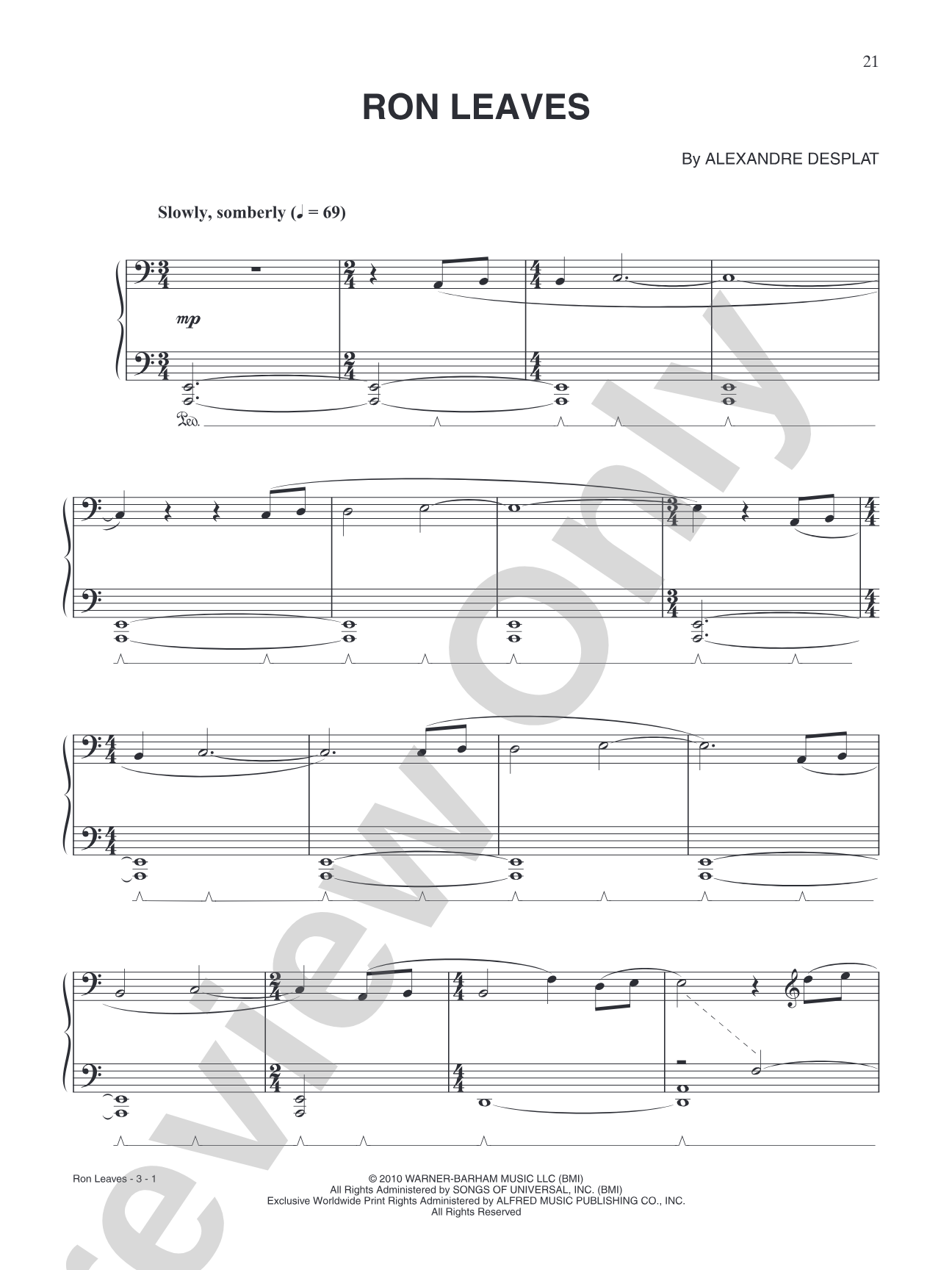

Ron Leaves (from "Harry Potter & The Deathly Hallows: Part 1"): Piano
Selections from the Motion Picture
Music by Alexandre Desplat
Item: 00-XS-0000133
$4.99
Pickup currently not available
Related Items
Snape to Malfoy Manor (from "Harry Potter & The Deathly Hallows: Part 1"): Piano |
$4.99
|
View | |
Polyjuice Potion (from "Harry Potter & The Deathly Hallows: Part 1"): Piano |
$4.99
|
View | |
Ron’s Speech (from "Harry Potter & The Deathly Hallows: Part 1"): Piano |
$4.99
|
View | |
Obliviate (from "Harry Potter & The Deathly Hallows: Part 1"): Piano |
$4.99
|
View | |
At the Burrow (from "Harry Potter & The Deathly Hallows: Part 1"): Piano |
$4.99
|
View | |
Harry and Ginny (from "Harry Potter & The Deathly Hallows: Part 1"): Piano |
$4.99
|
View | |
Godric's Hollow Graveyard (from "Harry Potter & The Deathly Hallows: Part 1"): Piano |
$4.99
|
View | |
Lovegood (from "Harry Potter & The Deathly Hallows: Part 1"): Piano |
$5.99
|
View | |
Farewell to Dobby (from "Harry Potter & The Deathly Hallows: Part 1"): Piano |
$4.99
|
View | |
Harry Potter and the Deathly Hallows, Part 1: Piano Book |
$14.99
|
View |
Description
Complete with pages of color screen shots from the film, this collectible book of 10 superb solo piano transcriptions from Alexandre Desplat's dramatic score will thrill pianists and their audiences alike. Titles: * Obliviate * Snape to Malfoy Manor * Polyjuice Potion * At the Burrow * Harry and Ginny * Ron Leaves * Godric's Hollow Graveyard * Ron's Speech * Lovegood * Farewell to Dobby.


Ron Leaves (from "Harry Potter & The Deathly Hallows: Part 1"): Piano isn't in MakeMusic Cloud just yet...but it could be. Let us know you'd like to see it, and you'll help shape what comes next. In the meantime, start a free trial and dive into thousands of interactive titles your students can play along with today.
Request This Title
Tell us you want it.
Start Your Free Trial
Explore everything that's ready to play right now.
Sample Audio
No sample audio found.
Sample Video
No sample videos found.
Additional Details
Publisher:
Alfred Music
Page Count:
40
SKU:
00-XS-0000133
More about this title
About the Composer: Alexander Desplat
Alexander Desplat has become one of contemporary film music's most distinctive voices, known for his ability to craft character-driven themes that anchor narrative moments across multiple genres. His work on the Harry Potter franchise spans eight films, where his orchestrations evolve alongside the story's emotional arc, moving from wonder to darkness to resolution.
Beyond Potter, Desplat has scored films for directors including Guillermo del Toro, Wes Anderson, and David Yates, earning multiple Oscar and Grammy nominations. His music emphasizes melody and emotional clarity, making his scores particularly accessible to student musicians while maintaining the sophistication that appeals to concert audiences.
Why we love this
These transcriptions capture some of the score's most emotionally complex moments—the quiet introspection of "Ron Leaves," the tender "Harry and Ginny," the haunting graveyard sequence—giving pianists access to substantial, filmically rooted material that feels both recognizable and musically substantial. The collection balances intimate character moments with larger orchestral textures translated gracefully for solo piano, making it ideal for recitals, film music programs, or showcasing arrangements that respect the original while embracing the piano's strengths.
What to expect
These pieces inhabit the tender spaces between action and reflection, often built on repetitive, meditative figures that grow through harmonic color rather than melodic elaboration. The sound world is introspective yet cinematic, balancing moments of fragility (the isolation in "Ron Leaves") with sweeping harmonic shifts that evoke loss, memory, and farewell.
Who it's for
Intermediate to advanced pianists seeking contemporary film scores with genuine musical depth, as well as pianists and audiences familiar with the Harry Potter films who want to reconnect with moments that resonated emotionally. This collection works equally well for solo recitalists building a mixed program and for students exploring how orchestral writing translates to the keyboard.
How to get the most out of it
- Pay close attention to the film screenshots included in the score; they anchor the emotional landscape of each piece and clarify phrasing intentions that might feel ambiguous on the page alone.
- Treat pedal markings as suggestions, not absolutes. These transcriptions often layer orchestral textures, so experiment with whether fuller resonance or cleaner articulation serves the harmonic movement in your performance space.
- Approach tempo as flexible within each piece rather than metronomic. The original score breathes with cinematic pacing; allow rubato to shape the emotional arc, particularly in pieces like "Farewell to Dobby" and "Godric's Hollow Graveyard."
How to use it
Program individual selections as palette cleansers alongside classical sonata movements or contemporary concert works, or perform the entire collection as a thematic journey through a single narrative arc for a film music recital. These pieces also serve as accessible entry points for students discovering how screen scores function as serious compositional work, particularly when programmed alongside traditional piano literature of similar harmonic language.
Skills your students will build
- Translating orchestral textures to the keyboard, including voiced chord clusters and layered melodic lines
- Rubato and phrasing in music built on harmonic development rather than traditional tonal structures
- Pedaling technique for sustaining complex harmonies across register changes
- Sight-reading contemporary film scores that use minimal traditional notation for rhythmic/metric shifts
- Emotional narrative interpretation through instrumental color and dynamic shaping