
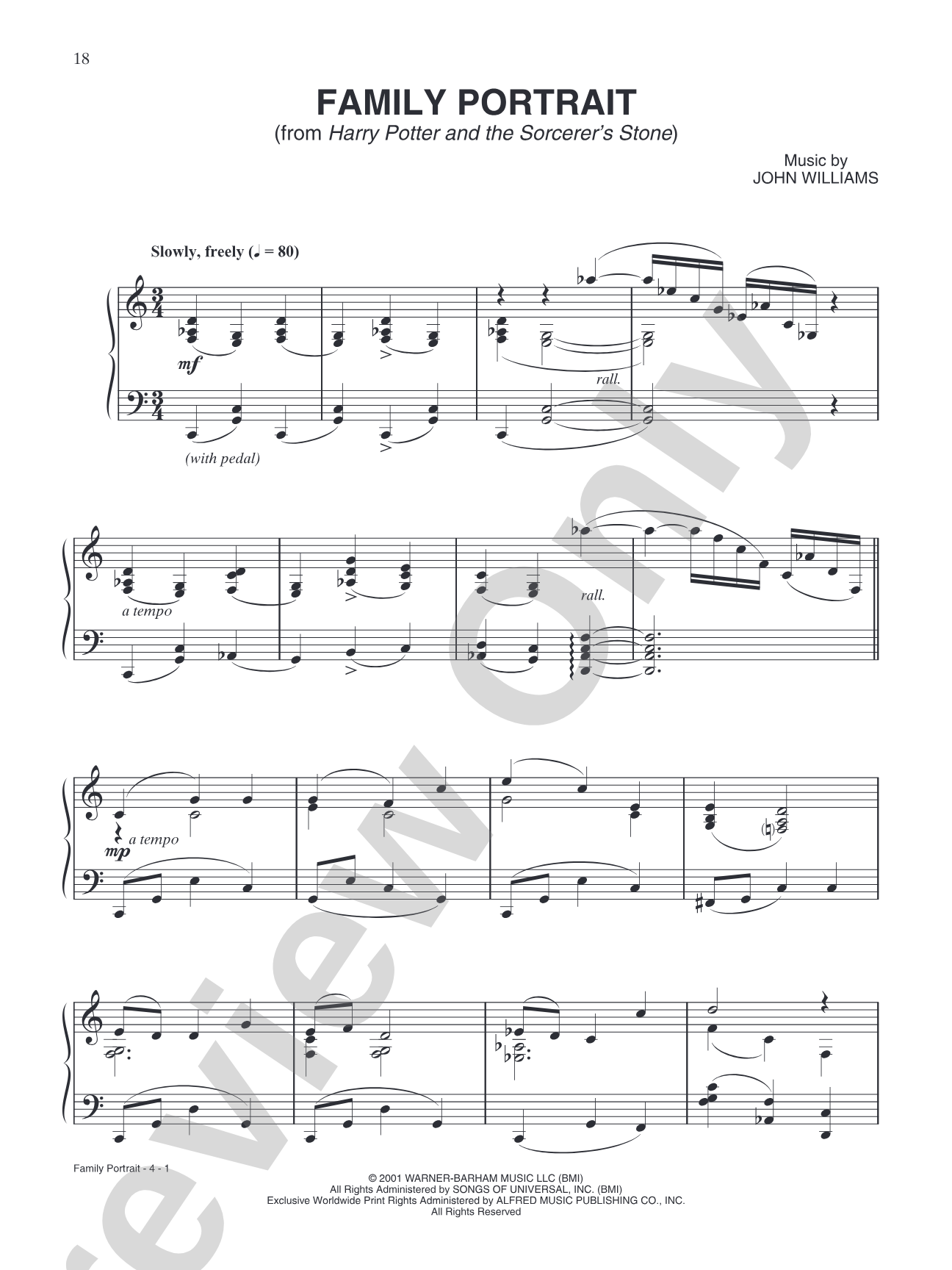

Family Protrait (from "Harry Potter and the Sorcerer's Stone"): Piano
Music by John Williams, Patrick Doyle, Nicholas Hooper, and Alexandre Desplat
Level: Intermediate / Advanced
Item: 00-XS-0000486
$4.99
Pickup currently not available
Related Items
Harry's Wondrous World (from "Harry Potter and the Sorcerer's Stone"): Piano |
$9.99
|
View | |
Diagon Alley (from "Harry Potter and the Sorcerer's Stone"): Piano |
$4.99
|
View | |
Nimbus 2000 (from "Harry Potter and the Sorcerer's Stone"): Piano |
$4.99
|
View | |
Voldemort (from "Harry Potter and the Sorcerer's Stone"): Piano |
$4.99
|
View | |
Chamber of Secrets (from "Harry Potter and the Chamber of Secrets"): Piano |
$4.99
|
View | |
Buckbeaks Flight (from "Harry Potter and the Prisoner of Azkaban"): Piano |
$4.99
|
View | |
Hagrid the Professor (from "Harry Potter and the Prisoner of Azkaban"): Piano |
$4.99
|
View | |
This is the Night (from "Harry Potter and the Goblet of Fire"): Piano |
$5.99
|
View | |
Potter Waltz (from "Harry Potter and the Goblet of Fire"): Piano |
$4.99
|
View | |
Harry In Winter (from "Harry Potter and the Goblet of Fire"): Piano |
$4.99
|
View | |
Leaving Hogwarts (from "Harry Potter and the Sorcerer's Stone"): Piano |
$4.99
|
View | |
Harry Potter: Sheet Music from the Complete Film Series: Piano Book |
$29.99
|
View |
Description
With the Harry Potter film series now complete, Alfred Music and Warner Bros. Entertainment are proud to present musical selections from the eight epic films together in one piano sheet music collectible volume. For the first time ever, 36 sheet music selections by John Williams, Patrick Doyle, Nicholas Hooper, and Alexandre Desplat are collected along with eight pages of color stills from The Sorcerer's Stone to The Deathly Hallows, Part 2. By popular request, "Leaving Hogwarts" from The Sorcerer's Stone appears in print in this collection for the first time. It's a perfect gift for intermediate to advanced pianists of all ages who love the music of Harry Potter. Titles: * Diagon Alley * Family Portrait * Harry's Wondrous World * Hedwig's Theme * Leaving Hogwarts * Nimbus 2000 * Voldemort * The Chamber of Secrets * Fawkes the Phoenix * Buckbeak's Flight * Double Trouble * Hagrid the Professor * Harry in Winter * Hogwarts March * Potter Waltz * This Is the Night * Dumbledore's Army * Fireworks * Loved Ones and Leaving * Professor Umbridge * Dumbledore's Farewell * Harry and Hermione * In Noctem * When Ginny Kissed Harry * Farewell to Dobby * Godric's Hollow Graveyard * Harry and Ginny * Obliviate * Ron Leaves * Snape to Malfoy Manor * Courtyard Apocalypse * Harry's Sacrifice * Lily's Lullaby * Lily's Theme * Severus and Lily * Statues.


Family Protrait (from "Harry Potter and the Sorcerer's Stone"): Piano isn't in MakeMusic Cloud just yet...but it could be. Let us know you'd like to see it, and you'll help shape what comes next. In the meantime, start a free trial and dive into thousands of interactive titles your students can play along with today.
Request This Title
Tell us you want it.
Start Your Free Trial
Explore everything that's ready to play right now.
Sample Audio
No sample audio found.
Sample Video
No sample videos found.
Additional Details
Publisher:
Alfred Music
Page Count:
144
SKU:
00-XS-0000486
More about this title
About the Composer: John Williams
John Williams stands as one of the most prolific and celebrated film composers of the past five decades. His scores for the Harry Potter series, Indiana Jones films, Star Wars saga, and Schindler's List have shaped how millions experience cinema, earning him five Academy Awards and a place among the most recorded composers in history. Williams brings symphonic depth and thematic invention to every project, crafting musical ideas that are instantly memorable yet structurally sophisticated enough to reward repeated listening and study.
As a composer, Williams demonstrates mastery across multiple genres: orchestral adventure, intimate character themes, and fantastical underscores. His work shows pianists how instrumental color, harmonic language, and melodic clarity can convey narrative without words. For music educators, his compositions offer rich material for teaching orchestration concepts, harmonic analysis, and how film music shapes emotional response.
Why we love this
This collection captures the full arc of a beloved film series in one carefully curated volume, making it an ideal gift and reference resource for intermediate to advanced pianists. The variety of Williams's approaches across the eight films, from the whimsical Diagon Alley to the emotionally complex Lily's Theme, gives pianists exposure to different harmonic palettes, textures, and expressive techniques without requiring a full film score album. The inclusion of Leaving Hogwarts in print for the first time adds genuine value to collectors and performers who have searched for this particular arrangement.
What to expect
These arrangements shimmer with the wonder and darkness of the wizarding world, moving from the bustling energy of Diagon Alley to the quiet sorrow of farewell scenes. You'll encounter moments of pure magical whimsy alongside genuinely complex harmonic writing that asks for thoughtful listening, precise control, and emotional maturity in your interpretation. The piano becomes a window into how Williams builds narrative tension and emotional resonance across eight films.
Who it's for
Intermediate to advanced pianists who want to engage with film music on a serious artistic level will find substantial musical challenge and reward here. This collection works equally well for solo performers exploring contemporary concert repertoire, for students developing their own interpretive voice, and for teachers who want to introduce film composition techniques through analysis and performance of genuine, sophisticated orchestral arrangements.
How to get the most out of it
- Pay attention to the orchestral layering in pieces like Harry's Wondrous World. Williams often writes themes that shift between registers and doublings in the original scores; use dynamic differentiation and careful pedal work to suggest how these ideas move through an orchestra.
- Tempo flexibility matters in the more reflective pieces such as Lily's Lullaby and Dumbledore's Farewell. Avoid metronomic playing; allow rubato to breathe during phrase endings and emotional peaks.
- Approach the faster, rhythmically driven selections like Buckbeak's Flight and Courtyard Apocalypse with clarity in the accompaniment patterns, ensuring the melodic line sings without becoming buried. These pieces reward confident, articulate playing in the left hand.
- Study the color changes between key areas in pieces like Voldemort. Williams often uses harmonic shifts and modal movement to suggest different emotional or dramatic spaces; highlight these transitions through subtle voicing and dynamic choices.
How to use it
A pianist performing this collection could structure a recital around thematic progression, opening with the brightness of the early films and moving toward the emotional weight of the final chapters, creating a natural arc that mirrors the series itself. The arrangement also serves well as concert material for intermediate and advanced students preparing for competitions or recitals where contemporary, recognizable music alongside classical standards makes strategic programming sense. Teachers can use individual selections from this volume as performance repertoire while building sight-reading and interpretation skills across a span of musical styles and emotional registers.
Skills your students will build
- Reading and executing complex rhythmic figures and syncopation (Buckbeak's Flight, Courtyard Apocalypse)
- Pedal technique for sustaining harmonies and creating orchestral color without muddying texture (Lily's Theme, Dumbledore's Farewell)
- Voicing and balance between melodic and accompaniment layers in dense harmonic writing (Harry's Wondrous World, Hogwarts March)
- Expressive control and phrasing in music with minimal tempo marking guidance
- Analysis of leitmotif and how Williams uses harmonic language to suggest character and emotion across multiple compositions