
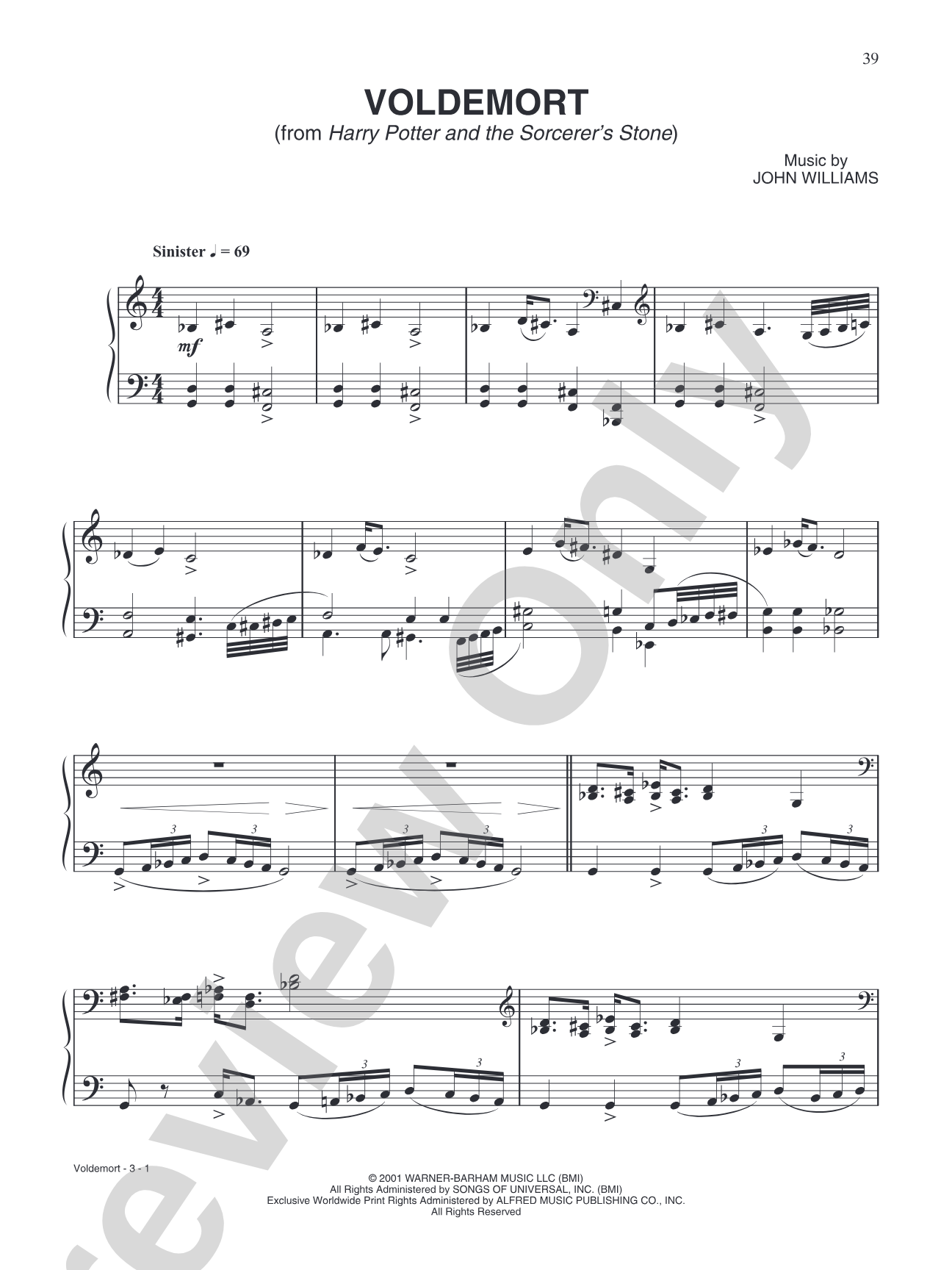

Voldemort (from "Harry Potter and the Sorcerer's Stone"): Piano
Music by John Williams, Patrick Doyle, Nicholas Hooper, and Alexandre Desplat
Level: Intermediate / Advanced
Item: 00-XS-0000487
$4.99
Pickup currently not available
Related Items
Harry's Wondrous World (from "Harry Potter and the Sorcerer's Stone"): Piano |
$9.99
|
View | |
Diagon Alley (from "Harry Potter and the Sorcerer's Stone"): Piano |
$4.99
|
View | |
Nimbus 2000 (from "Harry Potter and the Sorcerer's Stone"): Piano |
$4.99
|
View | |
Family Protrait (from "Harry Potter and the Sorcerer's Stone"): Piano |
$4.99
|
View | |
Chamber of Secrets (from "Harry Potter and the Chamber of Secrets"): Piano |
$4.99
|
View | |
Buckbeaks Flight (from "Harry Potter and the Prisoner of Azkaban"): Piano |
$4.99
|
View | |
Hagrid the Professor (from "Harry Potter and the Prisoner of Azkaban"): Piano |
$4.99
|
View | |
This is the Night (from "Harry Potter and the Goblet of Fire"): Piano |
$5.99
|
View | |
Potter Waltz (from "Harry Potter and the Goblet of Fire"): Piano |
$4.99
|
View | |
Harry In Winter (from "Harry Potter and the Goblet of Fire"): Piano |
$4.99
|
View | |
Leaving Hogwarts (from "Harry Potter and the Sorcerer's Stone"): Piano |
$4.99
|
View | |
Harry Potter: Sheet Music from the Complete Film Series: Piano Book |
$29.99
|
View |
Description
With the Harry Potter film series now complete, Alfred Music and Warner Bros. Entertainment are proud to present musical selections from the eight epic films together in one piano sheet music collectible volume. For the first time ever, 36 sheet music selections by John Williams, Patrick Doyle, Nicholas Hooper, and Alexandre Desplat are collected along with eight pages of color stills from The Sorcerer's Stone to The Deathly Hallows, Part 2. By popular request, "Leaving Hogwarts" from The Sorcerer's Stone appears in print in this collection for the first time. It's a perfect gift for intermediate to advanced pianists of all ages who love the music of Harry Potter. Titles: * Diagon Alley * Family Portrait * Harry's Wondrous World * Hedwig's Theme * Leaving Hogwarts * Nimbus 2000 * Voldemort * The Chamber of Secrets * Fawkes the Phoenix * Buckbeak's Flight * Double Trouble * Hagrid the Professor * Harry in Winter * Hogwarts March * Potter Waltz * This Is the Night * Dumbledore's Army * Fireworks * Loved Ones and Leaving * Professor Umbridge * Dumbledore's Farewell * Harry and Hermione * In Noctem * When Ginny Kissed Harry * Farewell to Dobby * Godric's Hollow Graveyard * Harry and Ginny * Obliviate * Ron Leaves * Snape to Malfoy Manor * Courtyard Apocalypse * Harry's Sacrifice * Lily's Lullaby * Lily's Theme * Severus and Lily * Statues.


Discover MakeMusic Cloud: thousands of interactive titles your students can play along with today.
Sample Audio
No sample audio found.
Sample Video
No sample videos found.
Additional Details
Publisher:
Alfred Music
Page Count:
144
SKU:
00-XS-0000487
More about this title
About the Composer: John Williams
John Williams stands as one of the most prolific and celebrated film composers in cinema history. His career spans over six decades, during which he has created some of the most recognizable themes in popular culture, from Star Wars to Indiana Jones to Schindler's List. Williams brings classical training and orchestral sophistication to every project, crafting melodies that endure far beyond their original films and teaching generations of listeners what memorable music sounds like.
For music educators, Williams' work offers exceptional models of thematic development, orchestration, and how melody can carry narrative weight. His Harry Potter scores, in particular, demonstrate how leitmotif works in practice: themes recur, transform, and deepen as characters and stories evolve across eight films.
Why we love this
This collection captures the full emotional arc of the Harry Potter series through music written by Williams and his successor composers, all arranged for solo piano at a level that challenges intermediate to advanced pianists without becoming inaccessible. The 36 selections range from intimate character themes like "Lily's Lullaby" to grand set pieces like "Courtyard Apocalypse," giving pianists genuine variety in style, texture, and dramatic purpose. It's the kind of repertoire that motivates students to practice because they already love the source material, and the writing is sophisticated enough that the music itself becomes the real draw.
What to expect
These arrangements capture the emotional precision of the films: moments of wonder and magic sitting alongside darker, more introspective passages. You'll find yourself moving between the playfulness of "Nimbus 2000," the solemnity of "Dumbledore's Farewell," and the tension of pieces like "Voldemort." The piano writing preserves the orchestral thinking of the original scores while giving your hands room to shape melody and manage the harmonic architecture without overwhelming technical demands.
Who it's for
Intermediate to advanced pianists seeking repertoire that connects to beloved stories will find genuine musical substance here, not just soundtrack nostalgia. Solo pianists preparing recitals, students exploring film music composition, and adult learners returning to piano who grew up with these films all have compelling reasons to engage with this collection.
How to get the most out of it
- Approach the leitmotifs as characters rather than abstract melodies. When you encounter Hedwig's theme or Voldemort's dark material, imagine what that presence feels like in the story; let that inform your phrasing and tone color.
- Study the relative sections of each piece first. Identify where the main theme sits alongside supporting material, then build outward. This prevents the accompaniment from overshadowing the melodic line.
- Respect the film's pacing in pieces like "Harry in Winter" and "Lily's Theme." These moments demand space and restraint rather than technical speed; clarity of the harmonic progression matters more than velocity.
- Use pedal deliberately in atmospheric sections such as "Godric's Hollow Graveyard." The sustain should enhance texture, not blur harmonic changes.
How to use it
Use individual selections to bookend recital programs or create thematic mini-programs around specific Harry Potter films or emotional arcs (the coming-of-age pieces, the darker material, the triumphant endings). Some pianists will program a single film's themes as a suite; others will use selections to teach their own students about leitmotif, film scoring, and how character themes evolve across a narrative.
Skills your students will build
- Recognizing and performing leitmotifs and their variations across multiple pieces
- Sustaining legato melody lines while managing complex accompanying figures
- Using pedal as a compositional tool rather than a reflex, especially in atmospheric writing
- Understanding how orchestral textures translate to solo piano
- Interpreting dynamic contrast and tone color in the absence of orchestral color changes