
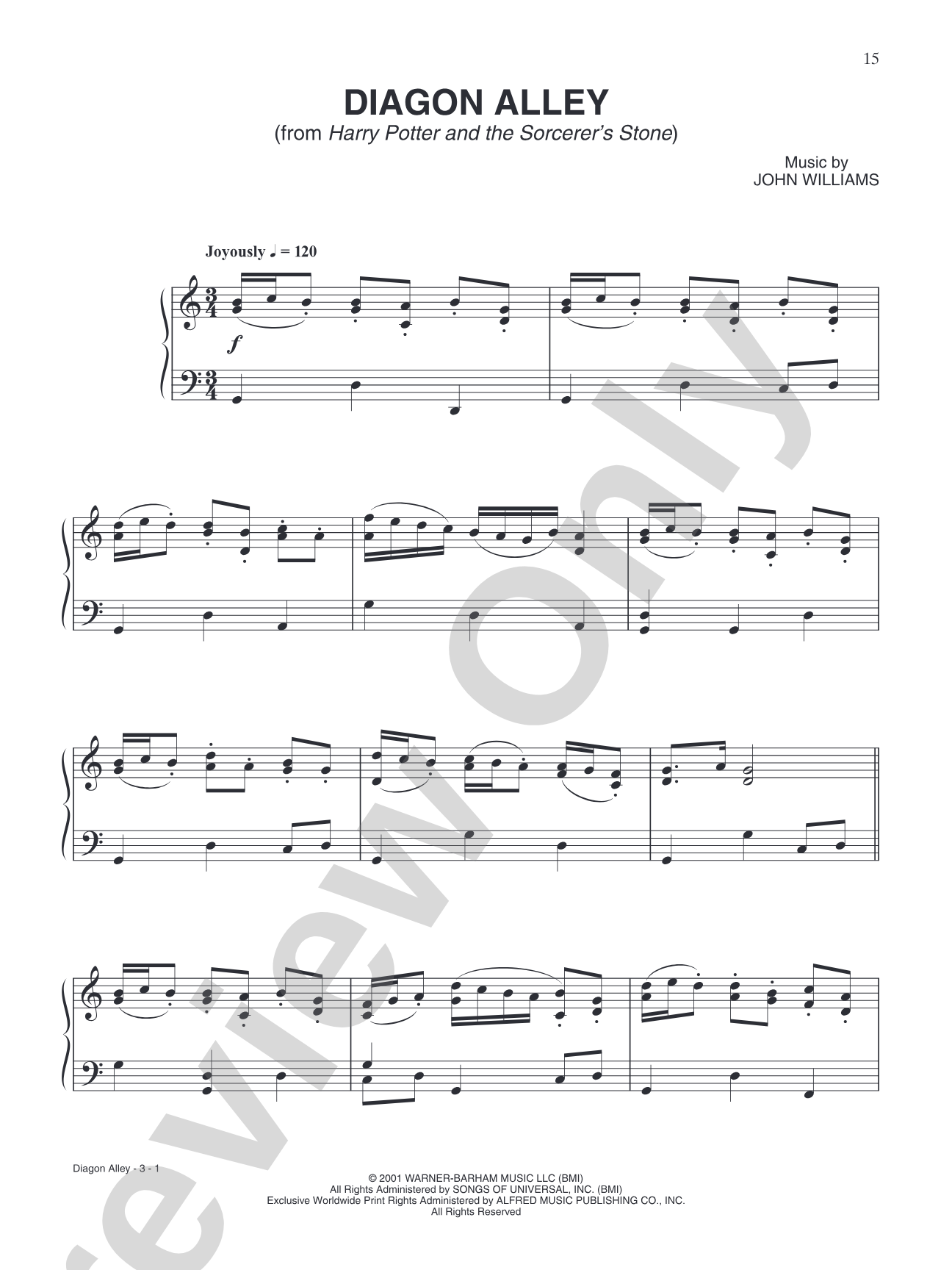

Diagon Alley (from "Harry Potter and the Sorcerer's Stone"): Piano
Music by John Williams, Patrick Doyle, Nicholas Hooper, and Alexandre Desplat
Level: Intermediate / Advanced
Item: 00-XS-0000484
$4.99
Pickup currently not available
Related Items
Harry's Wondrous World (from "Harry Potter and the Sorcerer's Stone"): Piano |
$9.99
|
View | |
Nimbus 2000 (from "Harry Potter and the Sorcerer's Stone"): Piano |
$4.99
|
View | |
Family Protrait (from "Harry Potter and the Sorcerer's Stone"): Piano |
$4.99
|
View | |
Voldemort (from "Harry Potter and the Sorcerer's Stone"): Piano |
$4.99
|
View | |
Chamber of Secrets (from "Harry Potter and the Chamber of Secrets"): Piano |
$4.99
|
View | |
Buckbeaks Flight (from "Harry Potter and the Prisoner of Azkaban"): Piano |
$4.99
|
View | |
Hagrid the Professor (from "Harry Potter and the Prisoner of Azkaban"): Piano |
$4.99
|
View | |
This is the Night (from "Harry Potter and the Goblet of Fire"): Piano |
$5.99
|
View | |
Potter Waltz (from "Harry Potter and the Goblet of Fire"): Piano |
$4.99
|
View | |
Harry In Winter (from "Harry Potter and the Goblet of Fire"): Piano |
$4.99
|
View | |
Leaving Hogwarts (from "Harry Potter and the Sorcerer's Stone"): Piano |
$4.99
|
View | |
Harry Potter: Sheet Music from the Complete Film Series: Piano Book |
$29.99
|
View |
Description
With the Harry Potter film series now complete, Alfred Music and Warner Bros. Entertainment are proud to present musical selections from the eight epic films together in one piano sheet music collectible volume. For the first time ever, 36 sheet music selections by John Williams, Patrick Doyle, Nicholas Hooper, and Alexandre Desplat are collected along with eight pages of color stills from The Sorcerer's Stone to The Deathly Hallows, Part 2. By popular request, "Leaving Hogwarts" from The Sorcerer's Stone appears in print in this collection for the first time. It's a perfect gift for intermediate to advanced pianists of all ages who love the music of Harry Potter. Titles: * Diagon Alley * Family Portrait * Harry's Wondrous World * Hedwig's Theme * Leaving Hogwarts * Nimbus 2000 * Voldemort * The Chamber of Secrets * Fawkes the Phoenix * Buckbeak's Flight * Double Trouble * Hagrid the Professor * Harry in Winter * Hogwarts March * Potter Waltz * This Is the Night * Dumbledore's Army * Fireworks * Loved Ones and Leaving * Professor Umbridge * Dumbledore's Farewell * Harry and Hermione * In Noctem * When Ginny Kissed Harry * Farewell to Dobby * Godric's Hollow Graveyard * Harry and Ginny * Obliviate * Ron Leaves * Snape to Malfoy Manor * Courtyard Apocalypse * Harry's Sacrifice * Lily's Lullaby * Lily's Theme * Severus and Lily * Statues.


Diagon Alley (from "Harry Potter and the Sorcerer's Stone"): Piano isn't in MakeMusic Cloud just yet...but it could be. Let us know you'd like to see it, and you'll help shape what comes next. In the meantime, start a free trial and dive into thousands of interactive titles your students can play along with today.
Request This Title
Tell us you want it.
Start Your Free Trial
Explore everything that's ready to play right now.
Sample Audio
No sample audio found.
Sample Video
No sample videos found.
Additional Details
Publisher:
Alfred Music
Page Count:
144
SKU:
00-XS-0000484
More about this title
About the Composer: John Williams
John Williams is among the most celebrated film composers of our time, with a catalog spanning over six decades and nine Academy Award nominations. His work on the Harry Potter series demonstrates his mastery of thematic composition: each character and location receives a distinctive musical identity that audiences recognize instantly, making his scores as memorable as the films themselves.
Williams's approach to orchestration translates remarkably well to the piano. His themes are built on strong melodic foundations and harmonic clarity, qualities that make them ideal for solo keyboard adaptation. For pianists, his music offers the chance to engage with orchestral thinking at the keyboard level, discovering how rich harmonic movement and layered textures can be rendered through fingering and pedal work.
Why we love this
These arrangements capture the emotional core of Williams's orchestral writing without sacrificing musical substance. Pianists encounter genuine compositional depth here: themes that evolve, harmonic progressions that surprise, and moments of real tenderness alongside adventure. The collection spans the entire narrative arc of the films, making it possible to tell a complete musical story across a single recital or practice session.
What to expect
Opening these pages feels like stepping into a beloved story. Williams's melodies are instantly familiar yet fresh each time you play them, offering the particular pleasure of music that feels both emotionally resonant and pianistically idiomatic. From the whimsical wonder of Diagon Alley to the quiet grief of Lily's Theme, this collection invites you into eight films' worth of musical storytelling.
Who it's for
Intermediate to advanced pianists drawn to film music and popular orchestral repertoire will find substantial material here. Whether you're exploring narrative-driven music, seeking accessible entry points into thematic composition, or simply want to play music you love, this collection offers something for solo pianists of varying interests and backgrounds.
How to get the most out of it
- Approach each theme as a character study. Williams crafted these melodies to be instantly recognizable and emotionally distinct. Invest in the melodic line with warmth and clarity, allowing the harmonic support underneath to enhance rather than compete.
- Pay attention to the emotional context of each piece. 'Dumbledore's Farewell' requires a very different touch than 'Buckbeak's Flight.' Let the source material inform your interpretation, but trust your own musical instincts about tempo and dynamics.
- Use the pedal strategically to sustain harmonic color without muddying fast passage work. Many of these arrangements require texture as much as precision, especially in pieces like 'Diagon Alley' with its bustling energy.
- Research the film scenes if possible. Watching the moments these pieces accompany will deepen your understanding of pacing, emotional arc, and where Williams emphasizes wonder versus danger or melancholy.
How to use it
Program individual selections as encores or lighter repertoire alongside more formal classical works. The collection works beautifully for shared recitals where multiple pianists each perform one or two pieces, creating a collaborative narrative arc. You might also use this as bridge repertoire for intermediate pianists moving toward advanced concert programming, since Williams's writing rewards both technical facility and interpretive maturity.
Skills your students will build
- Sustaining melodic lines across hand positions while maintaining harmonic clarity
- Managing varied textures and densities in a single piece (sparse passages alternating with full sonorities)
- Shaping thematic material across longer forms without relying on obvious rubato
- Reading and interpreting film-derived orchestral music at the keyboard
- Using pedal as a compositional tool rather than a reflexive technique