
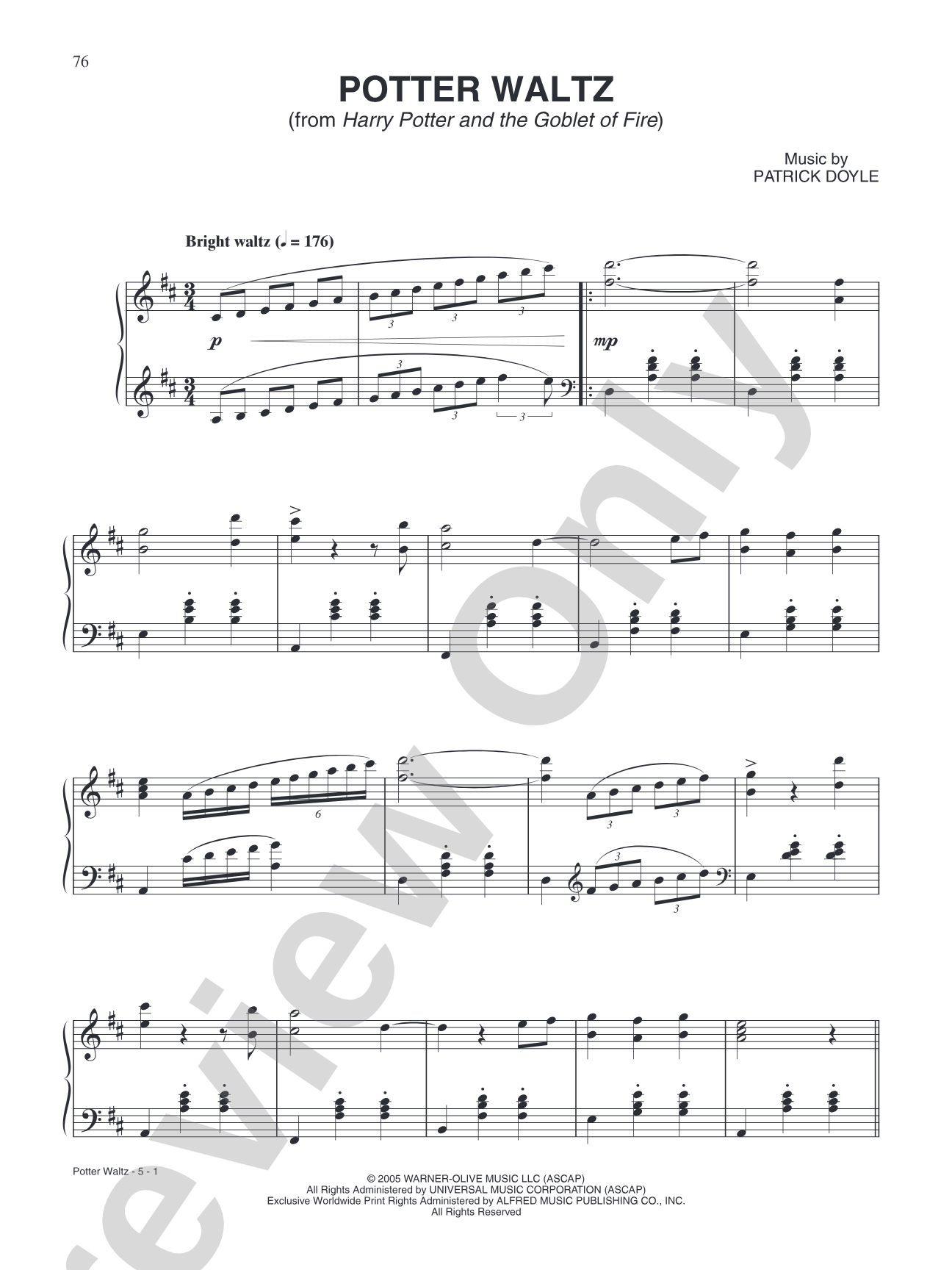

Potter Waltz (from "Harry Potter and the Goblet of Fire"): Piano
Music by John Williams, Patrick Doyle, Nicholas Hooper, and Alexandre Desplat
Level: Intermediate / Advanced
Item: 00-XS-0000497
$4.99
Pickup currently not available
Related Items
Harry's Wondrous World (from "Harry Potter and the Sorcerer's Stone"): Piano |
$9.99
|
View | |
Diagon Alley (from "Harry Potter and the Sorcerer's Stone"): Piano |
$4.99
|
View | |
Nimbus 2000 (from "Harry Potter and the Sorcerer's Stone"): Piano |
$4.99
|
View | |
Family Protrait (from "Harry Potter and the Sorcerer's Stone"): Piano |
$4.99
|
View | |
Voldemort (from "Harry Potter and the Sorcerer's Stone"): Piano |
$4.99
|
View | |
Chamber of Secrets (from "Harry Potter and the Chamber of Secrets"): Piano |
$4.99
|
View | |
Buckbeaks Flight (from "Harry Potter and the Prisoner of Azkaban"): Piano |
$4.99
|
View | |
Hagrid the Professor (from "Harry Potter and the Prisoner of Azkaban"): Piano |
$4.99
|
View | |
This is the Night (from "Harry Potter and the Goblet of Fire"): Piano |
$5.99
|
View | |
Harry In Winter (from "Harry Potter and the Goblet of Fire"): Piano |
$4.99
|
View | |
Leaving Hogwarts (from "Harry Potter and the Sorcerer's Stone"): Piano |
$4.99
|
View | |
Harry Potter: Sheet Music from the Complete Film Series: Piano Book |
$29.99
|
View |
Description
With the Harry Potter film series now complete, Alfred Music and Warner Bros. Entertainment are proud to present musical selections from the eight epic films together in one piano sheet music collectible volume. For the first time ever, 36 sheet music selections by John Williams, Patrick Doyle, Nicholas Hooper, and Alexandre Desplat are collected along with eight pages of color stills from The Sorcerer's Stone to The Deathly Hallows, Part 2. By popular request, "Leaving Hogwarts" from The Sorcerer's Stone appears in print in this collection for the first time. It's a perfect gift for intermediate to advanced pianists of all ages who love the music of Harry Potter. Titles: * Diagon Alley * Family Portrait * Harry's Wondrous World * Hedwig's Theme * Leaving Hogwarts * Nimbus 2000 * Voldemort * The Chamber of Secrets * Fawkes the Phoenix * Buckbeak's Flight * Double Trouble * Hagrid the Professor * Harry in Winter * Hogwarts March * Potter Waltz * This Is the Night * Dumbledore's Army * Fireworks * Loved Ones and Leaving * Professor Umbridge * Dumbledore's Farewell * Harry and Hermione * In Noctem * When Ginny Kissed Harry * Farewell to Dobby * Godric's Hollow Graveyard * Harry and Ginny * Obliviate * Ron Leaves * Snape to Malfoy Manor * Courtyard Apocalypse * Harry's Sacrifice * Lily's Lullaby * Lily's Theme * Severus and Lily * Statues.


Potter Waltz (from "Harry Potter and the Goblet of Fire"): Piano isn't in MakeMusic Cloud just yet...but it could be. Let us know you'd like to see it, and you'll help shape what comes next. In the meantime, start a free trial and dive into thousands of interactive titles your students can play along with today.
Request This Title
Tell us you want it.
Start Your Free Trial
Explore everything that's ready to play right now.
Sample Audio
No sample audio found.
Sample Video
No sample videos found.
Additional Details
Publisher:
Alfred Music
Page Count:
144
SKU:
00-XS-0000497
More about this title
About the Composer: Patrick Doyle
Patrick Doyle is a Scottish composer whose film scores combine classical sensibility with contemporary orchestration. He has written extensively for cinema, with particular success in fantasy and period drama, bringing lyrical depth and structural clarity to narratives that demand both intimacy and grandeur.
Why we love this
This collection captures the emotional arc of the entire Harry Potter saga in piano arrangements that preserve the orchestral sophistication of the original scores. Pianists at this level gain access to music that feels genuinely cinematic without requiring chamber ensemble or backing tracks, and the inclusion of 36 pieces means you can program anything from a single memorable theme to an extended medley that spans the full eight-film narrative.
What to expect
These arrangements transport you into Rowling's magical world through music that shifts from whimsy and wonder to darkness and loss. Each piece carries the emotional weight of its narrative moment, whether it's the bright discovery of Diagon Alley or the haunting sorrow of Lily's Theme, creating a listening and playing experience that feels both intimate and cinematic.
Who it's for
Intermediate to advanced pianists seeking repertoire that combines recognizable film music with genuine pianistic substance will find this collection essential. It works equally well for performers preparing concert recitals, students exploring how orchestral composition translates to the keyboard, and adult learners returning to piano through music they love.
How to get the most out of it
- Study the orchestral textures implied in each arrangement and imagine how strings, brass, and woodwinds originally carried the melody; this informs phrasing and weight distribution across the keyboard.
- Balance melodic clarity with harmonic richness by ensuring inner voices don't obscure the primary line, especially in pieces like Hedwig's Theme where counterpoint drives the emotional impact.
- Shape phrases according to the dramatic context of each scene rather than mechanical phrasing; Potter Waltz benefits from rubato that mirrors the formal dance it accompanies.
- Adjust pedal use to match the reverb and spatial qualities of each piece's original orchestral setting, avoiding muddiness in fast-moving passages like Buckbeak's Flight.
How to use it
Build a thematic recital around moments from the saga, perhaps pairing early adventure themes with the darker later pieces to trace Harry's journey. Shorter selections like Nimbus 2000 or When Ginny Kissed Harry work as elegant concert openers or encores, while longer suites constructed from multiple pieces become vehicles for demonstrating range across eight years of film scoring.
Skills your students will build
- Interpreting orchestral textures at the piano keyboard
- Balancing melody and harmony in complex arrangements
- Sustaining musical line across tempo and dynamic shifts
- Pedal technique for varying acoustic spaces and moods
- Reading film score language and narrative-driven phrasing