
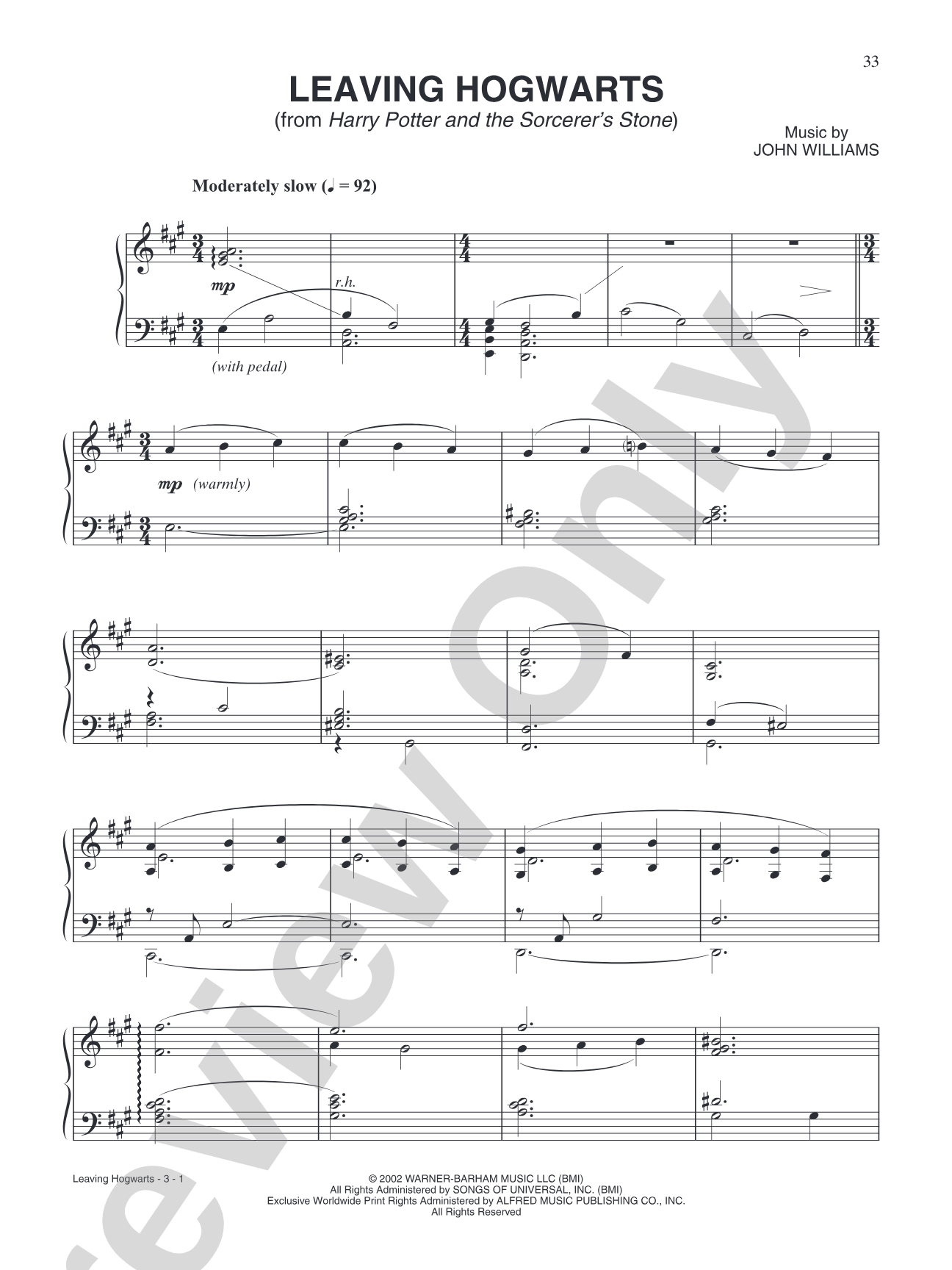

Leaving Hogwarts (from "Harry Potter and the Sorcerer's Stone"): Piano
Music by John Williams, Patrick Doyle, Nicholas Hooper, and Alexandre Desplat
Level: Intermediate / Advanced
Item: 00-XS-0000512
$4.99
Pickup currently not available
Related Items
Harry's Wondrous World (from "Harry Potter and the Sorcerer's Stone"): Piano |
$9.99
|
View | |
Diagon Alley (from "Harry Potter and the Sorcerer's Stone"): Piano |
$4.99
|
View | |
Nimbus 2000 (from "Harry Potter and the Sorcerer's Stone"): Piano |
$4.99
|
View | |
Family Protrait (from "Harry Potter and the Sorcerer's Stone"): Piano |
$4.99
|
View | |
Voldemort (from "Harry Potter and the Sorcerer's Stone"): Piano |
$4.99
|
View | |
Chamber of Secrets (from "Harry Potter and the Chamber of Secrets"): Piano |
$4.99
|
View | |
Buckbeaks Flight (from "Harry Potter and the Prisoner of Azkaban"): Piano |
$4.99
|
View | |
Hagrid the Professor (from "Harry Potter and the Prisoner of Azkaban"): Piano |
$4.99
|
View | |
This is the Night (from "Harry Potter and the Goblet of Fire"): Piano |
$5.99
|
View | |
Potter Waltz (from "Harry Potter and the Goblet of Fire"): Piano |
$4.99
|
View | |
Harry In Winter (from "Harry Potter and the Goblet of Fire"): Piano |
$4.99
|
View | |
Harry Potter: Sheet Music from the Complete Film Series: Piano Book |
$29.99
|
View |
Description
With the Harry Potter film series now complete, Alfred Music and Warner Bros. Entertainment are proud to present musical selections from the eight epic films together in one piano sheet music collectible volume. For the first time ever, 36 sheet music selections by John Williams, Patrick Doyle, Nicholas Hooper, and Alexandre Desplat are collected along with eight pages of color stills from The Sorcerer's Stone to The Deathly Hallows, Part 2. By popular request, "Leaving Hogwarts" from The Sorcerer's Stone appears in print in this collection for the first time. It's a perfect gift for intermediate to advanced pianists of all ages who love the music of Harry Potter. Titles: * Diagon Alley * Family Portrait * Harry's Wondrous World * Hedwig's Theme * Leaving Hogwarts * Nimbus 2000 * Voldemort * The Chamber of Secrets * Fawkes the Phoenix * Buckbeak's Flight * Double Trouble * Hagrid the Professor * Harry in Winter * Hogwarts March * Potter Waltz * This Is the Night * Dumbledore's Army * Fireworks * Loved Ones and Leaving * Professor Umbridge * Dumbledore's Farewell * Harry and Hermione * In Noctem * When Ginny Kissed Harry * Farewell to Dobby * Godric's Hollow Graveyard * Harry and Ginny * Obliviate * Ron Leaves * Snape to Malfoy Manor * Courtyard Apocalypse * Harry's Sacrifice * Lily's Lullaby * Lily's Theme * Severus and Lily * Statues.


Leaving Hogwarts (from "Harry Potter and the Sorcerer's Stone"): Piano isn't in MakeMusic Cloud just yet...but it could be. Let us know you'd like to see it, and you'll help shape what comes next. In the meantime, start a free trial and dive into thousands of interactive titles your students can play along with today.
Request This Title
Tell us you want it.
Start Your Free Trial
Explore everything that's ready to play right now.
Sample Audio
No sample audio found.
Sample Video
No sample videos found.
Additional Details
Publisher:
Alfred Music
Page Count:
144
SKU:
00-XS-0000512
More about this title
About the Composer: John Williams
John Williams stands among the most recorded composers in history, having shaped the soundtracks of cinema since the 1970s. His orchestral mastery, gift for memorable themes, and understanding of how music deepens narrative have made him essential listening across generations of musicians. For pianists, his concert works and film arrangements offer technical challenge paired with the reward of playing music the world already knows and loves.
Why we love this
This collection captures one of cinema's most beloved musical universes in a single, beautifully curated volume. The presence of "Leaving Hogwarts" in print here for the first time makes this a genuine resource for pianists who have searched for this specific piece. The span of 36 selections across all eight films means you can program continuity, thematic development, and dramatic arc in recitals or student performances without reaching for multiple sources.
What to expect
Opening these pages feels like walking back into the films' most memorable moments. Williams' themes carry their cinematic magic onto the piano, whether you're playing the wistful nostalgia of "Leaving Hogwarts" or the driving intensity of "Buckbeak's Flight." Even in keyboard form, the music maintains its sweep and emotional directness, making the practice room feel momentarily larger than itself.
Who it's for
Intermediate to advanced pianists who bring enthusiasm for the Harry Potter films to their practice room and want to engage with this music at a serious pianistic level. This collection serves ensemble pianists preparing solo material for recitals, film music enthusiasts exploring arrangement and transcription, and teachers seeking repertoire that motivates students through cultural relevance without compromising musical substance.
How to get the most out of it
- Pay attention to the film's original orchestration as a touchstone for tempo and character, even as you translate it to the keyboard. Williams' themes often carry cinematic weight that benefits from clarity of phrasing rather than rushing.
- Manage the registrational possibilities of your instrument to create depth; many of these selections benefit from thoughtful use of the sustain pedal to simulate the resonance of a full orchestra.
- Work with dynamics as structural markers. Williams builds emotional intensity through gradual dynamic shifts, so resist the urge to make early sections too loud.
- Isolate the thematic material in passages that layer multiple melodic lines. Practicing hands separately will clarify which voice needs to sing through the texture.
How to use it
Build a concert segment around the emotional arc of a single film or trace thematic development across multiple films using selections from this collection. Alternatively, pair a single iconic selection like "Hedwig's Theme" with other film or contemporary music to demonstrate how memorable melodic writing functions across genres. The collection's breadth makes it equally suited to solo recital repertoire and to studio programming that celebrates students' own musical interests.
Skills your students will build
- Orchestral-to-keyboard transcription and the translation of large ensemble sound into single-instrument texture
- Pedal technique and registrational awareness to create harmonic depth and orchestral resonance
- Sustained legato and thematic clarity in passages with multiple voice layers
- Tempo consistency and structural pacing in longer, multi-sectional arrangements