
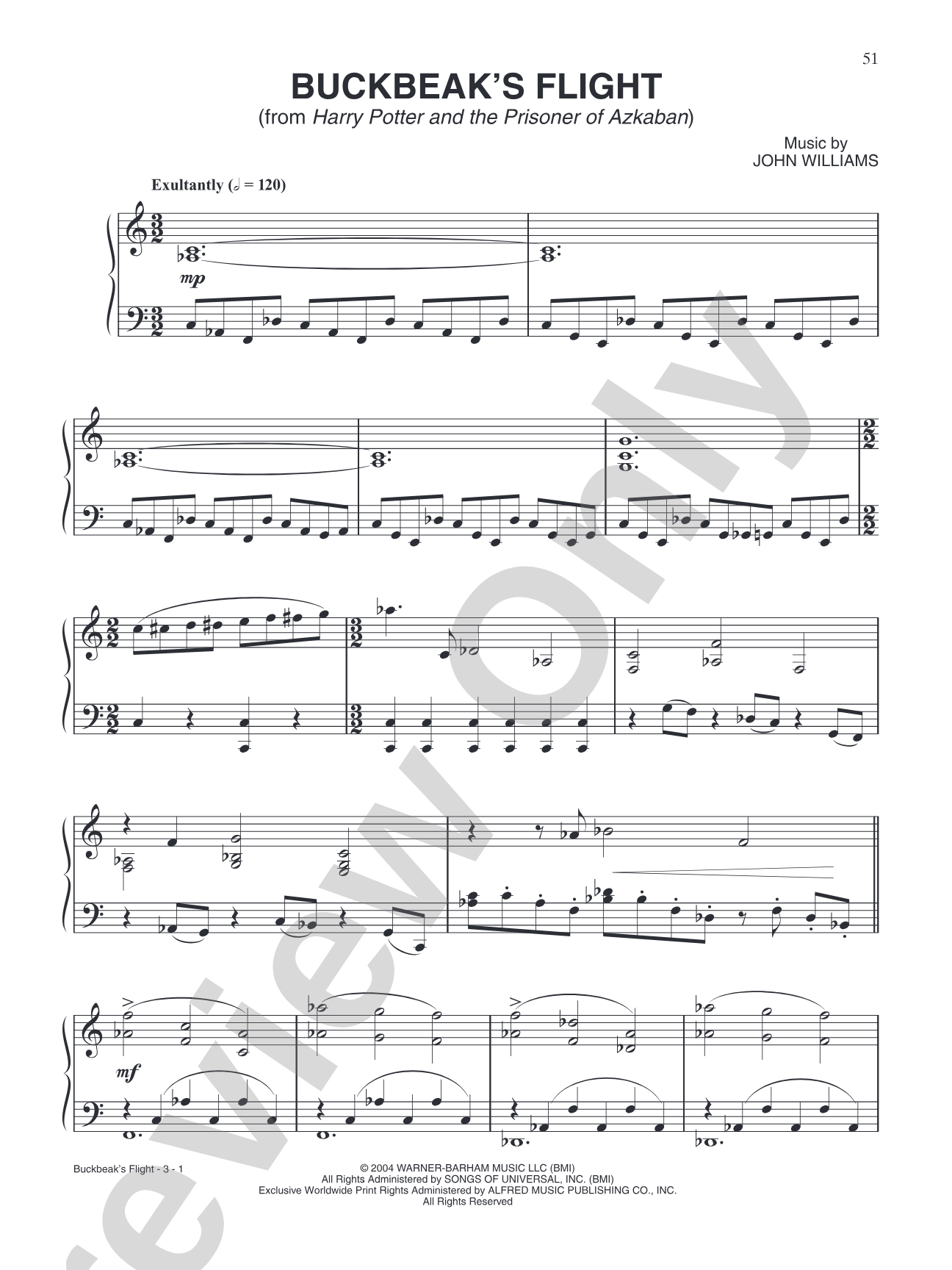

Buckbeaks Flight (from "Harry Potter and the Prisoner of Azkaban"): Piano
Music by John Williams, Patrick Doyle, Nicholas Hooper, and Alexandre Desplat
Level: Intermediate / Advanced
Item: 00-XS-0000493
$4.99
Pickup currently not available
Related Items
Harry's Wondrous World (from "Harry Potter and the Sorcerer's Stone"): Piano |
$9.99
|
View | |
Diagon Alley (from "Harry Potter and the Sorcerer's Stone"): Piano |
$4.99
|
View | |
Nimbus 2000 (from "Harry Potter and the Sorcerer's Stone"): Piano |
$4.99
|
View | |
Family Protrait (from "Harry Potter and the Sorcerer's Stone"): Piano |
$4.99
|
View | |
Voldemort (from "Harry Potter and the Sorcerer's Stone"): Piano |
$4.99
|
View | |
Chamber of Secrets (from "Harry Potter and the Chamber of Secrets"): Piano |
$4.99
|
View | |
Hagrid the Professor (from "Harry Potter and the Prisoner of Azkaban"): Piano |
$4.99
|
View | |
This is the Night (from "Harry Potter and the Goblet of Fire"): Piano |
$5.99
|
View | |
Potter Waltz (from "Harry Potter and the Goblet of Fire"): Piano |
$4.99
|
View | |
Harry In Winter (from "Harry Potter and the Goblet of Fire"): Piano |
$4.99
|
View | |
Leaving Hogwarts (from "Harry Potter and the Sorcerer's Stone"): Piano |
$4.99
|
View | |
Harry Potter: Sheet Music from the Complete Film Series: Piano Book |
$29.99
|
View |
Description
With the Harry Potter film series now complete, Alfred Music and Warner Bros. Entertainment are proud to present musical selections from the eight epic films together in one piano sheet music collectible volume. For the first time ever, 36 sheet music selections by John Williams, Patrick Doyle, Nicholas Hooper, and Alexandre Desplat are collected along with eight pages of color stills from The Sorcerer's Stone to The Deathly Hallows, Part 2. By popular request, "Leaving Hogwarts" from The Sorcerer's Stone appears in print in this collection for the first time. It's a perfect gift for intermediate to advanced pianists of all ages who love the music of Harry Potter. Titles: * Diagon Alley * Family Portrait * Harry's Wondrous World * Hedwig's Theme * Leaving Hogwarts * Nimbus 2000 * Voldemort * The Chamber of Secrets * Fawkes the Phoenix * Buckbeak's Flight * Double Trouble * Hagrid the Professor * Harry in Winter * Hogwarts March * Potter Waltz * This Is the Night * Dumbledore's Army * Fireworks * Loved Ones and Leaving * Professor Umbridge * Dumbledore's Farewell * Harry and Hermione * In Noctem * When Ginny Kissed Harry * Farewell to Dobby * Godric's Hollow Graveyard * Harry and Ginny * Obliviate * Ron Leaves * Snape to Malfoy Manor * Courtyard Apocalypse * Harry's Sacrifice * Lily's Lullaby * Lily's Theme * Severus and Lily * Statues.


Discover MakeMusic Cloud: thousands of interactive titles your students can play along with today.
Sample Audio
No sample audio found.
Sample Video
No sample videos found.
Additional Details
Publisher:
Alfred Music
Page Count:
144
SKU:
00-XS-0000493
More about this title
About the Composer: John Williams
John Williams is one of the most celebrated film composers of the last fifty years, with a catalog spanning Star Wars, Jaws, E.T., Schindler's List, and the Harry Potter series. His work defines the modern orchestral film score, combining memorable melodic themes with sophisticated harmonic language and masterful orchestration. Williams has received five Academy Awards and numerous Grammy Awards, cementing his influence on both cinema and concert music worldwide.
Beyond his film work, Williams has composed extensively for concert hall and educational settings, making his music accessible to student musicians across all levels. His themes are instantly recognizable yet rich enough to reward deep musical study, making them ideal repertoire for pianists developing their interpretive voice.
Why we love this
Williams's Harry Potter themes translate beautifully to solo piano, preserving their harmonic sophistication while offering pianists manageable arrangements of some of cinema's most beloved melodies. Intermediate and advanced pianists get to inhabit the emotional architecture of these scores, from the whimsy of Buckbeak's Flight to the gravitas of Dumbledore's Farewell, without needing an orchestra behind them. The collection spans all eight films, giving you narrative arc and thematic variety that rewards both performance and repeated listening.
What to expect
These arrangements capture the sweep and emotion of Williams's film scores, from moments of magic and wonder to darker, more introspective passages. Playing through the collection is like reliving the emotional journey of the films, with each piece unlocking specific memories and atmospheres from the Harry Potter world.
Who it's for
This collection serves intermediate to advanced pianists seeking substantial, engaging repertoire with broad appeal. It's equally at home in a serious student's practice routine, a recital program, or a casual play-through for Harry Potter fans who play piano.
How to get the most out of it
- Honor the character in each piece before focusing on technical accuracy. Buckbeak's Flight needs airiness and playfulness; Dumbledore's Farewell demands weight and reflection. Let the emotional intention shape your tempo and phrasing choices.
- Pay close attention to dynamic markings and articulation, especially in the lighter, more whimsical pieces. Williams uses these tools to create texture and personality, not just volume changes.
- In pieces with repeated sections or themes, find subtle variations in tone color or rubato to maintain listener interest without overplaying the material.
How to use it
Feature individual pieces in student recitals to introduce audiences to the sophistication of film music arrangements and showcase pianists' interpretive range. The thematic variety allows you to pair contrasting selections together (a lighter theme with a more dramatic one), or program an entire recital around the Harry Potter collection for a cohesive, themed concert. The presence of color film stills makes this especially effective for concert programs aimed at general audiences.
Skills your students will build
- Harmonic analysis of sophisticated film score orchestrations adapted for solo piano
- Pedal control and voicing to sustain orchestral textures on a single keyboard
- Tempo flexibility and rubato appropriate to film music phrasing
- Interpretive choices in arranging contexts where the original orchestration must be reimagined
- Navigation of varied stylistic demands (whimsy, drama, mystery, emotion) within a single collection