
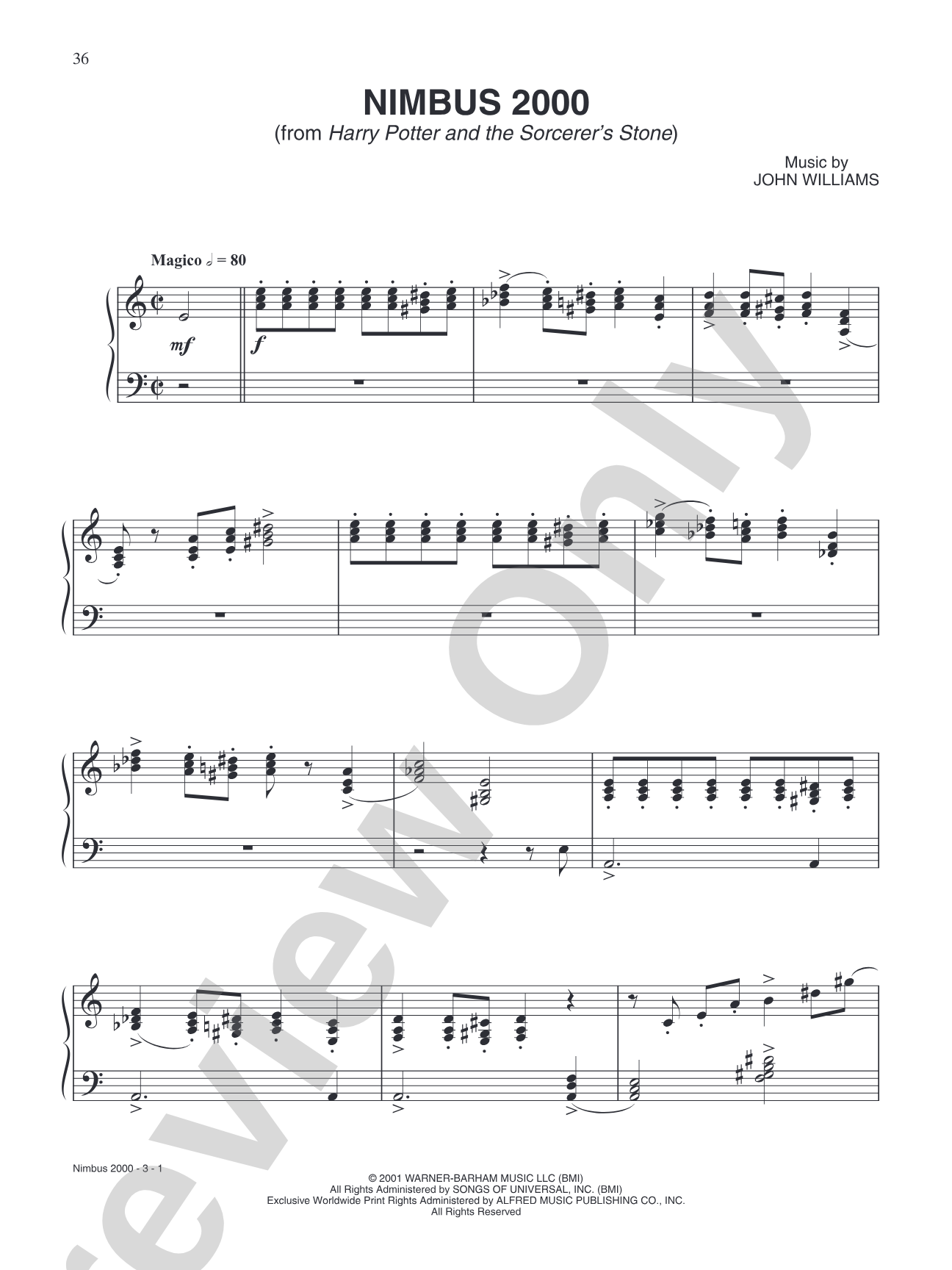

Nimbus 2000 (from "Harry Potter and the Sorcerer's Stone"): Piano
Music by John Williams, Patrick Doyle, Nicholas Hooper, and Alexandre Desplat
Level: Intermediate / Advanced
Item: 00-XS-0000485
$4.99
Pickup currently not available
Related Items
Harry's Wondrous World (from "Harry Potter and the Sorcerer's Stone"): Piano |
$9.99
|
View | |
Diagon Alley (from "Harry Potter and the Sorcerer's Stone"): Piano |
$4.99
|
View | |
Family Protrait (from "Harry Potter and the Sorcerer's Stone"): Piano |
$4.99
|
View | |
Voldemort (from "Harry Potter and the Sorcerer's Stone"): Piano |
$4.99
|
View | |
Chamber of Secrets (from "Harry Potter and the Chamber of Secrets"): Piano |
$4.99
|
View | |
Buckbeaks Flight (from "Harry Potter and the Prisoner of Azkaban"): Piano |
$4.99
|
View | |
Hagrid the Professor (from "Harry Potter and the Prisoner of Azkaban"): Piano |
$4.99
|
View | |
This is the Night (from "Harry Potter and the Goblet of Fire"): Piano |
$5.99
|
View | |
Potter Waltz (from "Harry Potter and the Goblet of Fire"): Piano |
$4.99
|
View | |
Harry In Winter (from "Harry Potter and the Goblet of Fire"): Piano |
$4.99
|
View | |
Leaving Hogwarts (from "Harry Potter and the Sorcerer's Stone"): Piano |
$4.99
|
View | |
Harry Potter: Sheet Music from the Complete Film Series: Piano Book |
$29.99
|
View |
Description
With the Harry Potter film series now complete, Alfred Music and Warner Bros. Entertainment are proud to present musical selections from the eight epic films together in one piano sheet music collectible volume. For the first time ever, 36 sheet music selections by John Williams, Patrick Doyle, Nicholas Hooper, and Alexandre Desplat are collected along with eight pages of color stills from The Sorcerer's Stone to The Deathly Hallows, Part 2. By popular request, "Leaving Hogwarts" from The Sorcerer's Stone appears in print in this collection for the first time. It's a perfect gift for intermediate to advanced pianists of all ages who love the music of Harry Potter. Titles: * Diagon Alley * Family Portrait * Harry's Wondrous World * Hedwig's Theme * Leaving Hogwarts * Nimbus 2000 * Voldemort * The Chamber of Secrets * Fawkes the Phoenix * Buckbeak's Flight * Double Trouble * Hagrid the Professor * Harry in Winter * Hogwarts March * Potter Waltz * This Is the Night * Dumbledore's Army * Fireworks * Loved Ones and Leaving * Professor Umbridge * Dumbledore's Farewell * Harry and Hermione * In Noctem * When Ginny Kissed Harry * Farewell to Dobby * Godric's Hollow Graveyard * Harry and Ginny * Obliviate * Ron Leaves * Snape to Malfoy Manor * Courtyard Apocalypse * Harry's Sacrifice * Lily's Lullaby * Lily's Theme * Severus and Lily * Statues.


Nimbus 2000 (from "Harry Potter and the Sorcerer's Stone"): Piano isn't in MakeMusic Cloud just yet...but it could be. Let us know you'd like to see it, and you'll help shape what comes next. In the meantime, start a free trial and dive into thousands of interactive titles your students can play along with today.
Request This Title
Tell us you want it.
Start Your Free Trial
Explore everything that's ready to play right now.
Sample Audio
No sample audio found.
Sample Video
No sample videos found.
Additional Details
Publisher:
Alfred Music
Page Count:
144
SKU:
00-XS-0000485
More about this title
About the Composer: John Williams
John Williams stands as one of the most prolific and celebrated film composers in cinema history. His work across eight decades spans nearly every major studio and genre, from intimate character moments to sprawling orchestral landscapes. Williams earned his place in music education through melodies that are simultaneously sophisticated enough to challenge advanced pianists and memorable enough to inspire students of all levels to keep playing.
Why we love this
This collection captures Williams at his most lyrical, translating orchestral textures into idiomatic piano writing that sounds both singable and technically satisfying. Intermediate-to-advanced pianists get to explore how a master composer builds emotional arcs across eight films; each piece stands alone while the collection as a whole tells a story. The variety here is exceptional: you'll move from the whimsical accessibility of "Hedwig's Theme" to the dramatic weight of "Dumbledore's Farewell," keeping students engaged across rehearsals and recitals.
What to expect
Stepping into these pieces feels like walking through familiar landscapes with fresh eyes. Each arrangement preserves the emotional heart of the films; some pieces shimmer with wonder and magic, while others anchor you in moments of profound loss or quiet reflection. The piano becomes a window into how melody, harmony, and orchestration work together to build a seven-film arc.
Who it's for
Pianists comfortable with intermediate-to-advanced repertoire who want to explore Hollywood's most iconic film music. This collection appeals equally to students learning the pieces as recital selections and to accomplished pianists who treasure having 36 Williams arrangements accessible in one volume.
How to get the most out of it
- Pay attention to the film's pacing when learning a piece. Williams' melodies often breathe at specific moments; listening to the original soundtrack while you practice will teach you where to linger and where to push forward.
- Balance melodic clarity with harmonic richness. Many of these arrangements layer accompaniment patterns beneath beautiful themes; resist the urge to let either hand disappear.
- Honor the dynamic markings as emotional signposts. Williams uses dynamics not just for contrast but to shape phrases, especially in the more introspective pieces like "Lily's Theme" and "Dumbledore's Farewell."
How to use it
These arrangements work beautifully as recital closers or program openers, depending on your concert's emotional tone. You might pair lighter selections like "Diagon Alley" or "Buckbeak's Flight" with classical repertoire to show students how film composers engage the same compositional principles they're studying elsewhere. For students preparing for guild auditions or competitions, the range of styles here offers something for nearly every musical mood.
Skills your students will build
- Translating orchestral textures to the piano keyboard
- Managing flowing accompaniment patterns while maintaining melodic focus
- Interpreting dynamic and articulation markings as emotional direction
- Sustaining long, lyrical phrases at intermediate-to-advanced levels
- Understanding thematic development across a multi-movement collection