
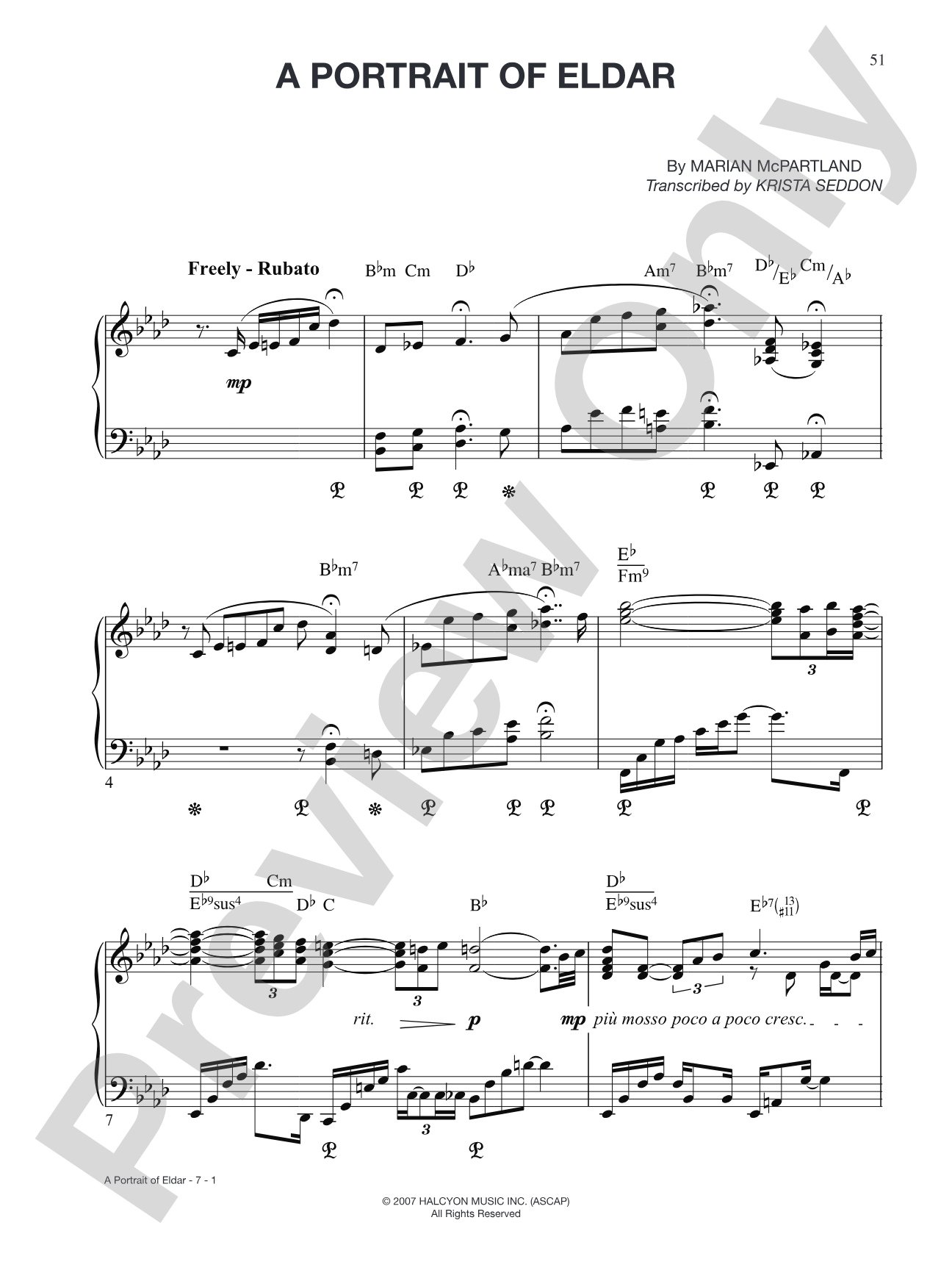
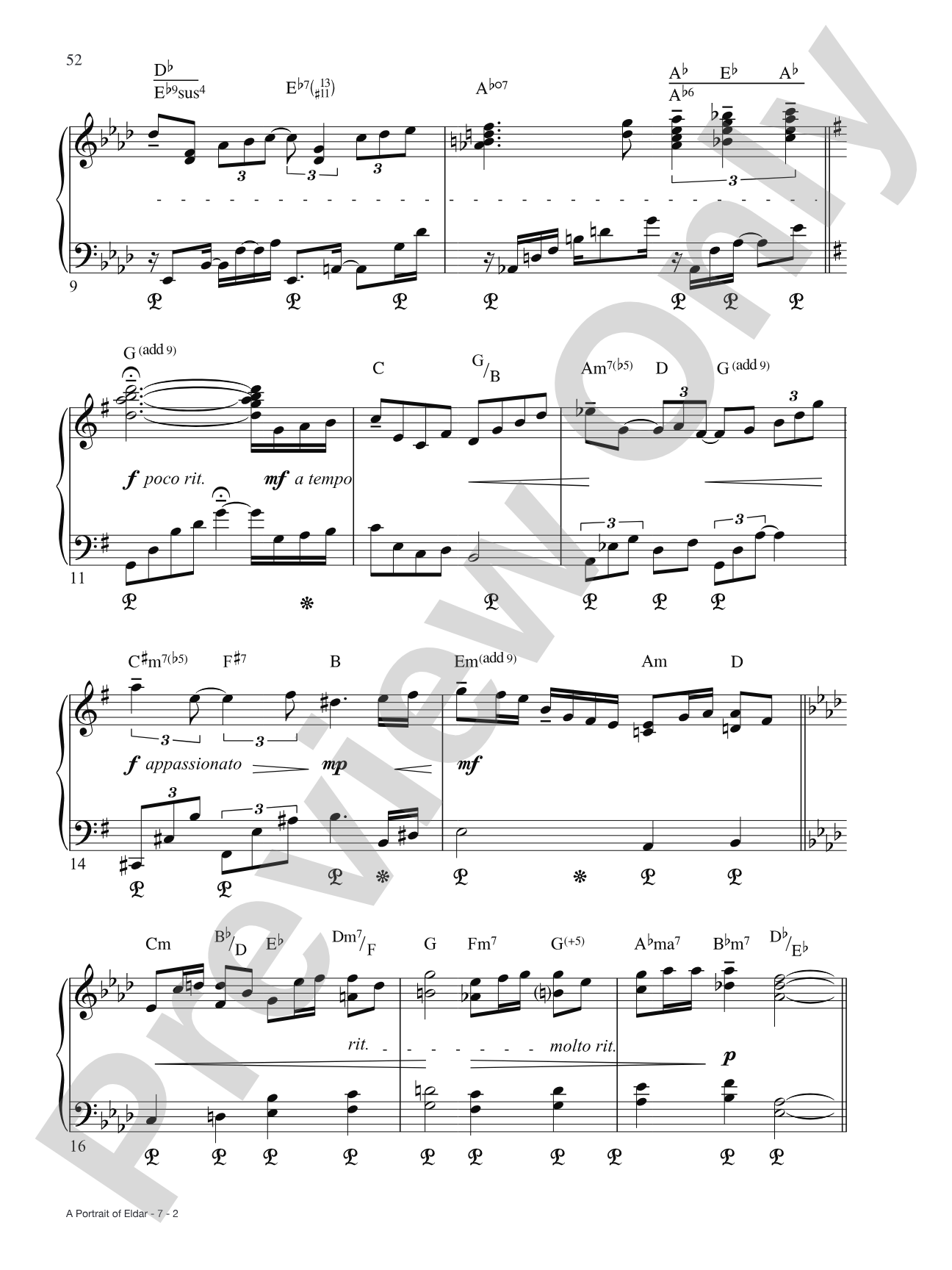

A Portrait of Eldar: Piano
Marian McPartland
Level: Advanced
Item: 00-PS-0013081
$5.99
Pickup currently not available
Related Items
A Portrait of Clint Eastwood: Piano |
$4.99
|
View | |
A Portrait of Burt Bacharach: Piano |
$5.99
|
View | |
A Song for Earma: Piano |
$5.99
|
View | |
A Portrait of Bix: Piano |
$5.99
|
View | |
A Portrait of Billy Taylor: Piano |
$4.99
|
View | |
A Portrait of Ron Carter: Piano |
$5.99
|
View | |
A Portrait of Keith Jarrett: Piano |
$5.99
|
View | |
A Portrait of Whitney Balliett: Piano |
$4.99
|
View | |
Marian McPartland Portraits: The Second Set: Piano Book |
$17.99
|
View |
Description
This book is the sequel to Marian McPartland's previously published collection of musical impressions of personalities interviewed on the National Public Radio program Marian McPartland's Piano Jazz. In this second edition, McPartland's compositions celebrate the personalities and musicality of actor Clint Eastwood, writer Whitney Balliett, composer Burt Bacharach, jazz musicians Ron Carter, Keith Jarrett, and Dr. Billy Taylor, and her own musical reflection of Bix Beiderbecke.


A Portrait of Eldar: Piano isn't in MakeMusic Cloud just yet...but it could be. Let us know you'd like to see it, and you'll help shape what comes next. In the meantime, start a free trial and dive into thousands of interactive titles your students can play along with today.
Request This Title
Tell us you want it.
Start Your Free Trial
Explore everything that's ready to play right now.
Sample Audio
No sample audio found.
Sample Video
No sample videos found.
Additional Details
Publisher:
Alfred Music
Page Count:
64
SKU:
00-PS-0013081
More about this title
About the Composer: Marian McPartland
Marian McPartland (1918-2020) was a British-American jazz pianist and broadcaster whose seven-decade career spanned performance, composition, and music advocacy. She founded and hosted Marian McPartland's Piano Jazz on NPR, a weekly program that featured intimate conversations and musical exchanges with jazz legends, classical musicians, and artists across genres. Her ability to listen deeply and respond musically made her a trusted interviewer and a composer uniquely positioned to capture the essence of her subjects through improvisation and written work.
Why we love this
McPartland's portrait compositions offer advanced pianists a rare opportunity to explore jazz writing that celebrates real people and musical personalities rather than abstract concepts. Each piece in this collection reflects her gift for translating conversation and character into piano language, making this book valuable both as performance repertoire and as a model for how to compose narratively in jazz idiom. The subjects range from fellow musicians to cultural figures, giving pianists entry into McPartland's artistic universe and her deep listening practice.
What to expect
These pieces radiate the warmth and curiosity of genuine conversation. McPartland's portraits shimmer with impressionistic harmony, unexpected key relationships, and the spaciousness of someone listening more than lecturing. Playing them feels less like executing a score and more like stepping into someone else's memory or admiration.
Who it's for
This book is for advanced jazz pianists seeking sophisticated repertoire that goes beyond standards and transcriptions. It appeals to performers interested in composed jazz, music with narrative depth, and pieces that celebrate other artists. Pianists who study McPartland's own playing and philosophy will find this collection an extension of her educational mission.
How to get the most out of it
- Study the historical and personal context of each subject before learning the piece. McPartland's compositions are musical character studies, so understanding who these figures were and what they meant to her will inform your phrasing and emotional choices.
- Pay attention to the harmonic language in each portrait. McPartland uses chord extensions and substitutions distinctively for each person; let those colors shape your touch and dynamics rather than playing through them neutrally.
- Balance composition with improvisation in the form. These pieces often suggest space for personal interpretation. Use the written music as a framework, not a ceiling, and explore how your own voice can answer McPartland's initial statements.
How to use it
Program individual portraits alongside spoken introductions about the subjects to create a thematic recital that educates audiences about jazz history and McPartland's legacy as an interviewer. These pieces also work well as recital anchors for pianists exploring composed jazz or as set-closer material that showcases both technical command and interpretive depth. Consider pairing them with standards performed by the subjects themselves, creating a dialogue between McPartland's musical response and the original artists.
Skills your students will build
- Voice leading in jazz harmony with chromatic and extended chord movement
- Translating character and narrative into musical material
- Balancing composed sections with improvisational space
- Lyrical playing within a jazz context
- Harmonic analysis of contemporary jazz composition