
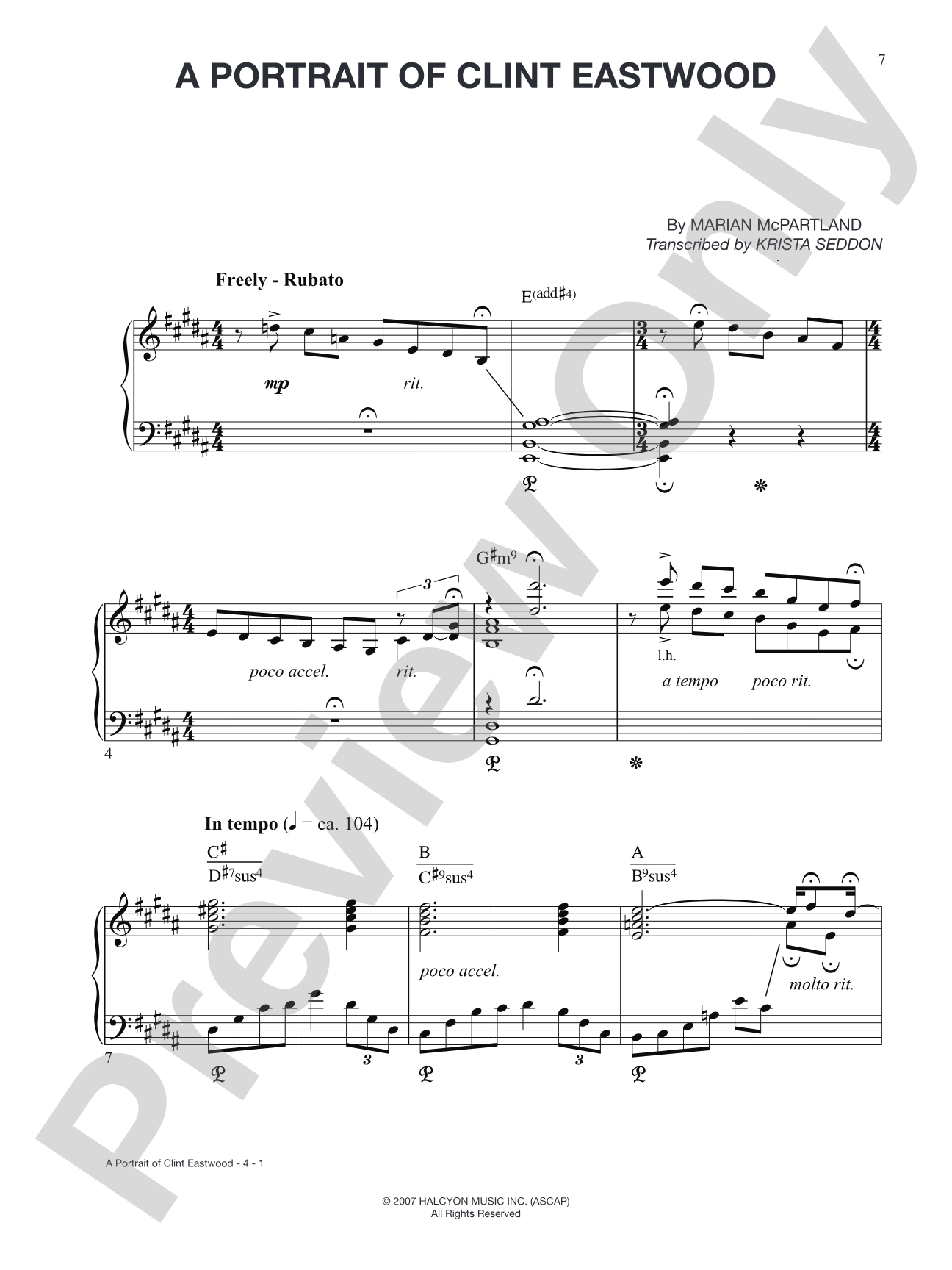

A Portrait of Clint Eastwood: Piano
Marian McPartland
Level: Advanced
Item: 00-PS-0013074
$4.99
Pickup currently not available
Related Items
A Portrait of Burt Bacharach: Piano |
$5.99
|
View | |
A Song for Earma: Piano |
$5.99
|
View | |
A Portrait of Bix: Piano |
$5.99
|
View | |
A Portrait of Billy Taylor: Piano |
$4.99
|
View | |
A Portrait of Ron Carter: Piano |
$5.99
|
View | |
A Portrait of Keith Jarrett: Piano |
$5.99
|
View | |
A Portrait of Eldar: Piano |
$5.99
|
View | |
A Portrait of Whitney Balliett: Piano |
$4.99
|
View | |
Marian McPartland Portraits: The Second Set: Piano Book |
$17.99
|
View |
Description
This book is the sequel to Marian McPartland's previously published collection of musical impressions of personalities interviewed on the National Public Radio program Marian McPartland's Piano Jazz. In this second edition, McPartland's compositions celebrate the personalities and musicality of actor Clint Eastwood, writer Whitney Balliett, composer Burt Bacharach, jazz musicians Ron Carter, Keith Jarrett, and Dr. Billy Taylor, and her own musical reflection of Bix Beiderbecke.


A Portrait of Clint Eastwood: Piano isn't in MakeMusic Cloud just yet...but it could be. Let us know you'd like to see it, and you'll help shape what comes next. In the meantime, start a free trial and dive into thousands of interactive titles your students can play along with today.
Request This Title
Tell us you want it.
Start Your Free Trial
Explore everything that's ready to play right now.
Sample Audio
No sample audio found.
Sample Video
No sample videos found.
Additional Details
Publisher:
Alfred Music
Page Count:
64
SKU:
00-PS-0013074
More about this title
About the Composer: Marian McPartland
Marian McPartland (1918-2020) was a British-American jazz pianist and composer whose career spanned seven decades. She became best known for founding and hosting Marian McPartland's Piano Jazz, an NPR program that ran for more than three decades and featured interviews and musical dialogues with hundreds of jazz musicians, composers, and other artists. Her ability to listen deeply and translate personality into music made her uniquely skilled at capturing the essence of her guests through original compositions.
Why we love this
McPartland's gift for musical portraiture comes through vividly in these pieces. Rather than generic character sketches, each composition reflects her intimate understanding of her subject's artistry and temperament, making this collection both a window into jazz history and a masterclass in how to compose with specificity and warmth.
What to expect
Each piece unfolds like a personal conversation captured in music. The writing is sophisticated without being dense, lyrical without being sentimental, and deeply informed by McPartland's decades of listening to and performing alongside the finest musicians of her era.
Who it's for
Advanced pianists with jazz fluency and interest in the repertoire beyond traditional standards. This collection suits performers comfortable with harmonic complexity, rhythmic flexibility, and the expressive demands of jazz composition.
How to get the most out of it
- Study the harmonic language carefully; McPartland's chords often layer subtle colorations that reveal character. Rushing through changes obscures the portraiture.
- Listen to recordings of the subjects when possible (Beiderbecke's early recordings, Keith Jarrett's improvisations, Eastwood's film scores). McPartland's compositional choices become clearer when you know the personalities she's capturing.
- Treat rubato as a compositional element, not an afterthought. These pieces invite flexibility in the service of expression, particularly in cadential moments.
- Balance sophistication with accessibility in your touch. Jazz pianists often think of McPartland's style as conversational; let that inform your phrasing and dynamics.
How to use it
These pieces work beautifully in recitals devoted to jazz composition or 20th-century American music. Consider pairing them with other jazz piano literature or with biographical program notes that help audiences understand McPartland's approach to musical portraiture.
Skills your students will build
- Harmonic analysis and chord voicing in advanced jazz contexts
- Interpreting compositional intent through biographical and musical context
- Flexible rhythmic execution and expressive rubato in jazz idiom
- Stylistic authenticity in jazz piano performance and touch