
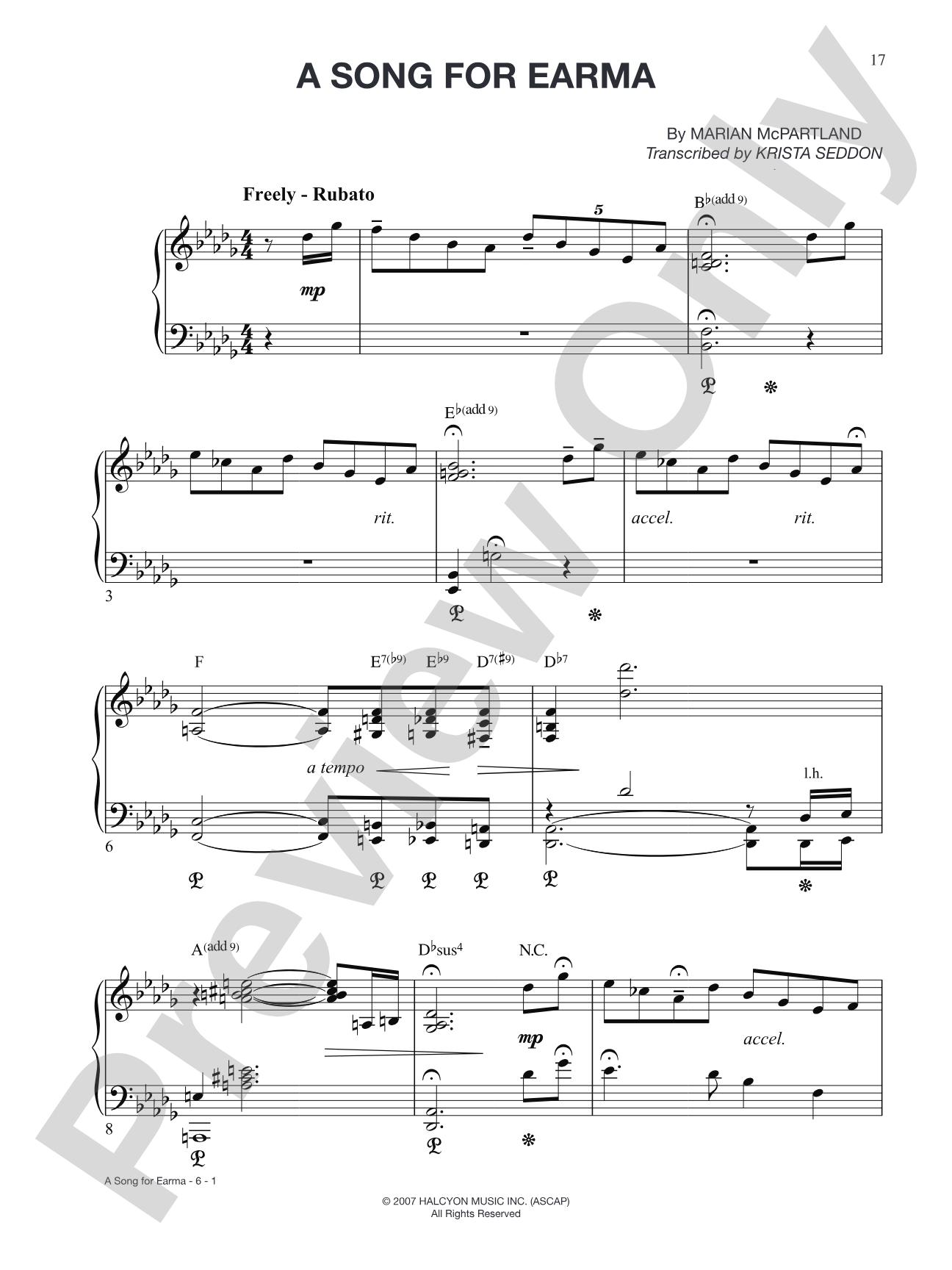
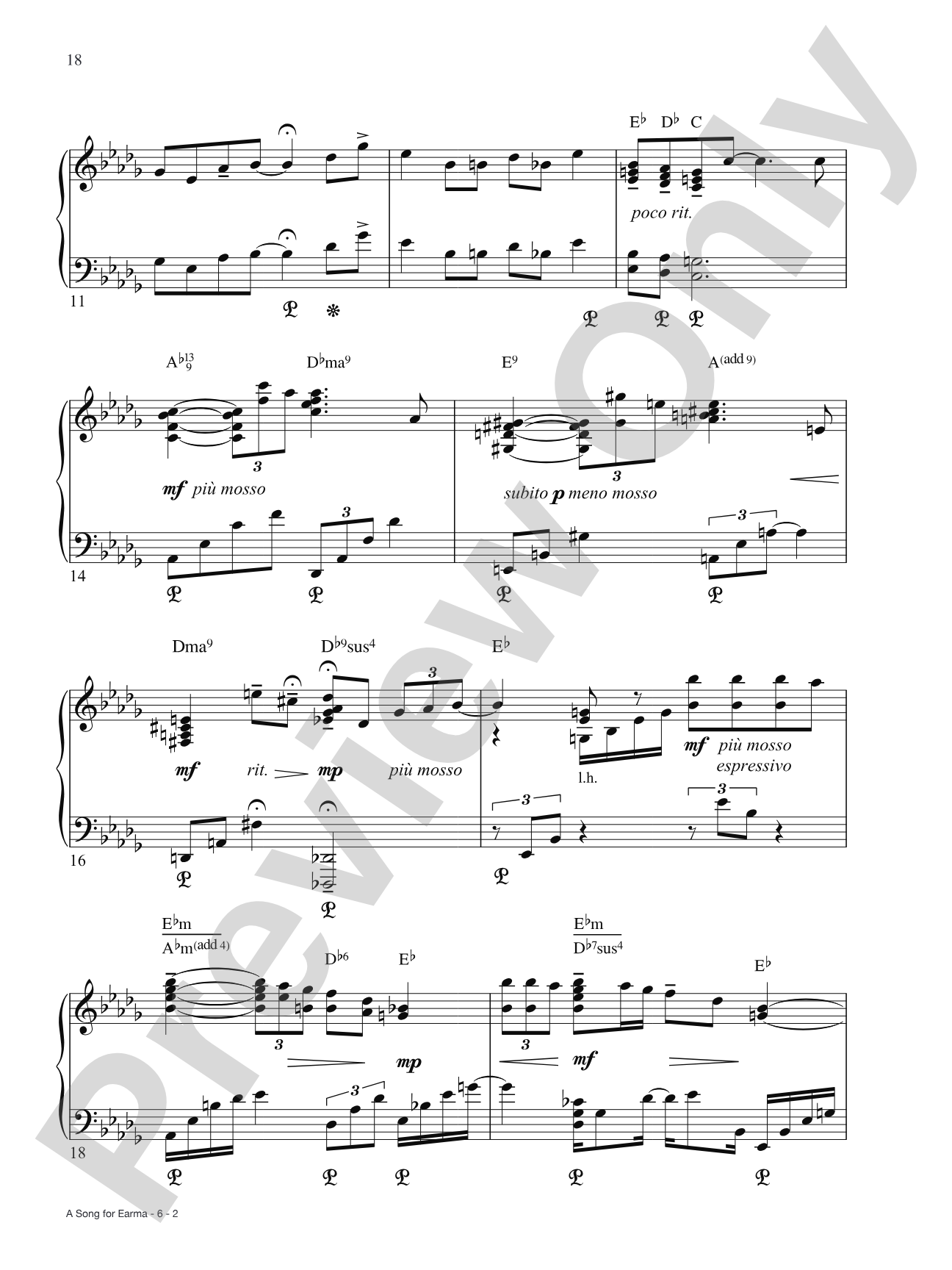

A Song for Earma: Piano
Marian McPartland
Level: Advanced
Item: 00-PS-0013076
$5.99
Pickup currently not available
Related Items
A Portrait of Clint Eastwood: Piano |
$4.99
|
View | |
A Portrait of Burt Bacharach: Piano |
$5.99
|
View | |
A Portrait of Bix: Piano |
$5.99
|
View | |
A Portrait of Billy Taylor: Piano |
$4.99
|
View | |
A Portrait of Ron Carter: Piano |
$5.99
|
View | |
A Portrait of Keith Jarrett: Piano |
$5.99
|
View | |
A Portrait of Eldar: Piano |
$5.99
|
View | |
A Portrait of Whitney Balliett: Piano |
$4.99
|
View | |
Marian McPartland Portraits: The Second Set: Piano Book |
$17.99
|
View |
Description
This book is the sequel to Marian McPartland's previously published collection of musical impressions of personalities interviewed on the National Public Radio program Marian McPartland's Piano Jazz. In this second edition, McPartland's compositions celebrate the personalities and musicality of actor Clint Eastwood, writer Whitney Balliett, composer Burt Bacharach, jazz musicians Ron Carter, Keith Jarrett, and Dr. Billy Taylor, and her own musical reflection of Bix Beiderbecke.


A Song for Earma: Piano isn't in MakeMusic Cloud just yet...but it could be. Let us know you'd like to see it, and you'll help shape what comes next. In the meantime, start a free trial and dive into thousands of interactive titles your students can play along with today.
Request This Title
Tell us you want it.
Start Your Free Trial
Explore everything that's ready to play right now.
Sample Audio
No sample audio found.
Sample Video
No sample videos found.
Additional Details
Publisher:
Alfred Music
Page Count:
64
SKU:
00-PS-0013076
More about this title
About the Composer: Marian McPartland
Marian McPartland (1918–2020) was a pioneering jazz pianist and broadcaster whose career spanned seven decades. Born in England and trained classically, she became a fundamental figure in American jazz, performing alongside legends like Dizzy Gillespie and Charlie Parker while maintaining a distinctive compositional voice rooted in lyrical melody and harmonic sophistication.
Why we love this
These portraits showcase McPartland's gift for translating personality into musical character. Each piece captures the essence of its subject through her sophisticated harmonic language and melodic intuition, giving advanced pianists a rare opportunity to explore jazz composition that honors both the subject and the listener with genuine musical substance.
What to expect
Each piece breathes with the presence of its subject. McPartland's melodies unfold with naturalistic grace, her harmonies suggesting both classical training and jazz sensibility in conversation. The collection feels like eavesdropping on intimate musical conversations rather than formal concert statements.
Who it's for
Advanced pianists with solid jazz vocabulary and interest in composition, as well as jazz educators seeking repertoire that demonstrates how personality, musicianship, and technique converge in meaningful writing. Performers exploring jazz piano beyond the standard canon will find these portraits rewarding both technically and musically.
How to get the most out of it
- Listen to recordings of McPartland's interpretations to absorb her touch, phrasing conventions, and the particular jazz vocabulary she employs in each piece.
- Study the harmonic progressions carefully; McPartland's chords often move with classical grace while maintaining jazz fluidity, requiring clarity in voice leading rather than aggressive comping.
- Allow space for the improvisation possibilities within each piece; these are portraits, not rigid blueprints, so responsive, conversational playing creates the intimacy McPartland intended.
- Balance technical precision with expressive warmth. These pieces demand clean execution while resisting any sense of mechanical accuracy.
How to use it
Feature individual portraits in recitals exploring women composers in jazz, or program the full collection as a suite to demonstrate how piano jazz can function as personal reflection and musical characterization. These pieces work equally well in academic settings as examples of small-form jazz composition.
Skills your students will build
- Voice leading through jazz harmonies with chromatic sophistication
- Balancing compositional intention with improvisational freedom
- Interpreting rubato and phrasing in the jazz lyrical tradition
- Understanding how melodic and harmonic color can convey personality in music
- Performance maturity in pieces that reward both technical command and emotional restraint