
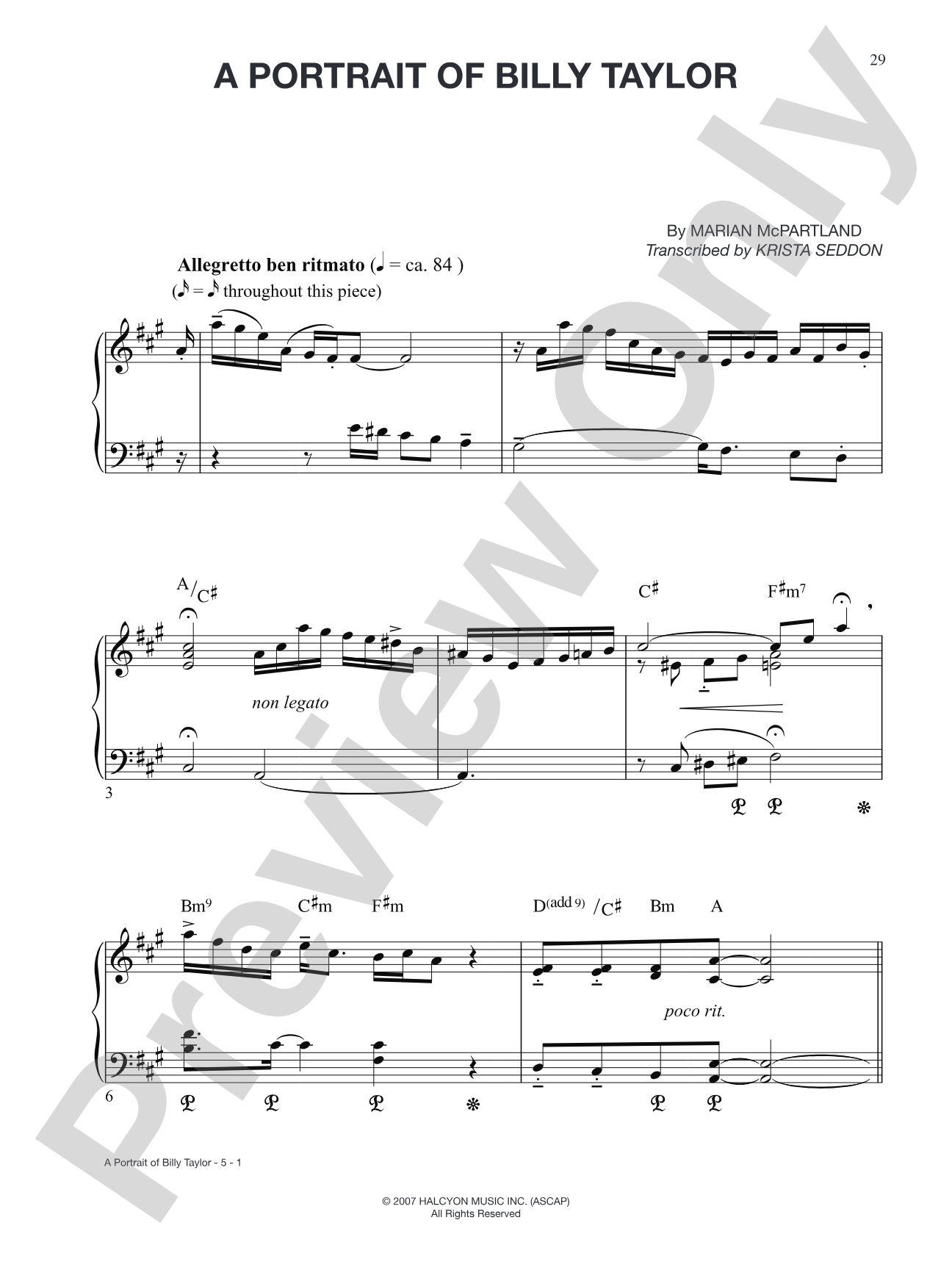

A Portrait of Billy Taylor: Piano
Marian McPartland
Level: Advanced
Item: 00-PS-0013078
$4.99
Pickup currently not available
Related Items
A Portrait of Clint Eastwood: Piano |
$4.99
|
View | |
A Portrait of Burt Bacharach: Piano |
$5.99
|
View | |
A Song for Earma: Piano |
$5.99
|
View | |
A Portrait of Bix: Piano |
$5.99
|
View | |
A Portrait of Ron Carter: Piano |
$5.99
|
View | |
A Portrait of Keith Jarrett: Piano |
$5.99
|
View | |
A Portrait of Eldar: Piano |
$5.99
|
View | |
A Portrait of Whitney Balliett: Piano |
$4.99
|
View | |
Marian McPartland Portraits: The Second Set: Piano Book |
$17.99
|
View |
Description
This book is the sequel to Marian McPartland's previously published collection of musical impressions of personalities interviewed on the National Public Radio program Marian McPartland's Piano Jazz. In this second edition, McPartland's compositions celebrate the personalities and musicality of actor Clint Eastwood, writer Whitney Balliett, composer Burt Bacharach, jazz musicians Ron Carter, Keith Jarrett, and Dr. Billy Taylor, and her own musical reflection of Bix Beiderbecke.


Discover MakeMusic Cloud: thousands of interactive titles your students can play along with today.
Sample Audio
No sample audio found.
Sample Video
No sample videos found.
Additional Details
Publisher:
Alfred Music
Page Count:
64
SKU:
00-PS-0013078
More about this title
About the Composer: Marian McPartland
Marian McPartland (1918-2020) was a British-American jazz pianist and broadcaster who became one of the most influential voices in jazz education and advocacy. For over sixty years, she hosted Marian McPartland's Piano Jazz on National Public Radio, conducting intimate interviews and musical dialogues with jazz legends and innovators. Her dual career as both performer and documentarian shaped how generations of musicians and listeners understood jazz as a living, evolving art form.
Why we love this
McPartland's gift for musical portraiture transforms these pieces into playable windows into the personalities and playing styles of jazz icons. Rather than abstract impressions, she crafts idiomatic piano writing that captures each subject's essence, making this collection both a rewarding performance challenge and a fascinating study in how compositional choices reflect character. For advanced pianists drawn to jazz, these pieces offer the rare opportunity to engage with originals written by someone who knew these artists intimately.
What to expect
These pieces breathe with the conversational intimacy of McPartland's radio interviews translated into sound. Each composition reveals a distinct musical personality, from angular modernism to blues-grounded warmth, creating a vivid gallery of jazz voices. The writing itself feels generous and pianistic, honoring the instrument while respecting the artistic legacies it's meant to celebrate.
Who it's for
Advanced pianists with solid jazz experience who want to deepen their understanding of jazz composition and performance style. This collection suits musicians preparing recital programs featuring contemporary jazz, as well as music educators teaching advanced students about jazz language and how to read and interpret the jazz piano tradition.
How to get the most out of it
- Listen to recordings of the subjects featured in these portraits (particularly Billy Taylor, Keith Jarrett, and Ron Carter) to understand the musicianship and sound world McPartland is capturing in each piece.
- Pay attention to McPartland's use of harmony and voicing; her jazz vocabulary assumes familiarity with chromatic alterations, extended chords, and reharmonization techniques common to the jazz tradition.
- Balance the written material with space for personal interpretation. McPartland's notation suggests phrasing and touch, but jazz performance requires flexibility in rubato and dynamic shaping.
How to use it
Feature individual portraits in a jazz-focused recital or concert to introduce audiences to both the subjects and McPartland's compositional voice. Alternatively, program the entire collection as a thematic evening that doubles as a lesson in how musicians have influenced one another across generations. These pieces also work well in advanced piano studios as repertoire for students exploring jazz composition and arrangement.
Skills your students will build
- Reading and performing jazz harmony including extended and altered chords
- Interpreting swing rhythms, syncopation, and rubato in a notated context
- Understanding jazz piano voicing conventions and comping techniques
- Translating musical personality into interpretive choices at the keyboard
- Sight-reading jazz idioms and contemporary notational practices