
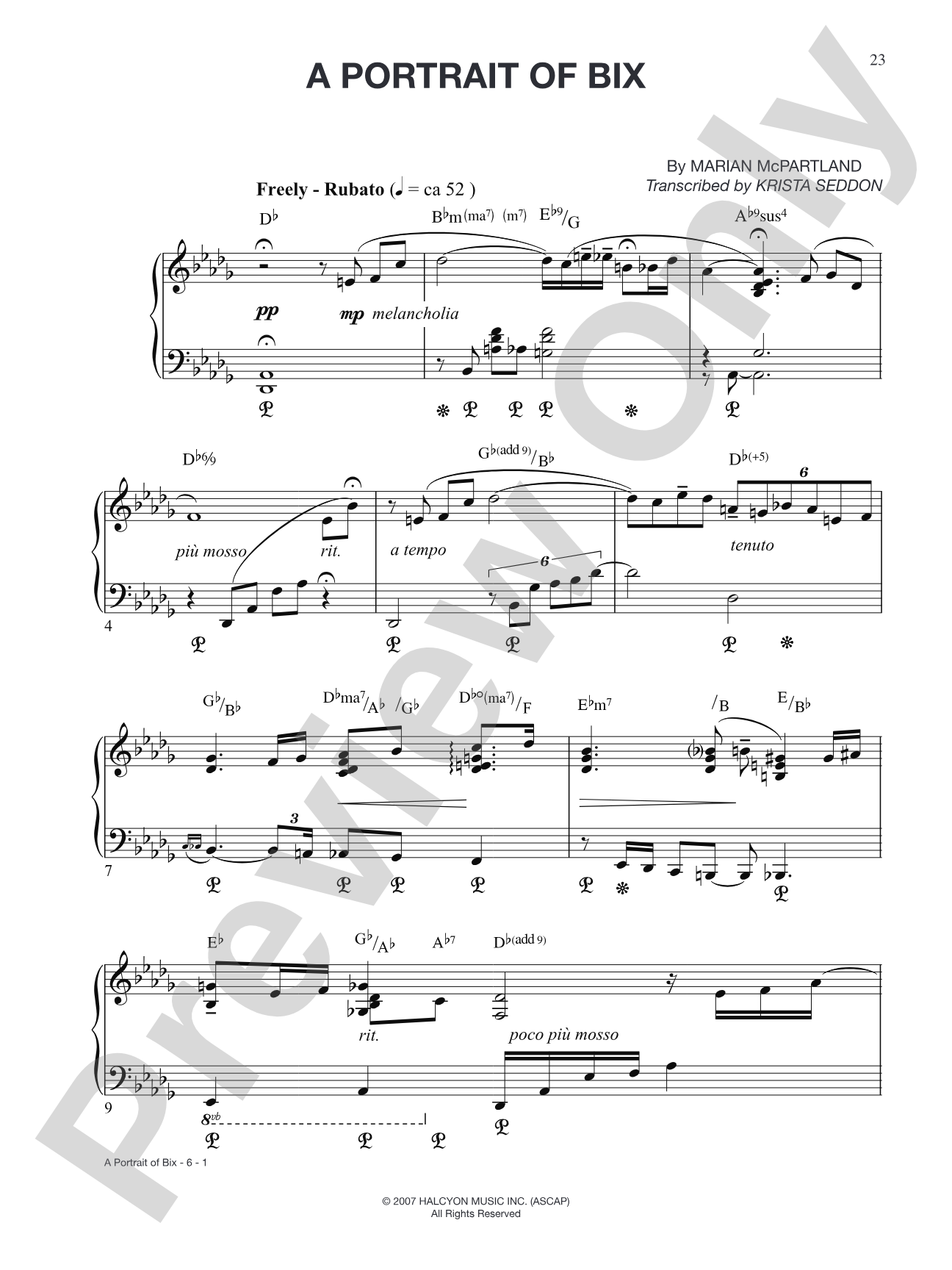
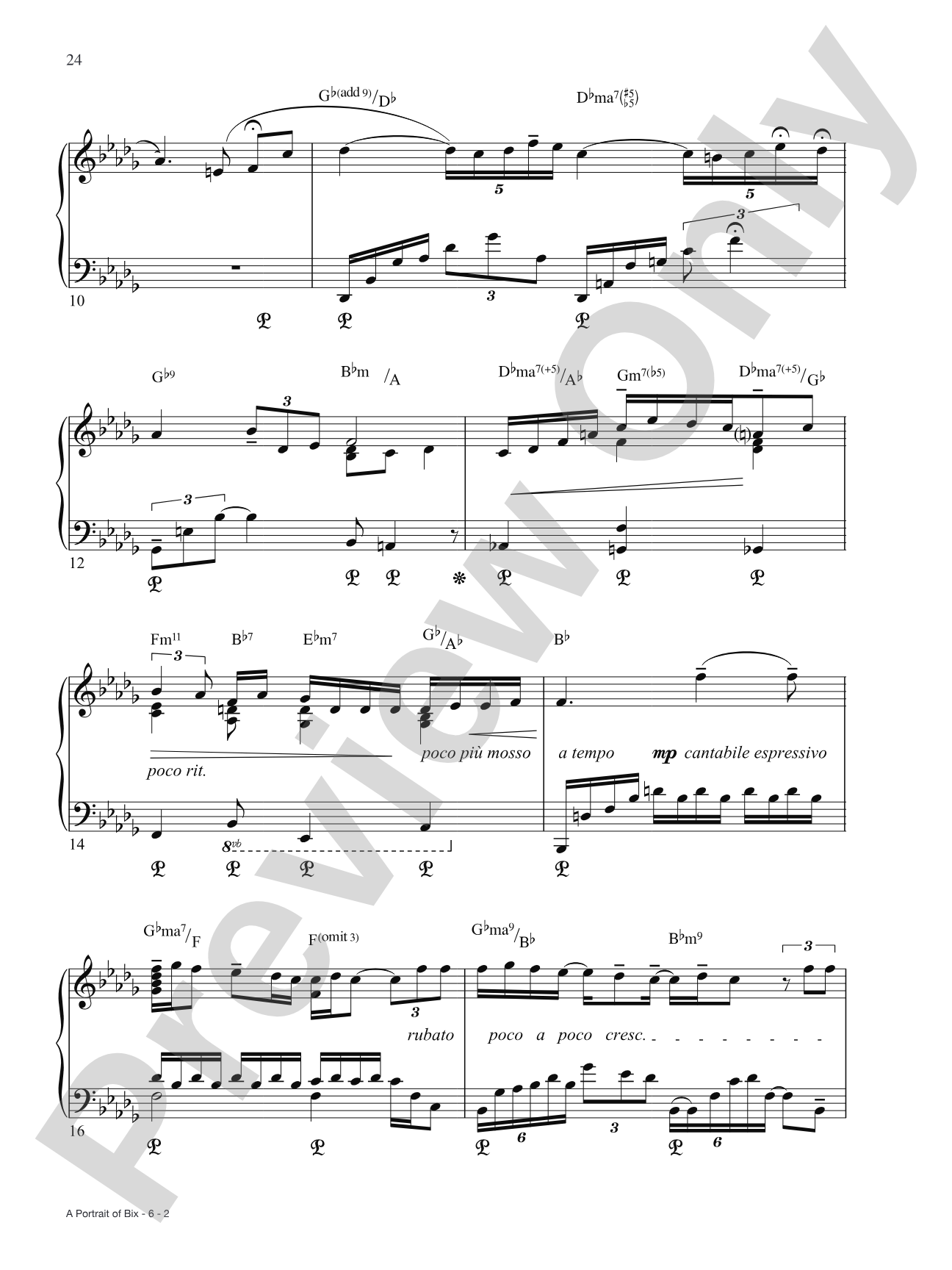

A Portrait of Bix: Piano
Marian McPartland
Level: Advanced
Item: 00-PS-0013077
$5.99
Pickup currently not available
Related Items
A Portrait of Clint Eastwood: Piano |
$4.99
|
View | |
A Portrait of Burt Bacharach: Piano |
$5.99
|
View | |
A Song for Earma: Piano |
$5.99
|
View | |
A Portrait of Billy Taylor: Piano |
$4.99
|
View | |
A Portrait of Ron Carter: Piano |
$5.99
|
View | |
A Portrait of Keith Jarrett: Piano |
$5.99
|
View | |
A Portrait of Eldar: Piano |
$5.99
|
View | |
A Portrait of Whitney Balliett: Piano |
$4.99
|
View | |
Marian McPartland Portraits: The Second Set: Piano Book |
$17.99
|
View |
Description
This book is the sequel to Marian McPartland's previously published collection of musical impressions of personalities interviewed on the National Public Radio program Marian McPartland's Piano Jazz. In this second edition, McPartland's compositions celebrate the personalities and musicality of actor Clint Eastwood, writer Whitney Balliett, composer Burt Bacharach, jazz musicians Ron Carter, Keith Jarrett, and Dr. Billy Taylor, and her own musical reflection of Bix Beiderbecke.


Discover MakeMusic Cloud: thousands of interactive titles your students can play along with today.
Sample Audio
No sample audio found.
Sample Video
No sample videos found.
Additional Details
Publisher:
Alfred Music
Page Count:
64
SKU:
00-PS-0013077
More about this title
About the Composer: Marian McPartland
Marian McPartland (1918-2016) was a British-American jazz pianist and broadcaster whose career spanned seven decades. She co-founded the Hickory House jazz club in New York, performed with leading jazz ensembles, and became the longest-running host of a music program on National Public Radio with Marian McPartland's Piano Jazz, a show that documented conversations and performances with hundreds of jazz musicians, composers, and cultural figures from 1978 until her retirement in 2011.
Beyond her performance career, McPartland was a prolific composer who translated her deep understanding of jazz harmony and improvisation into concert works. Her compositions for piano reflect her gift for capturing the essence of musicians and personalities she encountered, blending jazz sensibilities with classical forms. She received Grammy Awards, a National Medal of Arts, and numerous honorary doctorates in recognition of her contributions to jazz education and preservation.
Why we love this
McPartland's gift for musical portraiture makes this collection feel less like a technical exercise and more like sitting across from the pianist as she shares stories through sound. Each piece balances sophisticated harmonic language with genuine melodic warmth, giving advanced pianists the chance to inhabit distinct musical personalities rather than simply navigate technical demands. These compositions honor the subjects while remaining deeply personal statements about what McPartland heard and felt in her interviews.
What to expect
These pieces shimmer with the intimacy of a private conversation translated to the keyboard. The harmonies have the depth and sophistication of contemporary jazz while the writing feels personal and reflective, as if McPartland is inviting you into the room where the original interviews took place. Whether capturing Beiderbecke's lyrical sensibility or Bacharach's harmonic elegance, the collection radiates respect and affection for its subjects.
Who it's for
Advanced pianists drawn to jazz composition and interested in the intersection of classical form and jazz language will find authentic material here. Teachers seeking concert repertoire that speaks to the history and personalities of American jazz culture can program these pieces to give students insight into how composers honor musicians they admire.
How to get the most out of it
- Listen to recorded performances by each subject when possible (Bix Beiderbecke's recordings, Keith Jarrett's improvisations, Billy Taylor's playing) to understand the sonic world McPartland was depicting.
- Treat the compositions as character studies rather than strict classical forms; let the harmonic language and phrasing guide your interpretation rather than imposing rigid tempo or structure.
- Pay close attention to McPartland's use of jazz harmony and voice leading; these pieces require the same fluid approach to chord substitutions and extensions that you'd use in improvisation.
- Balance the lyrical, conversational passages with moments of rhythmic swing; McPartland's writing often captures both the introspective and the energetic sides of her subjects.
How to use it
Program individual portraits alongside standard jazz or contemporary classical repertoire to show how composers honor their influences and friendships through music. These pieces work beautifully as a complete recital set or as standalone encores that invite the audience into the story of American jazz and the musicians who shaped it. Consider pairing them with recordings or biographical information about the subjects to deepen the programming's educational impact.
Skills your students will build
- Voicing jazz chords and harmonic substitutions at the piano
- Reading and interpreting implied swing rhythms in classical notation
- Navigating complex harmonic progressions with fluidity and musicality
- Translating biographical or emotional content into coherent musical interpretation
- Balancing technical precision with the conversational, improvisational quality of jazz phrasing