
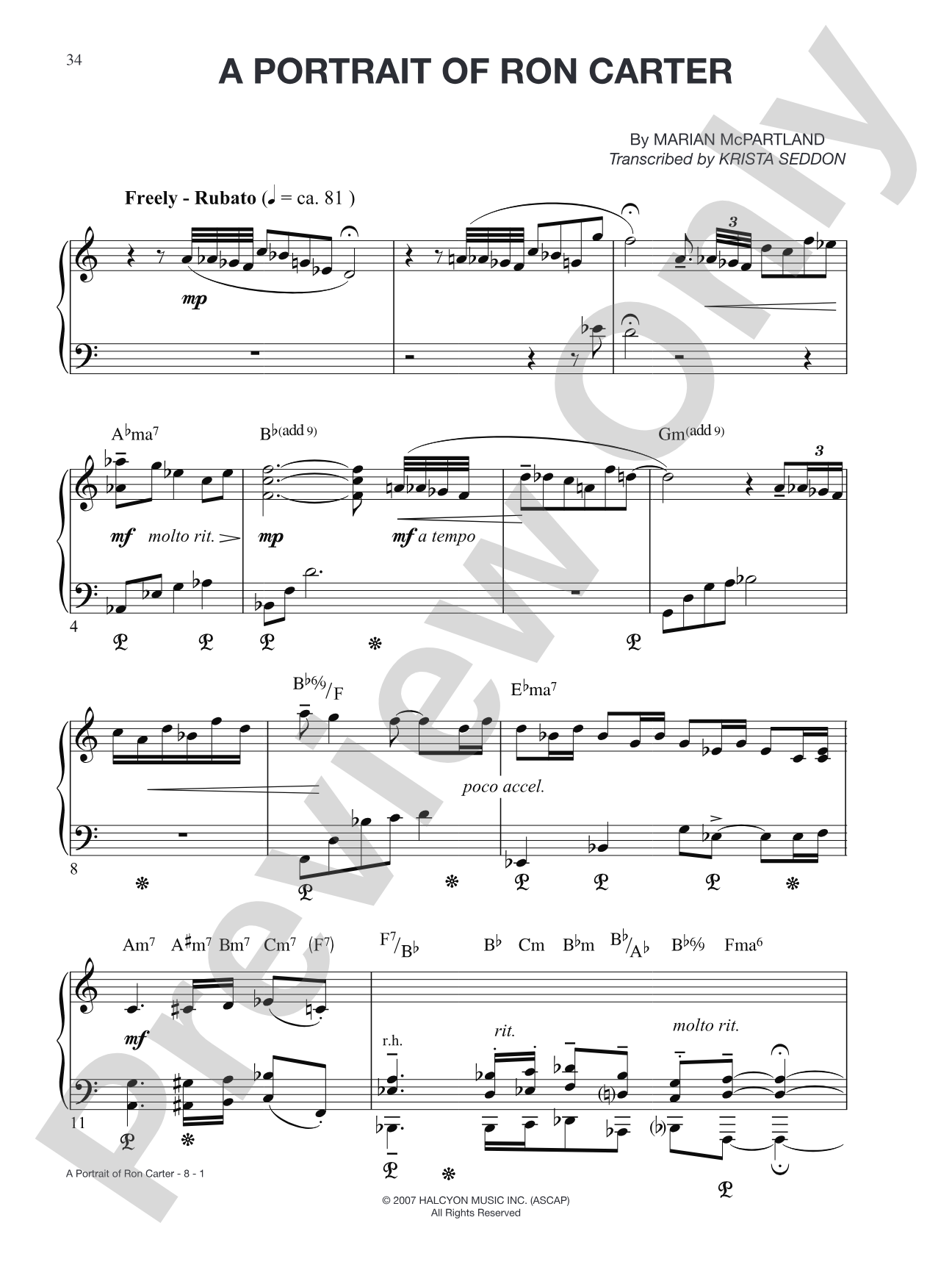
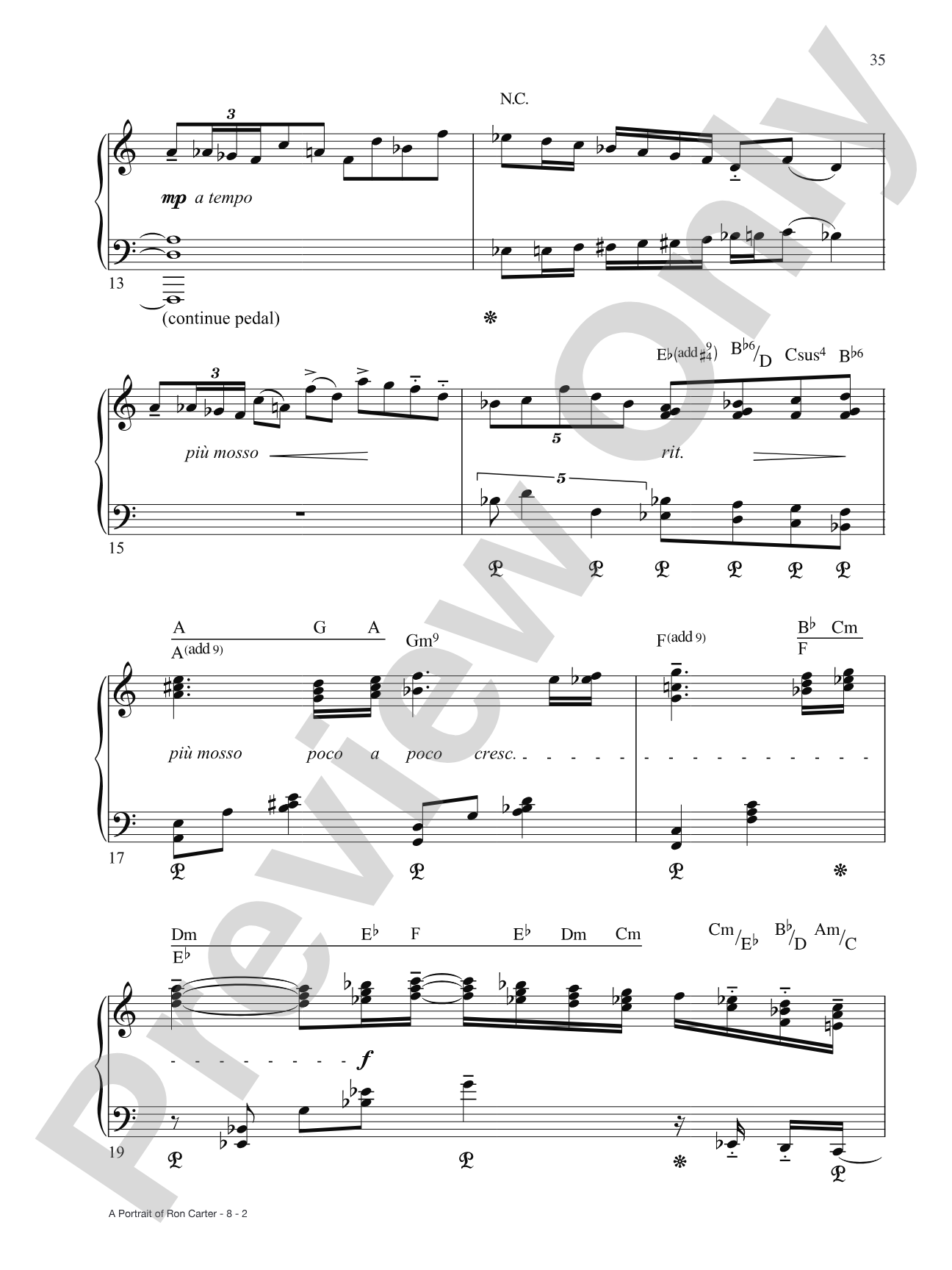

A Portrait of Ron Carter: Piano
Marian McPartland
Level: Advanced
Item: 00-PS-0013079
$5.99
Pickup currently not available
Related Items
A Portrait of Clint Eastwood: Piano |
$4.99
|
View | |
A Portrait of Burt Bacharach: Piano |
$5.99
|
View | |
A Song for Earma: Piano |
$5.99
|
View | |
A Portrait of Bix: Piano |
$5.99
|
View | |
A Portrait of Billy Taylor: Piano |
$4.99
|
View | |
A Portrait of Keith Jarrett: Piano |
$5.99
|
View | |
A Portrait of Eldar: Piano |
$5.99
|
View | |
A Portrait of Whitney Balliett: Piano |
$4.99
|
View | |
Marian McPartland Portraits: The Second Set: Piano Book |
$17.99
|
View |
Description
This book is the sequel to Marian McPartland's previously published collection of musical impressions of personalities interviewed on the National Public Radio program Marian McPartland's Piano Jazz. In this second edition, McPartland's compositions celebrate the personalities and musicality of actor Clint Eastwood, writer Whitney Balliett, composer Burt Bacharach, jazz musicians Ron Carter, Keith Jarrett, and Dr. Billy Taylor, and her own musical reflection of Bix Beiderbecke.


Discover MakeMusic Cloud: thousands of interactive titles your students can play along with today.
Sample Audio
No sample audio found.
Sample Video
No sample videos found.
Additional Details
Publisher:
Alfred Music
Page Count:
64
SKU:
00-PS-0013079
More about this title
About the Composer: Marian McPartland
Marian McPartland was a pianist, composer, and broadcaster whose career spanned seven decades. Born in England in 1918, she immigrated to the United States and became a central figure in jazz, known for her lyrical approach to the piano and her ability to accompany instrumentalists with sensitivity and harmonic sophistication. She founded and hosted Marian McPartland's Piano Jazz on National Public Radio, a program that aired for over thirty years and featured conversations and musical exchanges with jazz legends, classical composers, and cultural icons.
McPartland's dual gift for composition and performance shaped her interviewing style on Piano Jazz. Rather than simply talk with her guests, she would compose short musical portraits that captured something essential about their personalities or artistry, then perform them on the show. These compositions reveal a composer comfortable across jazz idioms, capable of writing memorable melodies, and skilled at translating human qualities into musical language.
Why we love this
McPartland's portraits work as a masterclass in jazz composition and ensemble listening disguised as solo repertoire. Each piece distills a musician's character into a concise, performable statement, making this collection invaluable for advanced pianists seeking repertoire that demands both technical command and interpretive maturity. The writing is sophisticated without being academic, proving that jazz composition can be both personally reflective and musically substantial.
What to expect
McPartland's musical impressions are intimate and observant, like overhearing a thoughtful conversation about someone you admire. The pieces balance melodic grace with harmonic sophistication, moving between moments of lyrical reflection and rhythmic energy without ever losing their conversational tone. Playing them feels like honoring both the subjects and the composer's affection for their artistry.
Who it's for
Advanced pianists with jazz fluency and an interest in composition. This collection appeals to performers who want repertoire that explores jazz language beyond the standard songbook, as well as jazz educators seeking examples of how composition can function as portraiture and cultural commentary. Musicians comfortable with chord changes, varied harmonic movement, and interpretive freedom will find these pieces rewarding.
How to get the most out of it
- Study recordings of your subject whenever possible. McPartland often drew inspiration from a musician's tone quality, phrasing, and harmonic preferences. Listening to Ron Carter's bass lines or Keith Jarrett's improvisations will deepen your understanding of what McPartland heard and wanted to capture.
- Treat these pieces as portraits, not abstractions. Each composition has a narrative quality beneath the changes. Look for moments where the harmony or melody shifts unexpectedly, as these often signal McPartland's observations about a musician's personality or artistic turning points.
- Balance precision with lyricism in the melodic line. McPartland's melodies are memorable, but they're not vocal in character. Shape them with the independence and fluidity you'd hear from an instrumentalist, not a singer.
- Let the harmony breathe. McPartland's voicings are elegant and often sparse in moments of reflection. Resist the urge to fill space with extra comping or rhythmic busywork during softer passages.
How to use it
Program a single portrait as an opener or interlude in a jazz recital, or sequence several together as a thematic set exploring different facets of jazz culture. A pianist studying improvisation or composition will benefit from learning all seven pieces as a unit, examining how McPartland solves different compositional problems across contrasting subjects. These works also pair well with other advanced jazz repertoire in studio recitals or concert settings focused on jazz as an art form.
Skills your students will build
- Interpreting jazz harmony beyond traditional chord symbol reading
- Balancing composed melody with improvisational phrasing in solo context
- Understanding how compositional choices can reflect and honor a musician's artistry
- Voicing and comping sophistication in ballad-like and uptempo sections
- Developing a personal interpretive approach to jazz standards and original compositions