
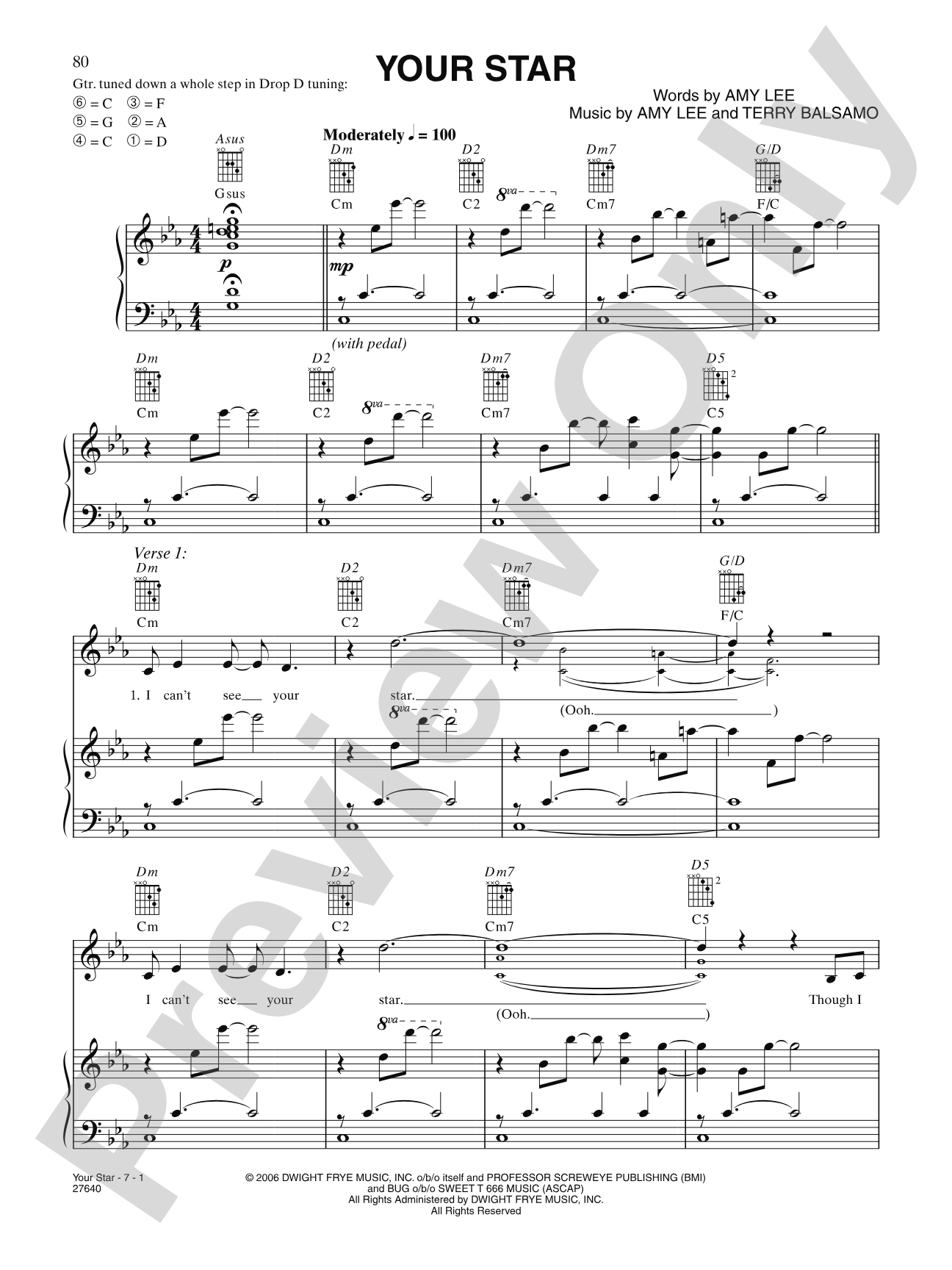
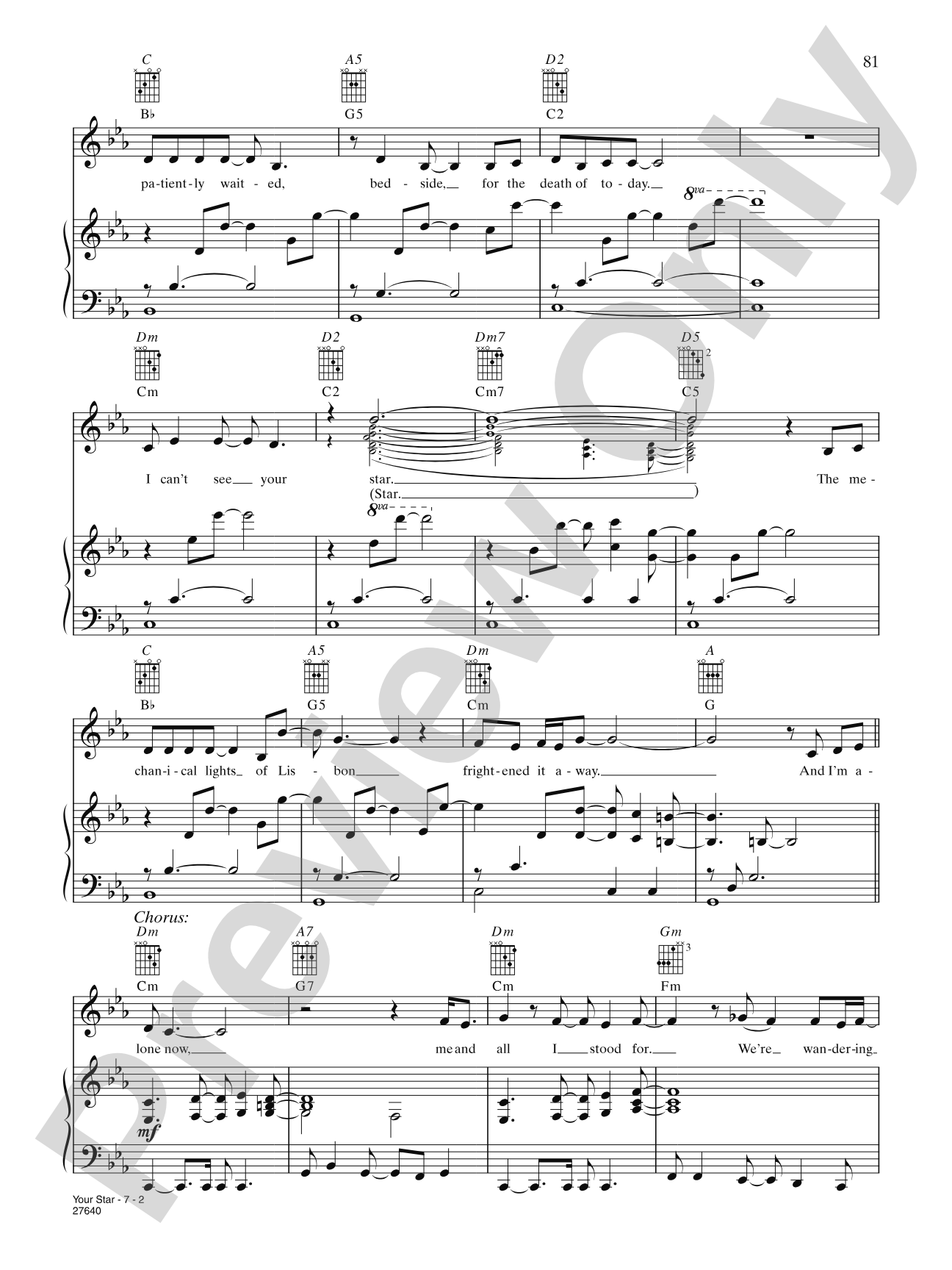

Your Star: Piano/Vocal/Chords
Evanescence
Item: 00-PSP-000194
$5.99
Pickup currently not available
Related Items
All That I'm Living For: Authentic Guitar TAB |
$4.99
|
View | |
Call Me When You're Sober: Authentic Guitar TAB |
$4.99
|
View | |
Cloud Nine: Authentic Guitar TAB |
$5.99
|
View | |
Good Enough: Authentic Guitar TAB |
$4.99
|
View | |
Lacrymosa: Authentic Guitar TAB |
$5.99
|
View | |
Like You: Authentic Guitar TAB |
$5.99
|
View | |
Lithium: Authentic Guitar TAB |
$4.99
|
View | |
Lose Control: Authentic Guitar TAB |
$4.99
|
View | |
Snow White Queen: Authentic Guitar TAB |
$5.99
|
View | |
Sweet Sacrifice: Authentic Guitar TAB |
$4.99
|
View | |
The Only One: Authentic Guitar TAB |
$4.99
|
View | |
Weight Of The World: Authentic Guitar TAB |
$5.99
|
View | |
Your Star: Authentic Guitar TAB |
$5.99
|
View | |
All That I'm Living For: Piano/Vocal/Chords |
$5.99
|
View | |
Call Me When You're Sober: Piano/Vocal/Chords |
$5.99
|
View | |
Cloud Nine: Piano/Vocal/Chords |
$5.99
|
View | |
Good Enough: Piano/Vocal/Chords |
$5.99
|
View | |
Lacrymosa: Piano/Vocal/Chords |
$5.99
|
View | |
Like You: Piano/Vocal/Chords |
$5.99
|
View | |
Lithium: Piano/Vocal/Chords |
$5.99
|
View | |
Lose Control: Piano/Vocal/Chords |
$4.99
|
View | |
Snow White Queen: Piano/Vocal/Chords |
$5.99
|
View | |
Sweet Sacrifice: Piano/Vocal/Chords |
$5.99
|
View | |
The Only One: Piano/Vocal/Chords |
$5.99
|
View | |
Weight Of The World: Piano/Vocal/Chords |
$5.99
|
View | |
Call Me When You're Sober: Piano/Vocal/Chords |
$5.99
|
View |
Description
Alfred is pleased to release the album-matching folio for Evanescence's third record, The Open Door. Released in 2006, The Open Door reached the No. 1 spot on Billboard's Top 200 Chart (2006). This book provides the lyrics along with piano and chord arrangements for all the songs on the record.
Titles: Sweet Sacrifice * Call Me When You're Sober * Weight Of The World * Lithium * Cloud Nine * Snow White Queen * Lacrymosa * Like You * Lose Control * The Only One * Your Star * All That I'm Living For * Good Enough.


Titles: Sweet Sacrifice * Call Me When You're Sober * Weight Of The World * Lithium * Cloud Nine * Snow White Queen * Lacrymosa * Like You * Lose Control * The Only One * Your Star * All That I'm Living For * Good Enough.
Your Star: Piano/Vocal/Chords isn't in MakeMusic Cloud just yet...but it could be. Let us know you'd like to see it, and you'll help shape what comes next. In the meantime, start a free trial and dive into thousands of interactive titles your students can play along with today.
Request This Title
Tell us you want it.
Start Your Free Trial
Explore everything that's ready to play right now.
Sample Audio
No sample audio found.
Sample Video
No sample videos found.
Additional Details
Publisher:
Alfred Music
Page Count:
104
SKU:
00-PSP-000194
More about this title
About the Artist: Evanescence
Evanescence emerged in the early 2000s as one of rock music's most distinctive voices, blending gothic atmospherics with heavy instrumentation and Amy Lee's operatic vocal range. The band's third album, The Open Door (2006), solidified their place in alternative rock history, reaching number one on the Billboard 200 and showcasing a more expansive sonic palette than their debut. Their music draws from classical training, metal influences, and emotional depth, making their work rich territory for musicians seeking to bridge popular and art music.
For music students and performers, Evanescence's catalog offers genuine compositional sophistication. The arrangements on The Open Door demand both technical proficiency and interpretive maturity, with chord progressions that reward close harmonic analysis and vocal lines that challenge singers across multiple registers.
Why we love this
This folio captures one of rock's most harmonically ambitious records, giving singers and pianists access to arrangements that refuse to simplify emotional complexity. Every song rewards detailed study of voicing and harmonic movement, making this book valuable for students developing taste in contemporary popular music.
What to expect
Atmospheric and introspective, with sudden dynamic shifts that move from whisper to power. The arrangements honor the record's layered production while remaining playable on piano and voice alone, creating space for intimate interpretation.
Who it's for
Singers with solid range who want to tackle contemporary material with real harmonic and emotional depth, and pianists ready to play beyond pop lead sheets. This book works for intermediate to advanced vocalists and pianists in studio lessons, recitals, or informal performance settings.
How to get the most out of it
- Balance the piano part against the vocal line by mapping dynamic curves for each song before rehearsal; Amy Lee's vocal phrasing often sits in the upper register, and a light accompaniment touch prevents covering the melody.
- Pay attention to the chord symbols for variations in inversions and extensions; many of these progressions gain their character from specific voicings rather than root position triads.
- Use the tempo and mood markings embedded in the lyrics to shape phrasing; Evanescence's songs build through restraint and release rather than constant intensity.
- When learning unfamiliar chords or progressions, isolate 4-8 bar passages and play them multiple times at slow tempo to internalize the harmonic color before adding vocal or dynamic layers.
How to use it
Ideal for a student recital focused on contemporary songwriting or a thematic program exploring emotional storytelling in rock. You might pair individual songs with classical art songs to highlight how popular music engages sophisticated harmonic language, or use them as rewards for students meeting technical milestones in other repertoire.
Skills your students will build
- Reading and interpreting chord symbols beyond basic triads (sevenths, suspensions, extensions)
- Performing across an extended vocal range with control in both intimate and powerful passages
- Shaping phrases through dynamic and harmonic analysis rather than imitation
- Accompanying singers as a collaborative pianist, balancing supportive texture with clear harmonic definition
- Understanding contemporary approaches to vocal melody and harmonic progression