
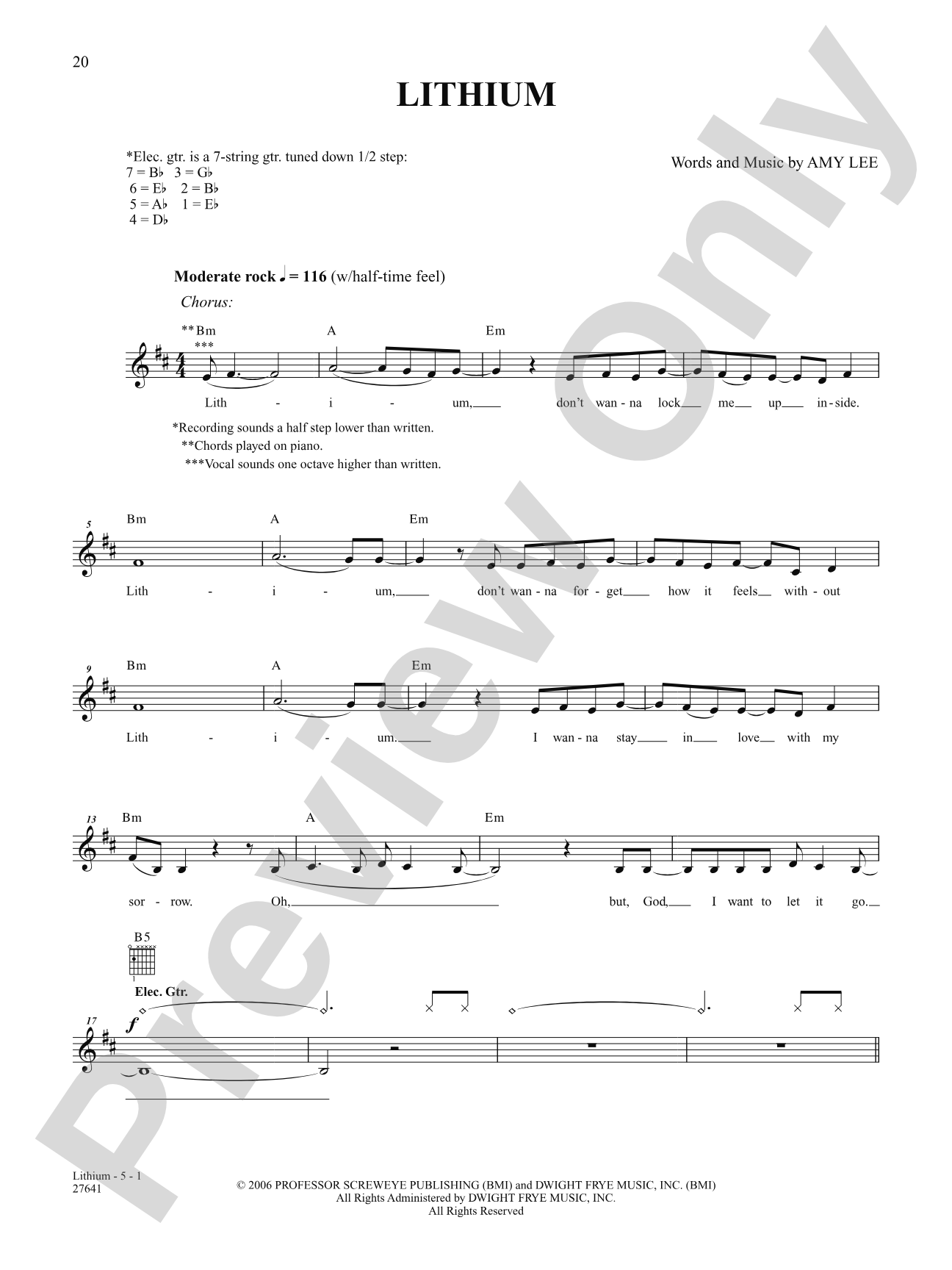

Lithium: Authentic Guitar TAB
Evanescence
Item: 00-PSG-000690
$4.99
Pickup currently not available
Related Items
All That I'm Living For: Authentic Guitar TAB |
$4.99
|
View | |
Call Me When You're Sober: Authentic Guitar TAB |
$4.99
|
View | |
Cloud Nine: Authentic Guitar TAB |
$5.99
|
View | |
Good Enough: Authentic Guitar TAB |
$4.99
|
View | |
Lacrymosa: Authentic Guitar TAB |
$5.99
|
View | |
Like You: Authentic Guitar TAB |
$5.99
|
View | |
Lose Control: Authentic Guitar TAB |
$4.99
|
View | |
Snow White Queen: Authentic Guitar TAB |
$5.99
|
View | |
Sweet Sacrifice: Authentic Guitar TAB |
$4.99
|
View | |
The Only One: Authentic Guitar TAB |
$4.99
|
View | |
Weight Of The World: Authentic Guitar TAB |
$5.99
|
View | |
Your Star: Authentic Guitar TAB |
$5.99
|
View | |
All That I'm Living For: Piano/Vocal/Chords |
$5.99
|
View | |
Call Me When You're Sober: Piano/Vocal/Chords |
$5.99
|
View | |
Cloud Nine: Piano/Vocal/Chords |
$5.99
|
View | |
Good Enough: Piano/Vocal/Chords |
$5.99
|
View | |
Lacrymosa: Piano/Vocal/Chords |
$5.99
|
View | |
Like You: Piano/Vocal/Chords |
$5.99
|
View | |
Lithium: Piano/Vocal/Chords |
$5.99
|
View | |
Lose Control: Piano/Vocal/Chords |
$4.99
|
View | |
Snow White Queen: Piano/Vocal/Chords |
$5.99
|
View | |
Sweet Sacrifice: Piano/Vocal/Chords |
$5.99
|
View | |
The Only One: Piano/Vocal/Chords |
$5.99
|
View | |
Weight Of The World: Piano/Vocal/Chords |
$5.99
|
View | |
Your Star: Piano/Vocal/Chords |
$5.99
|
View | |
Call Me When You're Sober: Piano/Vocal/Chords |
$5.99
|
View |
Description
Alfred is pleased to release the authentic guitar TAB version of the album-matching folio for Evanescence's third record, The Open Door. Released in 2006, The Open Door reached the No. 1 spot on Billboard's Top 200 Chart (2006). This book provides authentic guitar TAB for all the songs on the record.
Titles: Sweet Sacrifice * Call Me When You're Sober * Weight Of The World * Lithium * Cloud Nine * Snow White Queen * Lacrymosa * Like You * Lose Control * The Only One * Your Star * All That I'm Living For * Good Enough.


Titles: Sweet Sacrifice * Call Me When You're Sober * Weight Of The World * Lithium * Cloud Nine * Snow White Queen * Lacrymosa * Like You * Lose Control * The Only One * Your Star * All That I'm Living For * Good Enough.
Lithium: Authentic Guitar TAB isn't in MakeMusic Cloud just yet...but it could be. Let us know you'd like to see it, and you'll help shape what comes next. In the meantime, start a free trial and dive into thousands of interactive titles your students can play along with today.
Request This Title
Tell us you want it.
Start Your Free Trial
Explore everything that's ready to play right now.
Sample Audio
No sample audio found.
Sample Video
No sample videos found.
Additional Details
Publisher:
Alfred Music
Page Count:
88
SKU:
00-PSG-000690
More about this title
About the Artist: Evanescence
Evanescence emerged in the early 2000s as a defining voice in alternative rock, blending gothic atmospherics with heavy guitars and introspective songwriting. Led by Amy Lee's distinctive vocals, the band achieved massive commercial success with their 2003 debut Fallen before releasing The Open Door in 2006, an album that deepened their sonic complexity and emotional range while maintaining their signature blend of orchestral elements and rock instrumentation.
Why we love this
This folio captures the guitar work from one of the 2000s' most streamed alternative rock albums, giving students access to the exact voicings, techniques, and arrangements they hear on the record. The collection spans 13 songs with enough variety in texture and difficulty to sustain a serious guitarist's focus for months, and the album's cultural relevance means students will be genuinely motivated to learn this material.
What to expect
Moody and introspective, shifting between delicate fingerpicking and powerful distorted riffs. The guitar textures here range from atmospheric and layered to driving and aggressive, creating dynamic contrast within individual songs and across the album. You'll find yourself reaching for both clean and overdriven tones, often within the same track.
Who it's for
Intermediate to advanced guitarists who want to learn contemporary rock repertoire with real commercial and cultural resonance. This book appeals equally to students building their TAB reading skills on music they love and to performers preparing covers for recitals or ensemble contexts.
How to get the most out of it
- Spend time with the rhythm section first, particularly the palm-muted passages that define tracks like Lithium. The precision of timing here matters more than speed.
- Pay attention to Lee's vocal phrasing when learning lead lines; the guitar often mirrors or complements the melody, so listening to the album while reading TAB will clarify intent.
- Experiment with amp settings to capture the layered, atmospheric quality of songs like Cloud Nine. Clean tones with subtle effects often work better than heavy distortion for these arrangements.
- Practice transitions between rhythm and lead sections without losing the song's emotional momentum, especially in tracks where the guitar shifts from supporting vocals to taking a solo.
How to use it
Feature this in a contemporary rock concert or a themed program celebrating 2000s alternative music. The album's cohesion makes it ideal for a guitarist preparing a substantial recital set, or break it up as encores and standalone pieces throughout a season. Many songs work equally well as solo guitar arrangements or as pieces for ensemble performance.
Skills your students will build
- Reading and interpreting authentic guitar TAB from a professional recording
- Executing palm-muted rhythm patterns and transitions between muted and open sections
- Layering clean and distorted tones to create textural contrast
- Mirroring vocal phrasing with melodic guitar lines
- Combining fingerpicking and pick-based techniques within single arrangements
- Understanding how rhythm guitar and lead guitar interact in contemporary rock songwriting