
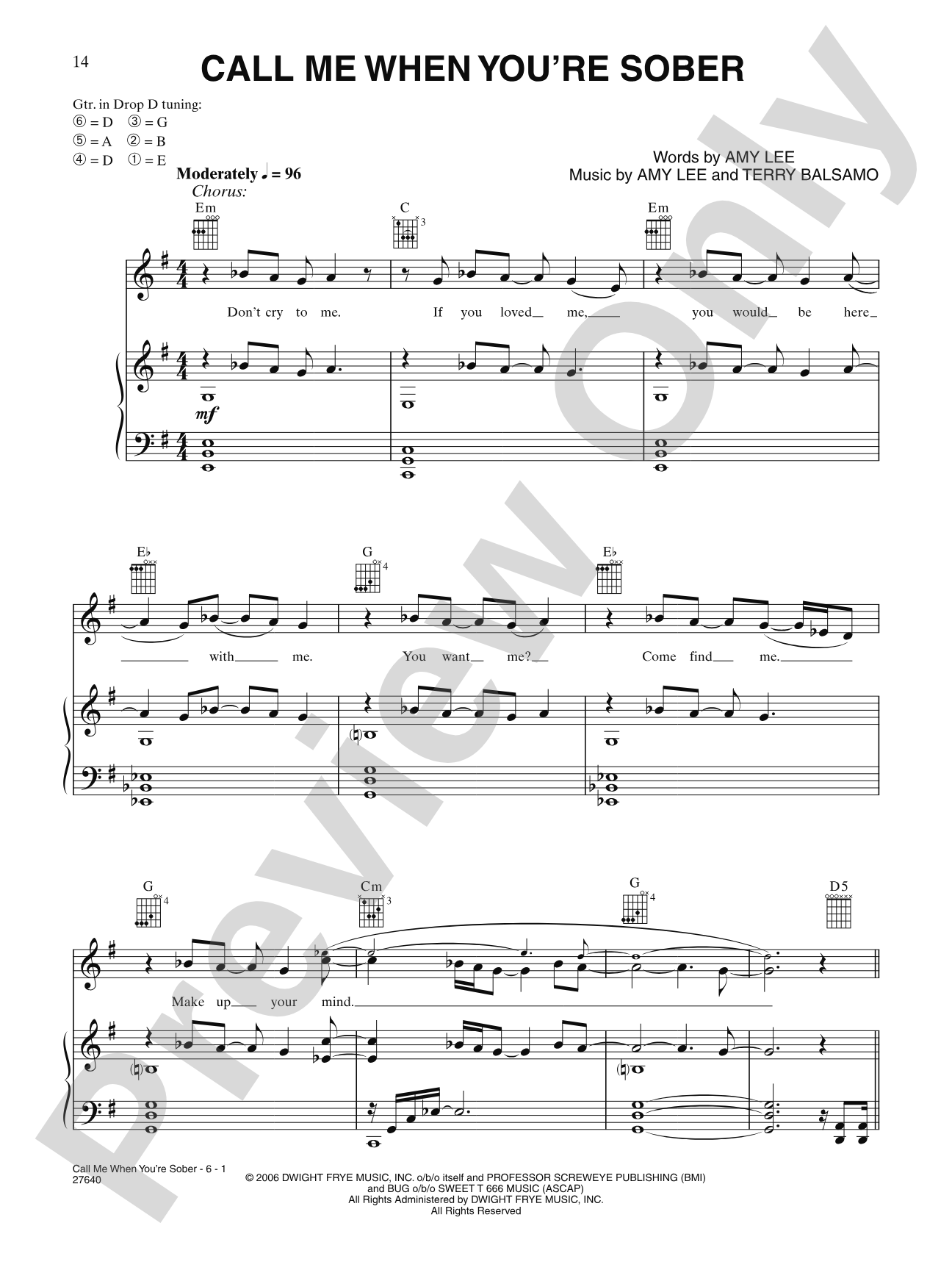
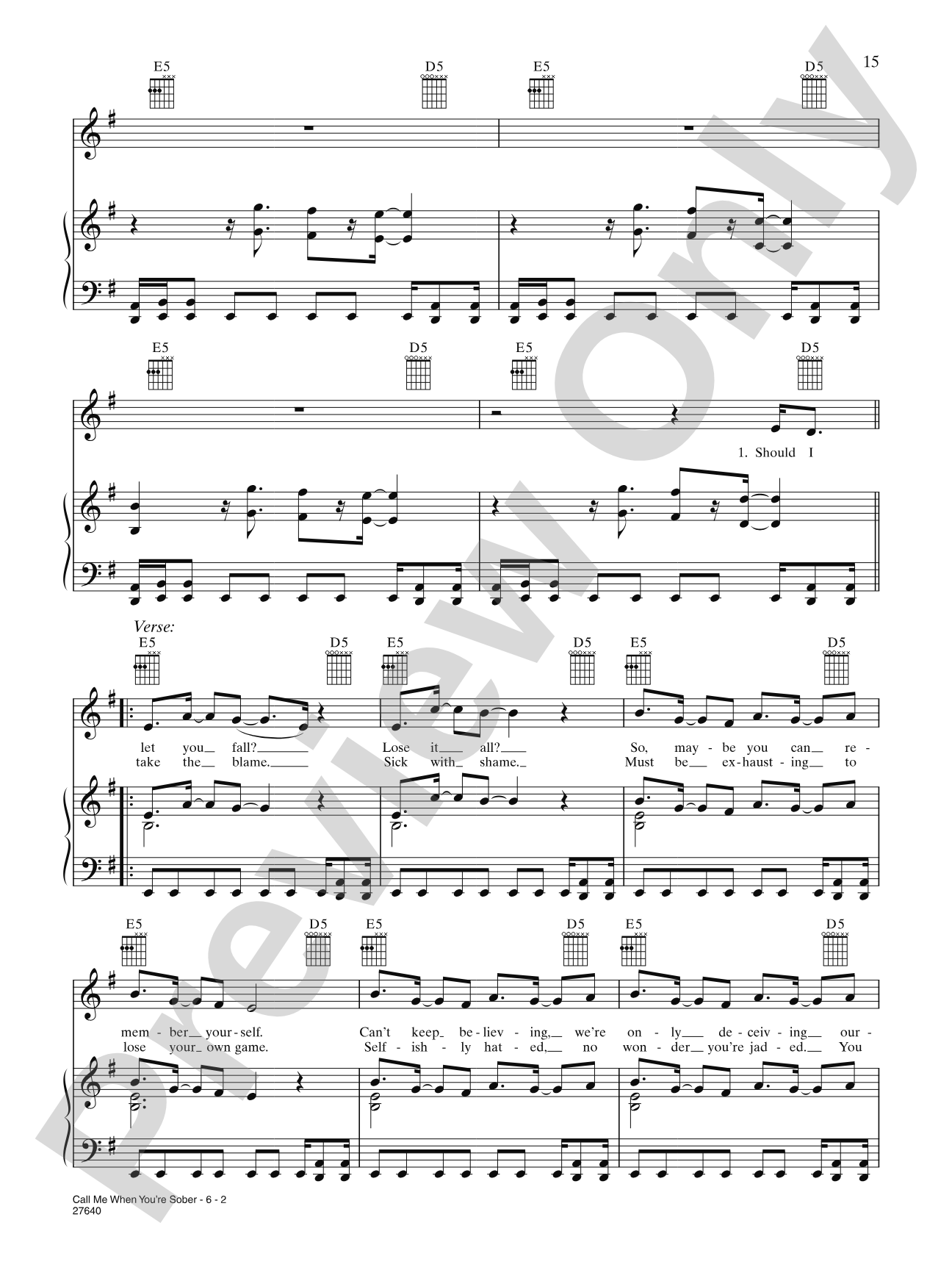

Call Me When You're Sober: Piano/Vocal/Chords
Evanescence
Item: 00-PSP-000183
$5.99
One moment…
Related Items
All That I'm Living For: Authentic Guitar TAB |
$4.99
|
View | |
Call Me When You're Sober: Authentic Guitar TAB |
$4.99
|
View | |
Cloud Nine: Authentic Guitar TAB |
$5.99
|
View | |
Good Enough: Authentic Guitar TAB |
$4.99
|
View | |
Lacrymosa: Authentic Guitar TAB |
$5.99
|
View | |
Like You: Authentic Guitar TAB |
$5.99
|
View | |
Lithium: Authentic Guitar TAB |
$4.99
|
View | |
Lose Control: Authentic Guitar TAB |
$4.99
|
View | |
Snow White Queen: Authentic Guitar TAB |
$5.99
|
View | |
Sweet Sacrifice: Authentic Guitar TAB |
$4.99
|
View | |
The Only One: Authentic Guitar TAB |
$4.99
|
View | |
Weight Of The World: Authentic Guitar TAB |
$5.99
|
View | |
Your Star: Authentic Guitar TAB |
$5.99
|
View | |
All That I'm Living For: Piano/Vocal/Chords |
$5.99
|
View | |
Cloud Nine: Piano/Vocal/Chords |
$5.99
|
View | |
Good Enough: Piano/Vocal/Chords |
$5.99
|
View | |
Lacrymosa: Piano/Vocal/Chords |
$5.99
|
View | |
Like You: Piano/Vocal/Chords |
$5.99
|
View | |
Lithium: Piano/Vocal/Chords |
$5.99
|
View | |
Lose Control: Piano/Vocal/Chords |
$4.99
|
View | |
Snow White Queen: Piano/Vocal/Chords |
$5.99
|
View | |
Sweet Sacrifice: Piano/Vocal/Chords |
$5.99
|
View | |
The Only One: Piano/Vocal/Chords |
$5.99
|
View | |
Weight Of The World: Piano/Vocal/Chords |
$5.99
|
View | |
Your Star: Piano/Vocal/Chords |
$5.99
|
View | |
Call Me When You're Sober: Piano/Vocal/Chords |
$5.99
|
View |
Description
Alfred is pleased to release the album-matching folio for Evanescence's third record, The Open Door. Released in 2006, The Open Door reached the No. 1 spot on Billboard's Top 200 Chart (2006). This book provides the lyrics along with piano and chord arrangements for all the songs on the record.
Titles: Sweet Sacrifice * Call Me When You're Sober * Weight Of The World * Lithium * Cloud Nine * Snow White Queen * Lacrymosa * Like You * Lose Control * The Only One * Your Star * All That I'm Living For * Good Enough.


Titles: Sweet Sacrifice * Call Me When You're Sober * Weight Of The World * Lithium * Cloud Nine * Snow White Queen * Lacrymosa * Like You * Lose Control * The Only One * Your Star * All That I'm Living For * Good Enough.
Call Me When You're Sober: Piano/Vocal/Chords isn't in MakeMusic Cloud just yet...but it could be. Let us know you'd like to see it, and you'll help shape what comes next. In the meantime, start a free trial and dive into thousands of interactive titles your students can play along with today.
Request This Title
Tell us you want it.
Start Your Free Trial
Explore everything that's ready to play right now.
Sample Audio
No sample audio found.
Sample Video
No sample videos found.
Additional Details
Publisher:
Alfred Music
Page Count:
104
SKU:
00-PSP-000183
More about this title
About the Artist: Evanescence
Evanescence emerged in the early 2000s as a defining voice in gothic rock and alternative metal, blending orchestral arrangements with heavy guitars and Amy Lee's classically trained soprano. The band's 2006 album The Open Door solidified their mainstream presence while deepening their exploration of darker themes and more intricate compositional structures, establishing them as serious musicians who refused to settle for surface-level songwriting.
Why we love this
This folio captures an album that teenage pianists and young vocalists already know by heart, making it an immediate draw for students hungry to play contemporary music that matters to them. The arrangements honor the original orchestral and guitar textures while remaining playable at the keyboard, and the full lyrical content supports singers developing emotional interpretation and phrasing in a rock idiom.
What to expect
These songs occupy the space between pop accessibility and classical ambition, with heavy minor keys, layered textures, and lyrics that grapple with real emotional weight. Playing through this album feels like stepping into a cathedral built from guitars and strings, where every note carries intention.
Who it's for
Pianists and singer-pianists at the intermediate to advanced level who want to perform contemporary music with genuine artistic depth. This collection also works well for students exploring how electric and orchestral instruments translate to acoustic keyboard, and for vocalists building their repertoire in alternative and rock styles.
How to get the most out of it
- Study the dynamics carefully. These songs live in contrast between whispered verses and powerful choruses; respect the empty space as much as the full moments.
- Lean into the minor keys and modal harmonies rather than treating them as melancholy background. The chord progressions contain real harmonic movement that rewards clear voice leading.
- Balance the vocal melody with piano texture. Many of these arrangements layer thematic material in the accompaniment that supports the vocal line rather than competing with it.
- Build stamina for the longer pieces. Several tracks sustain emotional intensity across extended sections, requiring consistent tone and breath control.
How to use it
Feature individual songs in student recitals where contemporary offerings are needed alongside classical repertoire. The variety of moods and tempos across the 13 tracks means you can program a cohesive set that showcases different sides of a young pianist's musicianship, or select specific pieces that fit thematic concert concepts.
Skills your students will build
- Reading chord symbols and jazz chord notation
- Playing full keyboard arrangements that translate orchestral textures to acoustic piano
- Interpreting rock vocal phrasing while maintaining melodic line clarity
- Managing sustained emotional intensity across longer song forms
- Voicing chords expressively rather than mechanically