
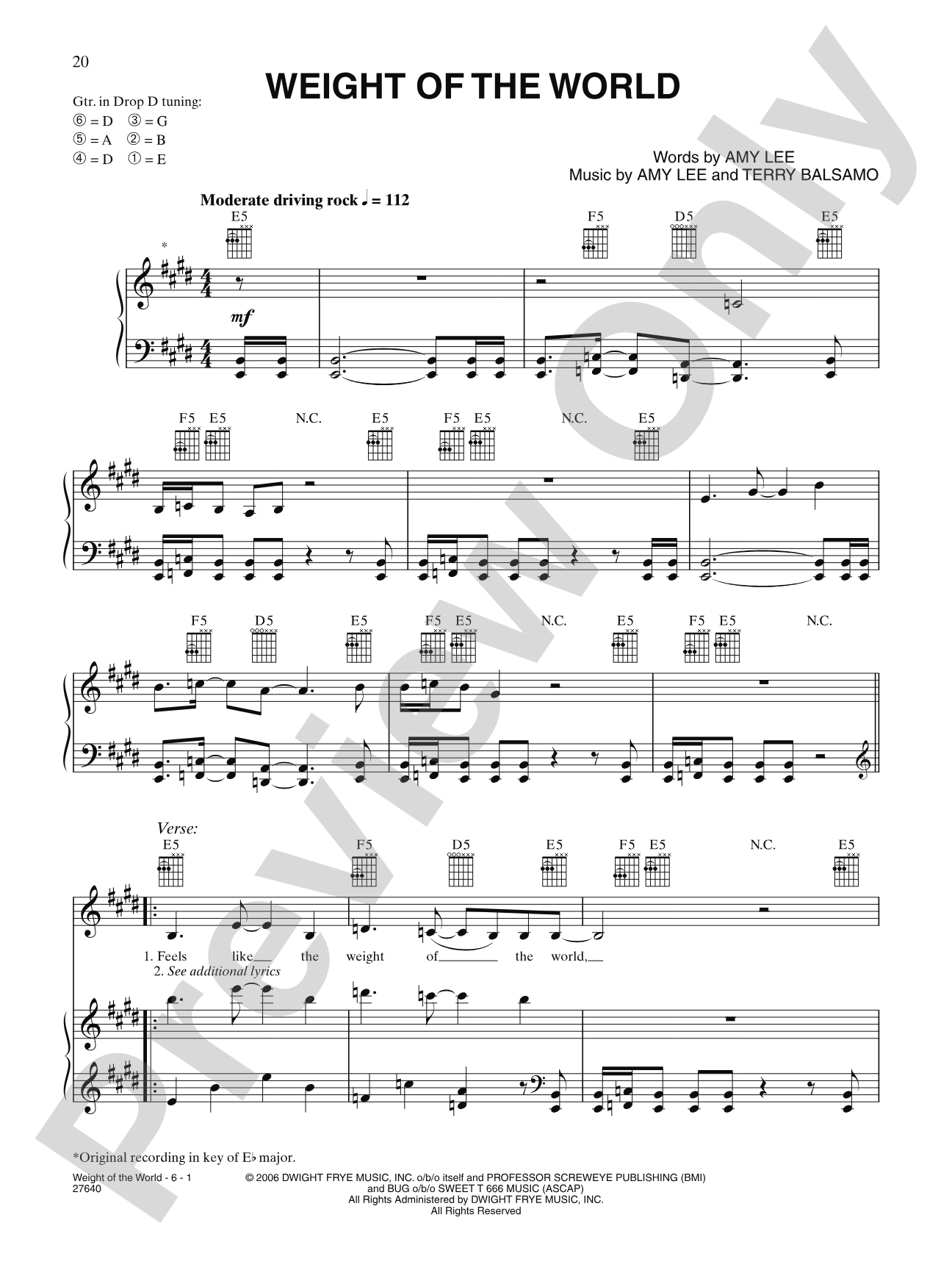
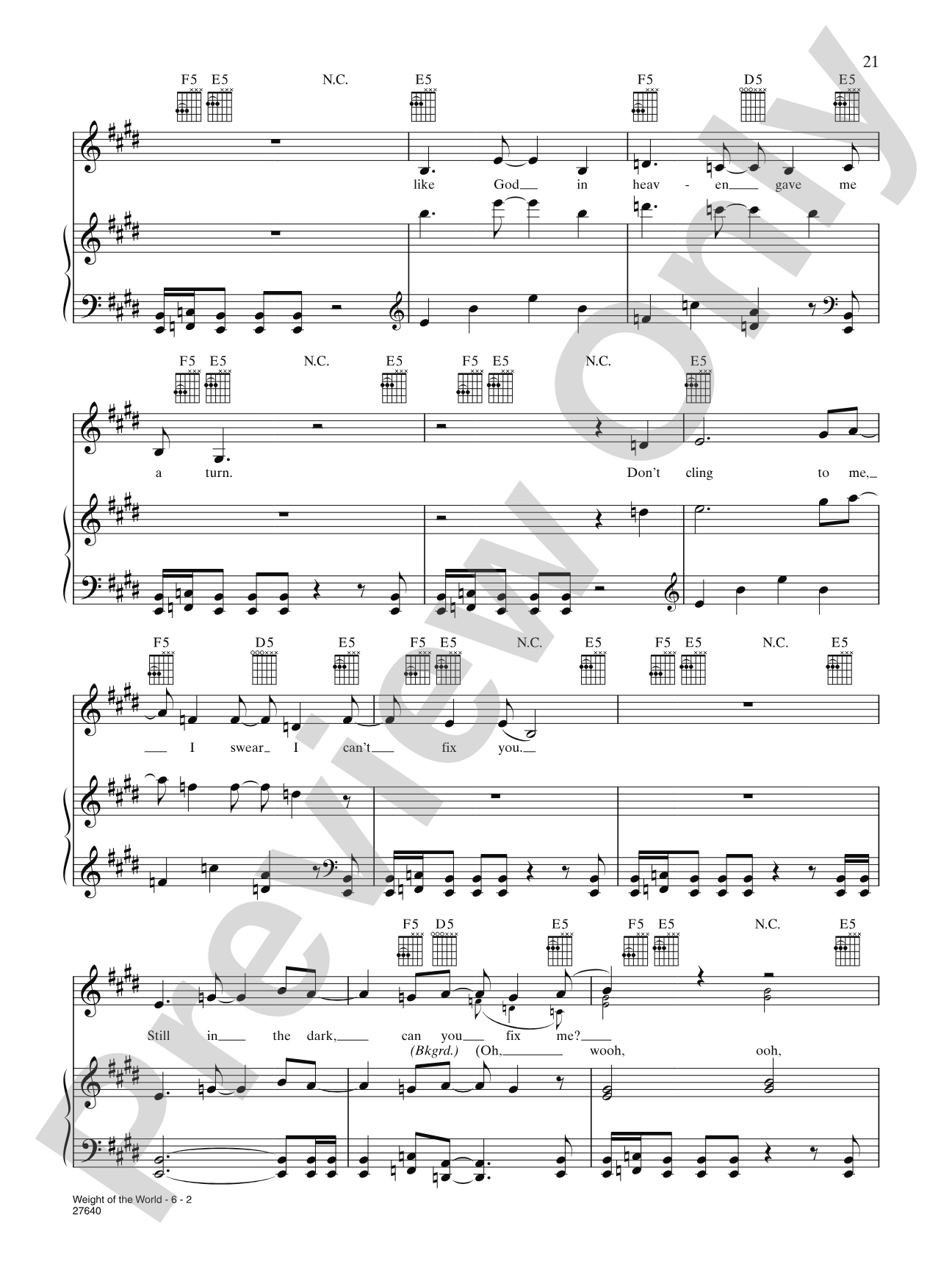

Weight Of The World: Piano/Vocal/Chords
Evanescence
Item: 00-PSP-000193
$5.99
Pickup currently not available
Related Items
All That I'm Living For: Authentic Guitar TAB |
$4.99
|
View | |
Call Me When You're Sober: Authentic Guitar TAB |
$4.99
|
View | |
Cloud Nine: Authentic Guitar TAB |
$5.99
|
View | |
Good Enough: Authentic Guitar TAB |
$4.99
|
View | |
Lacrymosa: Authentic Guitar TAB |
$5.99
|
View | |
Like You: Authentic Guitar TAB |
$5.99
|
View | |
Lithium: Authentic Guitar TAB |
$4.99
|
View | |
Lose Control: Authentic Guitar TAB |
$4.99
|
View | |
Snow White Queen: Authentic Guitar TAB |
$5.99
|
View | |
Sweet Sacrifice: Authentic Guitar TAB |
$4.99
|
View | |
The Only One: Authentic Guitar TAB |
$4.99
|
View | |
Weight Of The World: Authentic Guitar TAB |
$5.99
|
View | |
Your Star: Authentic Guitar TAB |
$5.99
|
View | |
All That I'm Living For: Piano/Vocal/Chords |
$5.99
|
View | |
Call Me When You're Sober: Piano/Vocal/Chords |
$5.99
|
View | |
Cloud Nine: Piano/Vocal/Chords |
$5.99
|
View | |
Good Enough: Piano/Vocal/Chords |
$5.99
|
View | |
Lacrymosa: Piano/Vocal/Chords |
$5.99
|
View | |
Like You: Piano/Vocal/Chords |
$5.99
|
View | |
Lithium: Piano/Vocal/Chords |
$5.99
|
View | |
Lose Control: Piano/Vocal/Chords |
$4.99
|
View | |
Snow White Queen: Piano/Vocal/Chords |
$5.99
|
View | |
Sweet Sacrifice: Piano/Vocal/Chords |
$5.99
|
View | |
The Only One: Piano/Vocal/Chords |
$5.99
|
View | |
Your Star: Piano/Vocal/Chords |
$5.99
|
View | |
Call Me When You're Sober: Piano/Vocal/Chords |
$5.99
|
View |
Description
Alfred is pleased to release the album-matching folio for Evanescence's third record, The Open Door. Released in 2006, The Open Door reached the No. 1 spot on Billboard's Top 200 Chart (2006). This book provides the lyrics along with piano and chord arrangements for all the songs on the record.
Titles: Sweet Sacrifice * Call Me When You're Sober * Weight Of The World * Lithium * Cloud Nine * Snow White Queen * Lacrymosa * Like You * Lose Control * The Only One * Your Star * All That I'm Living For * Good Enough.


Titles: Sweet Sacrifice * Call Me When You're Sober * Weight Of The World * Lithium * Cloud Nine * Snow White Queen * Lacrymosa * Like You * Lose Control * The Only One * Your Star * All That I'm Living For * Good Enough.
Weight Of The World: Piano/Vocal/Chords isn't in MakeMusic Cloud just yet...but it could be. Let us know you'd like to see it, and you'll help shape what comes next. In the meantime, start a free trial and dive into thousands of interactive titles your students can play along with today.
Request This Title
Tell us you want it.
Start Your Free Trial
Explore everything that's ready to play right now.
Sample Audio
No sample audio found.
Sample Video
No sample videos found.
Additional Details
Publisher:
Alfred Music
Page Count:
104
SKU:
00-PSP-000193
More about this title
About the Artist: Evanescence
Evanescence formed in 1995 and rose to mainstream prominence with their 2003 debut album Fallen, which sold millions of copies worldwide and established them as a defining voice in the rock and metal landscape. The Open Door (2006) solidified their signature sound: layered piano arrangements paired with Amy Lee's classically trained vocals, heavy orchestration, and introspective lyrics that explore themes of loss, identity, and resilience. The band's work demonstrates how classical training, electronic production, and rock instrumentation can converge to create emotionally dense, commercially successful music.
Why we love this
This folio captures thirteen tracks from one of the most sonically cohesive rock albums of the 2000s, giving pianists and vocalists direct access to professionally arranged interpretations of songs already built on rich piano foundations. Every song on The Open Door treats the keyboard as a lead instrument rather than accompaniment, making this collection exceptional for musicians who want to explore how contemporary rock songwriting employs classical harmony, layered textures, and dramatic dynamic shifts.
What to expect
These songs radiate vulnerability wrapped in architectural precision. Piano lines that move through minor keys and suspended chords create atmospheric depth, while the vocal melodies navigate introspective lyrics with moments of raw emotional release. The overall texture is intimate yet expansive, pulling listeners into private emotional spaces that feel simultaneously urgent and timeless.
Who it's for
This folio serves pianists and singers in advanced high school choirs, college vocal programs, and private studio settings who want to perform contemporary rock repertoire that doesn't sacrifice musical sophistication. It's also valuable for music theory students studying how modern composers layer harmonic complexity within accessible, popular song structures.
How to get the most out of it
- Pay attention to the chord voicings provided; many tracks use suspended and extended harmonies that create tension and atmosphere. Play them as written rather than substituting simpler alternatives.
- Balance the vocal melody line with the piano part. These arrangements often feature counter-melodies and fill passages that should complement rather than overshadow the singer.
- Notice the use of minor keys and modal interchange throughout the album. Lean into the darker harmonic language to capture the emotional weight these songs demand.
- Practice the vocal and piano parts separately before combining them. The rhythmic independence between voice and accompaniment requires careful coordination.
How to use it
Program individual tracks as encore pieces in pops or contemporary music concerts, or consider clustering several songs for a thematic set focused on grief, resilience, or identity. This material works particularly well in vocal recitals where you want to signal artistic range beyond traditional art song or musical theater repertoire.
Skills your students will build
- Reading and performing suspended and extended harmonic structures (sus2, sus4, maj7, min7 voicings) in a contemporary context
- Coordinating rhythmic independence between vocal melody and piano accompaniment
- Interpreting chord symbols to support rather than replace written notation
- Executing dynamic control in arrangements that shift between intimate verses and full, orchestrated sections
- Understanding modal interchange and minor key harmony in popular music composition