
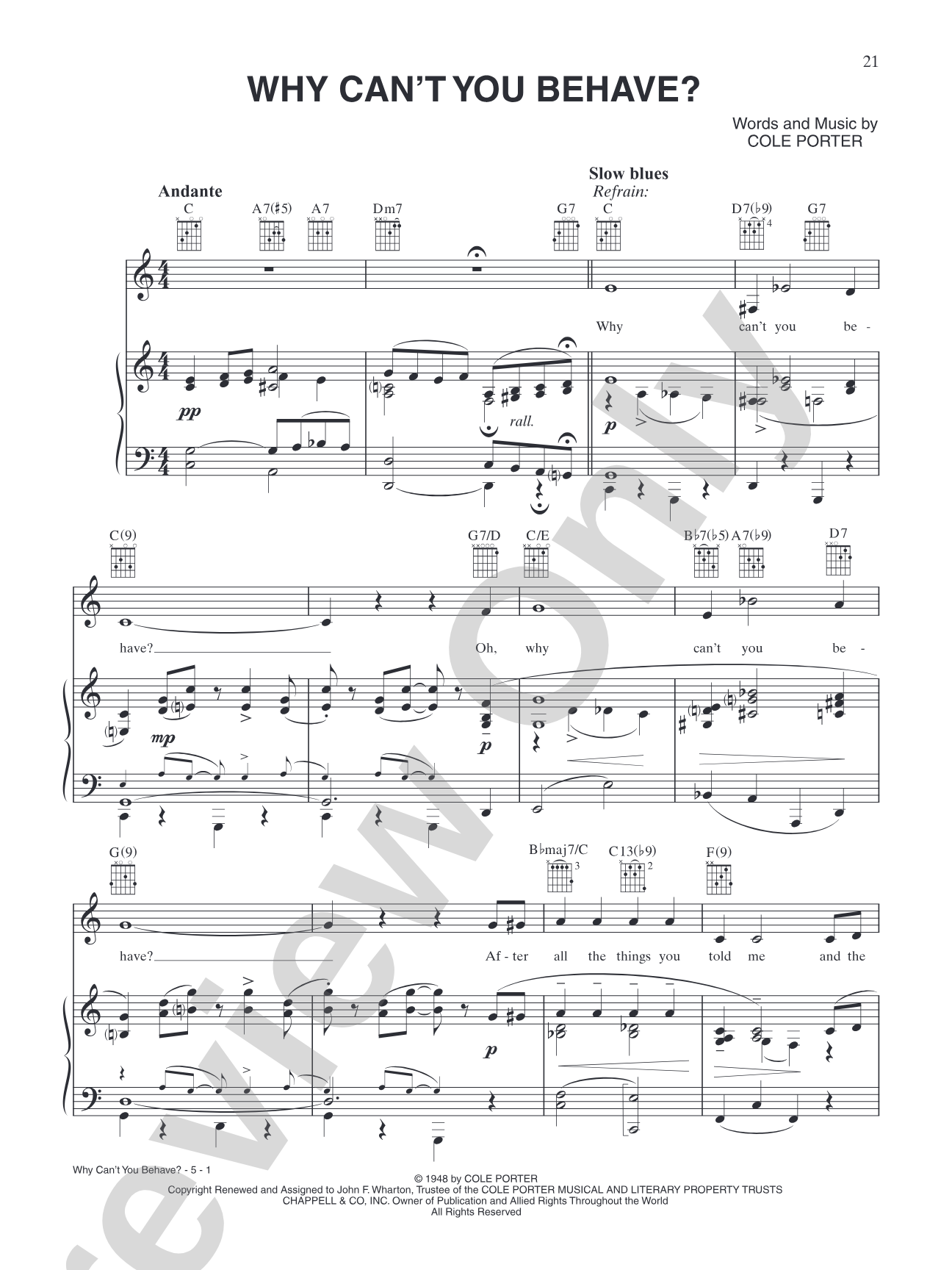

Why Can't You Behave?: Piano/Vocal/Chords
By Cole Porter
Item: 00-PS-0004488
$4.99
One moment…
Related Items
Tom, Dick or Harry: Piano/Vocal/Chords |
$5.99
|
View | |
I've Come to Wive It Wealthily in Padua: Piano/Vocal/Chords |
$5.99
|
View | |
Always True to You in My Fashion: Piano/Vocal/Chords |
$4.99
|
View | |
Another Op'nin', Another Show: Piano/Vocal/Chords |
$5.99
|
View | |
From This Moment On: Piano/Vocal/Chords |
$5.99
|
View | |
Brush up Your Shakespeare: Piano/Vocal/Chords |
$5.99
|
View | |
So In Love: Piano/Vocal/Chords |
$5.99
|
View | |
We Open In Venice (from "Kiss Me Kate"): Piano/Vocal/Chords |
$4.99
|
View | |
I Hate Men (from "Kiss Me Kate"): Piano/Vocal/Chords |
$4.99
|
View | |
Were Thine That Special Face (from "Kiss Me Kate"): Piano/Vocal/Chords |
$4.99
|
View | |
What Does Your Servant Dream About (from "Kiss Me Kate"): Piano/Vocal/Chords |
$4.99
|
View | |
We Shall Never Be Younger (from "Kiss Me Kate"): Piano/Vocal/Chords |
$4.99
|
View | |
I Am Ashamed That Women Are So Simple (from "Kiss Me Kate"): Piano/Vocal/Chords |
$4.99
|
View | |
Bianca (from "Kiss Me Kate"): Piano/Vocal/Chords |
$4.99
|
View | |
Wunderbar (from "Kiss Me Kate"): Piano/Vocal/Chords |
$4.99
|
View | |
I Sing of Love (from "Kiss Me Kate"): Piano/Vocal/Chords |
$5.99
|
View |
Description
This songbook contains all of the classic songs from Cole Porter's greatest success, the hilarious and tuneful Broadway production Kiss Me, Kate. A total of 19 songs are featured in the book, which includes two that were never used. The book also includes an essay about the history of the show, illustrations and memorabilia from its various productions, and a personal remembrance from Patricia Morison, who played Kate in the original Broadway run. Titles: Another Op'nin', Another Show * Why Can't You Behave? * Wunderbar * So in Love * We Open in Venice * Tom, Dick or Harry * I've Come to Wive It Wealthily in Padua * I Hate Men * Were Thine That Special Face * I Sing of Love * Too Darn Hot * Where Is the Life That Late I Led? * Always True to You in My Fashion * Bianca * Brush Up Your Shakespeare * From This Moment On * I Am Ashamed That Women Are So Simple * We Shall Never Be Younger * What Does Your Servant Dream Bout.


Why Can't You Behave?: Piano/Vocal/Chords isn't in MakeMusic Cloud just yet...but it could be. Let us know you'd like to see it, and you'll help shape what comes next. In the meantime, start a free trial and dive into thousands of interactive titles your students can play along with today.
Request This Title
Tell us you want it.
Start Your Free Trial
Explore everything that's ready to play right now.
Sample Audio
No sample audio found.
Sample Video
No sample videos found.
Additional Details
Publisher:
Alfred Music
Page Count:
120
SKU:
00-PS-0004488
More about this title
About the Composer: Cole Porter
Cole Porter (1891–1964) stands as one of Broadway's most distinctive voices, combining sophisticated harmonies, witty lyrics, and memorable melodies that shaped the American musical theater repertoire. His songs appear in countless jazz and cabaret settings, but his greatest strength lay in crafting complete theatrical works where music, comedy, and romance intertwined seamlessly. Porter's influence extends into music education through his harmonically inventive compositions, which challenge pianists and singers while remaining deeply rewarding to perform.
Porter's career spanned decades of hit productions, yet Kiss Me, Kate remains his masterwork: a show that transcends its era while teaching performers about stylistic flexibility, rhythmic clarity, and the art of balancing sentiment with humor. His melodies and chord progressions have become study material for jazz musicians, music theory students, and anyone serious about understanding how popular music works.
Why we love this
This collection captures the full theatrical arc of Porter's most enduring work, giving pianists and singers immediate access to the complete score without needing orchestral arrangements. The 19 songs span multiple moods and technical demands, from the sophisticated harmony of "So in Love" to the rhythmic precision of "Too Darn Hot," making it invaluable for teaching musical theater performance across skill levels. Including never-performed tracks, historical context, and firsthand accounts from the original cast transforms this songbook into both a performance resource and a window into how great musicals are actually made.
What to expect
These songs embody the confidence and elegance of postwar American musical theater. They move easily between romantic yearning and sharp-edged comedy, sophisticated harmony and memorable hooks. Performing them feels like stepping into a world where wit is valued as highly as beauty, and where a clever rhyme or unexpected modulation can land as powerfully as a soaring melody.
Who it's for
Pianists preparing audition material for musical theater programs, voice teachers seeking sophisticated standard repertoire, and ensemble directors building cabaret or concert programs will find this collection essential. It also serves singers and pianists who want to deepen their understanding of mid-century Broadway craft through direct engagement with one of its finest composers.
How to get the most out of it
- Study the harmonic language in context. Porter's chord progressions often surprise; playing through multiple songs in sequence helps you internalize his approach to voice leading and understand how he creates sophistication without sacrificing singability.
- Pay attention to lyric phrasing over metric regularity. Porter wrote for speech rhythms and comedic timing. Let the words guide your tempo and rubato rather than forcing rigid adherence to notated values, especially in patter sections.
- Balance elegance with directness in tempos. Songs like "Wunderbar" benefit from a touch of swagger, while "Were Thine That Special Face" requires genuine lyricism. Avoid treating all ballads identically.
- Use the provided chord symbols as a springboard for improvisation or accompanying reharmonization. Porter's chords are sophisticated, but they also invite creative interpretation in small ensemble or rehearsal settings.
How to use it
Build a Broadway recital or cabaret around selections from this collection; the variety of tempos, moods, and difficulty levels supports balanced programming for audiences ranging from school settings to community theater. The inclusion of supporting material and historical context makes this songbook a natural anchor for musical theater history units or interdisciplinary projects that connect drama, music, and American cultural studies. You can also draw from this for audition coaching, teaching jazz standards, or preparing singers for pit orchestra work.
Skills your students will build
- Reading and interpreting jazz harmonies and extended chord symbols in a theatrical context
- Phrasing and inflection in song interpretation, balancing notated rhythm with lyric-driven expression
- Sight-reading and transposition at the keyboard across multiple song keys and styles
- Recognizing and performing melodic conventions of mid-20th-century Broadway composition
- Coordinating vocal line with accompaniment while maintaining independent musicianship in both parts