
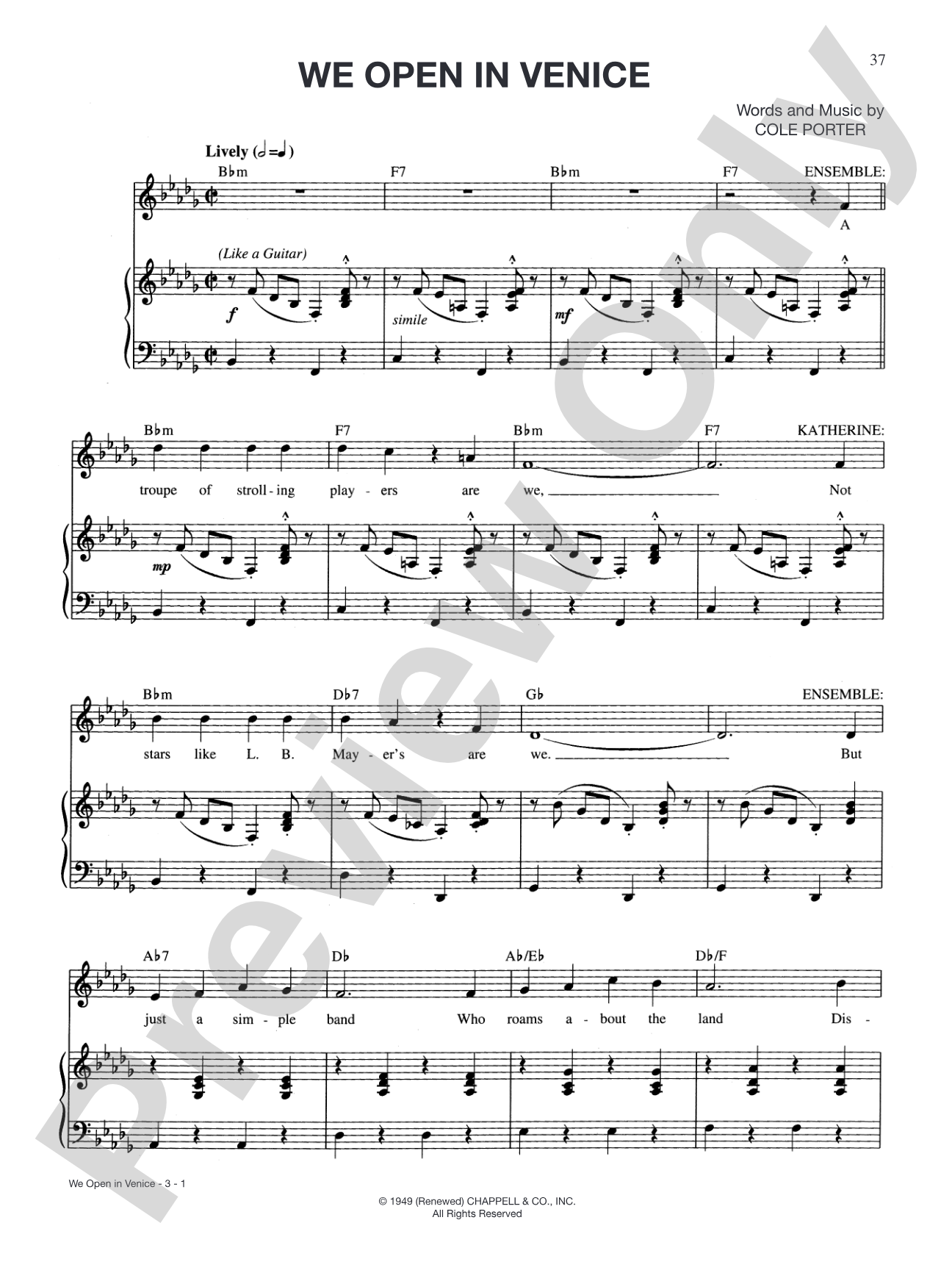

We Open In Venice (from "Kiss Me Kate"): Piano/Vocal/Chords
By Cole Porter
Item: 00-PS-0012989
$4.99
One moment…
Related Items
Tom, Dick or Harry: Piano/Vocal/Chords |
$5.99
|
View | |
I've Come to Wive It Wealthily in Padua: Piano/Vocal/Chords |
$5.99
|
View | |
Always True to You in My Fashion: Piano/Vocal/Chords |
$4.99
|
View | |
Another Op'nin', Another Show: Piano/Vocal/Chords |
$5.99
|
View | |
Why Can't You Behave?: Piano/Vocal/Chords |
$4.99
|
View | |
From This Moment On: Piano/Vocal/Chords |
$5.99
|
View | |
Brush up Your Shakespeare: Piano/Vocal/Chords |
$5.99
|
View | |
So In Love: Piano/Vocal/Chords |
$5.99
|
View | |
I Hate Men (from "Kiss Me Kate"): Piano/Vocal/Chords |
$4.99
|
View | |
Were Thine That Special Face (from "Kiss Me Kate"): Piano/Vocal/Chords |
$4.99
|
View | |
What Does Your Servant Dream About (from "Kiss Me Kate"): Piano/Vocal/Chords |
$4.99
|
View | |
We Shall Never Be Younger (from "Kiss Me Kate"): Piano/Vocal/Chords |
$4.99
|
View | |
I Am Ashamed That Women Are So Simple (from "Kiss Me Kate"): Piano/Vocal/Chords |
$4.99
|
View | |
Bianca (from "Kiss Me Kate"): Piano/Vocal/Chords |
$4.99
|
View | |
Wunderbar (from "Kiss Me Kate"): Piano/Vocal/Chords |
$4.99
|
View | |
I Sing of Love (from "Kiss Me Kate"): Piano/Vocal/Chords |
$5.99
|
View |
Description
This songbook contains all of the classic songs from Cole Porter's greatest success, the hilarious and tuneful Broadway production Kiss Me, Kate. A total of 19 songs are featured in the book, which includes two that were never used. The book also includes an essay about the history of the show, illustrations and memorabilia from its various productions, and a personal remembrance from Patricia Morison, who played Kate in the original Broadway run. Titles: Another Op'nin', Another Show * Why Can't You Behave? * Wunderbar * So in Love * We Open in Venice * Tom, Dick or Harry * I've Come to Wive It Wealthily in Padua * I Hate Men * Were Thine That Special Face * I Sing of Love * Too Darn Hot * Where Is the Life That Late I Led? * Always True to You in My Fashion * Bianca * Brush Up Your Shakespeare * From This Moment On * I Am Ashamed That Women Are So Simple * We Shall Never Be Younger * What Does Your Servant Dream Bout.


We Open In Venice (from "Kiss Me Kate"): Piano/Vocal/Chords isn't in MakeMusic Cloud just yet...but it could be. Let us know you'd like to see it, and you'll help shape what comes next. In the meantime, start a free trial and dive into thousands of interactive titles your students can play along with today.
Request This Title
Tell us you want it.
Start Your Free Trial
Explore everything that's ready to play right now.
Sample Audio
No sample audio found.
Sample Video
No sample videos found.
Additional Details
Publisher:
Alfred Music
Page Count:
120
SKU:
00-PS-0012989
More about this title
About the Composer: Cole Porter
Cole Porter (1891–1964) was an American composer and lyricist whose sophisticated harmonies, witty lyrics, and elegant melodies defined the Golden Age of Broadway and American popular song. A Yale graduate with European training, Porter brought both classical refinement and jazzy modernity to musical theatre, creating standards that remain central to the American songbook. His influence extends across jazz, cabaret, film, and concert music; his work appears constantly in music education because it balances accessibility with harmonic and lyrical complexity.
Porter's theatrical output was prolific and distinctive. He wrote both music and lyrics for most of his shows, a rarity that gave his work remarkable cohesion. Kiss Me, Kate (1948) stands as one of his masterpieces, earning a Tony Award and achieving a then-record run on Broadway. The score showcases his range: from intimate ballads to dazzling comedy songs, from lush romantic numbers to rhythmically intricate ensemble pieces.
Why we love this
Porter's melodic gift and harmonic sophistication make these songs enduringly rewarding for singers and pianists at intermediate to advanced levels. The collection balances comedy and sentiment; singers discover how to shape both comic timing and emotional depth within the same score. For music directors, Kiss Me, Kate offers unmatched versatility for concert programming, auditions, student recitals, or full theatrical production.
What to expect
Opening this book is like stepping into a dressing room backstage at a 1948 Broadway theatre. The music crackles with sophistication, charm, and theatrical energy. You'll encounter tender romantic moments alongside hilarious send-ups of theatrical convention, all wrapped in Porter's signature blend of elegant writing and clever wordplay. The accompaniments feel both supportive and artful, never plain.
Who it's for
This collection serves singers preparing audition material, pianists accompanying vocalists in lessons or recitals, music theatre students building their repertoire, and anyone deepening their knowledge of American musical theatre standards. Directors programming concert performances or variety shows will find 19 options ranging from intimate character songs to show-stopping ensemble pieces.
How to get the most out of it
- Study the lyrics closely before diving into the melody. Porter's wit lives in his words, and understanding the text informs phrasing, articulation, and comedic timing at the piano.
- Listen to multiple recordings to internalize Porter's harmonic language. His chromaticism and unexpected chord changes sound effortless when you know where they're coming from.
- Pay attention to syncopation and rhythmic displacement, especially in the uptempo comedy numbers. The piano part often sets the rhythmic foundation that singers need to land their jokes.
- Balance the vocal line with independence in the accompaniment. Porter's piano writing is conversational; it doesn't simply double the voice but comments, responds, and creates texture.
How to use it
Feature individual songs in a Broadway cabaret or theatre showcase; the variety of styles means you can program uptempo comedy, ballads, and ensemble pieces in one concert without repetition. This collection also works beautifully as a source for student recitals, where singers can select character-appropriate songs at different difficulty levels. For voice studios, return to these songs across multiple years as technique and artistry develop.
Skills your students will build
- Interpreting Cole Porter's chromaticism and extended harmony changes
- Coordinating comedic timing with musical phrasing
- Reading and balancing active piano accompaniment alongside the vocal line
- Approaching character-driven vocal performance in musical theatre repertoire
- Stylistic command of American songbook idioms (rhythm, articulation, diction)