
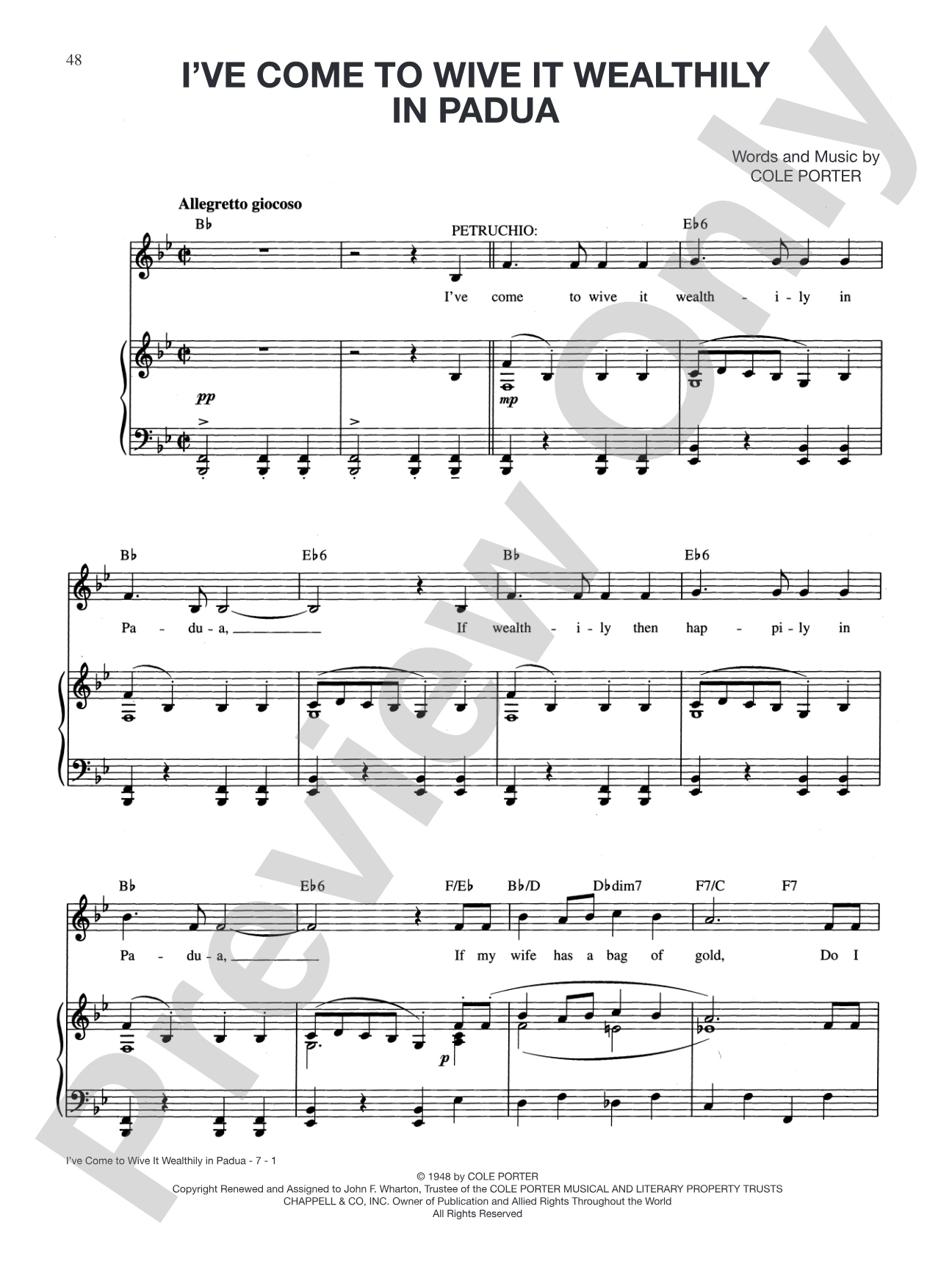
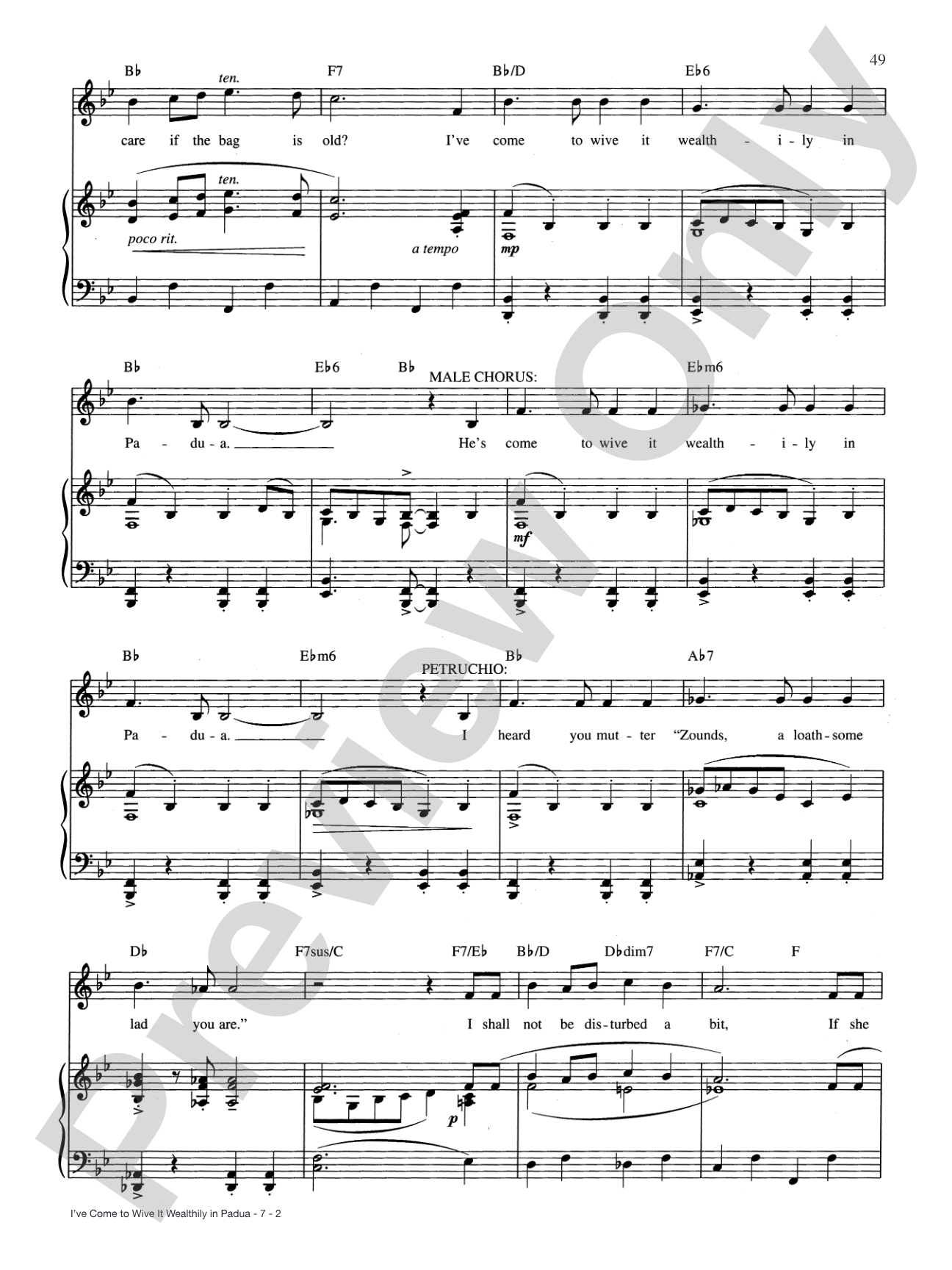

I've Come to Wive It Wealthily in Padua: Piano/Vocal/Chords
By Cole Porter
Item: 00-PS-0001065
$5.99
One moment…
Related Items
Tom, Dick or Harry: Piano/Vocal/Chords |
$5.99
|
View | |
Always True to You in My Fashion: Piano/Vocal/Chords |
$4.99
|
View | |
Another Op'nin', Another Show: Piano/Vocal/Chords |
$5.99
|
View | |
Why Can't You Behave?: Piano/Vocal/Chords |
$4.99
|
View | |
From This Moment On: Piano/Vocal/Chords |
$5.99
|
View | |
Brush up Your Shakespeare: Piano/Vocal/Chords |
$5.99
|
View | |
So In Love: Piano/Vocal/Chords |
$5.99
|
View | |
We Open In Venice (from "Kiss Me Kate"): Piano/Vocal/Chords |
$4.99
|
View | |
I Hate Men (from "Kiss Me Kate"): Piano/Vocal/Chords |
$4.99
|
View | |
Were Thine That Special Face (from "Kiss Me Kate"): Piano/Vocal/Chords |
$4.99
|
View | |
What Does Your Servant Dream About (from "Kiss Me Kate"): Piano/Vocal/Chords |
$4.99
|
View | |
We Shall Never Be Younger (from "Kiss Me Kate"): Piano/Vocal/Chords |
$4.99
|
View | |
I Am Ashamed That Women Are So Simple (from "Kiss Me Kate"): Piano/Vocal/Chords |
$4.99
|
View | |
Bianca (from "Kiss Me Kate"): Piano/Vocal/Chords |
$4.99
|
View | |
Wunderbar (from "Kiss Me Kate"): Piano/Vocal/Chords |
$4.99
|
View | |
I Sing of Love (from "Kiss Me Kate"): Piano/Vocal/Chords |
$5.99
|
View |
Description
This songbook contains all of the classic songs from Cole Porter's greatest success, the hilarious and tuneful Broadway production Kiss Me, Kate. A total of 19 songs are featured in the book, which includes two that were never used. The book also includes an essay about the history of the show, illustrations and memorabilia from its various productions, and a personal remembrance from Patricia Morison, who played Kate in the original Broadway run. Titles: Another Op'nin', Another Show * Why Can't You Behave? * Wunderbar * So in Love * We Open in Venice * Tom, Dick or Harry * I've Come to Wive It Wealthily in Padua * I Hate Men * Were Thine That Special Face * I Sing of Love * Too Darn Hot * Where Is the Life That Late I Led? * Always True to You in My Fashion * Bianca * Brush Up Your Shakespeare * From This Moment On * I Am Ashamed That Women Are So Simple * We Shall Never Be Younger * What Does Your Servant Dream Bout.


I've Come to Wive It Wealthily in Padua: Piano/Vocal/Chords isn't in MakeMusic Cloud just yet...but it could be. Let us know you'd like to see it, and you'll help shape what comes next. In the meantime, start a free trial and dive into thousands of interactive titles your students can play along with today.
Request This Title
Tell us you want it.
Start Your Free Trial
Explore everything that's ready to play right now.
Sample Audio
No sample audio found.
Sample Video
No sample videos found.
Additional Details
Publisher:
Alfred Music
Page Count:
120
SKU:
00-PS-0001065
More about this title
About the Composer: Cole Porter
Cole Porter (1891-1964) composed some of American musical theatre's most sophisticated and witty scores. His melodies are instantly memorable, his lyrics clever and urbane, and his harmonies distinctly advanced for Broadway. Porter's gift for both music and words made him unusual among composers; he could craft a complete song without collaborating, giving his work a cohesive style that influenced generations of songwriters.
Porter's life was as colorful as his music. A Yale graduate and trained pianist, he moved between Paris and New York, writing for stage and film with equal brilliance. His work defined the sound of mid-century American musical theatre, marked by jazz-inflected harmonies, unexpected chord progressions, and lyrics that could be both romantic and satirical in the same phrase.
Why we love this
Kiss Me, Kate showcases Porter at his absolute peak, with a score that gives singers and pianists genuine musical meat to sink their teeth into. The collection includes nineteen songs spanning nearly every theatrical moment: charm songs, comedy numbers, hot jazz numbers, and soaring romantic ballads. This songbook is valuable precisely because it assembles the full theatrical experience between two covers, letting singers access both the famous standards and the character-driven numbers that make the show complete.
What to expect
Kiss Me, Kate captures the witty banter and romantic tension of Shakespeare's Taming of the Shrew filtered through Porter's cosmopolitan sensibility. The score moves from rollicking opening numbers and sharp comedic songs into moments of genuine tenderness and sophisticated jazz-inflected beauty. It's sophisticated without being precious, funny without sacrificing musicality, and deeply romantic without losing its theatrical edge.
Who it's for
This collection serves singers learning Porter's style and pianists accompanying them in studio or recital. It's equally useful for theatre music programs teaching the American songbook canon and for performers building audition repertoire from a score with genuine theatrical substance.
How to get the most out of it
- Study the harmonic language carefully. Porter's chords move with chromatic sophistication; nail the voice-leading and harmonic rhythm before worrying about tempo.
- Pay attention to lyrical rhythm and placement. Porter's words sit on the beat with intention, especially in the comedy numbers; rushing or dragging the lyric will flatten the humor.
- Use the illustrative context provided by the show history and memorabilia to inform character choices. Understanding the scenes these songs inhabit shapes phrasing and emotional arc.
- Balance the range of moods. Moving from a comedy number like 'I Hate Men' to a tender moment like 'Were Thine That Special Face' requires clear tonal and textual contrast.
How to use it
Consider programming excerpts alongside other American songbook standards or assembling a thematic concert around Porter's theatrical genius. For voice students, these songs develop interpretive skills across multiple song types within a single coherent score. Theatre programs might use selections to build a unit on mid-century Broadway style and composition.
Skills your students will build
- Singing jazz-inflected harmonies and chromatic voice-leading
- Handling sophisticated lyrical rhythms and comic timing through music
- Accompanying singers with complex harmonic progressions and walking piano textures
- Interpreting character and emotional range across diverse song types within one show
- Understanding the conventions of mid-century Broadway orchestration and style through vocal score reduction