
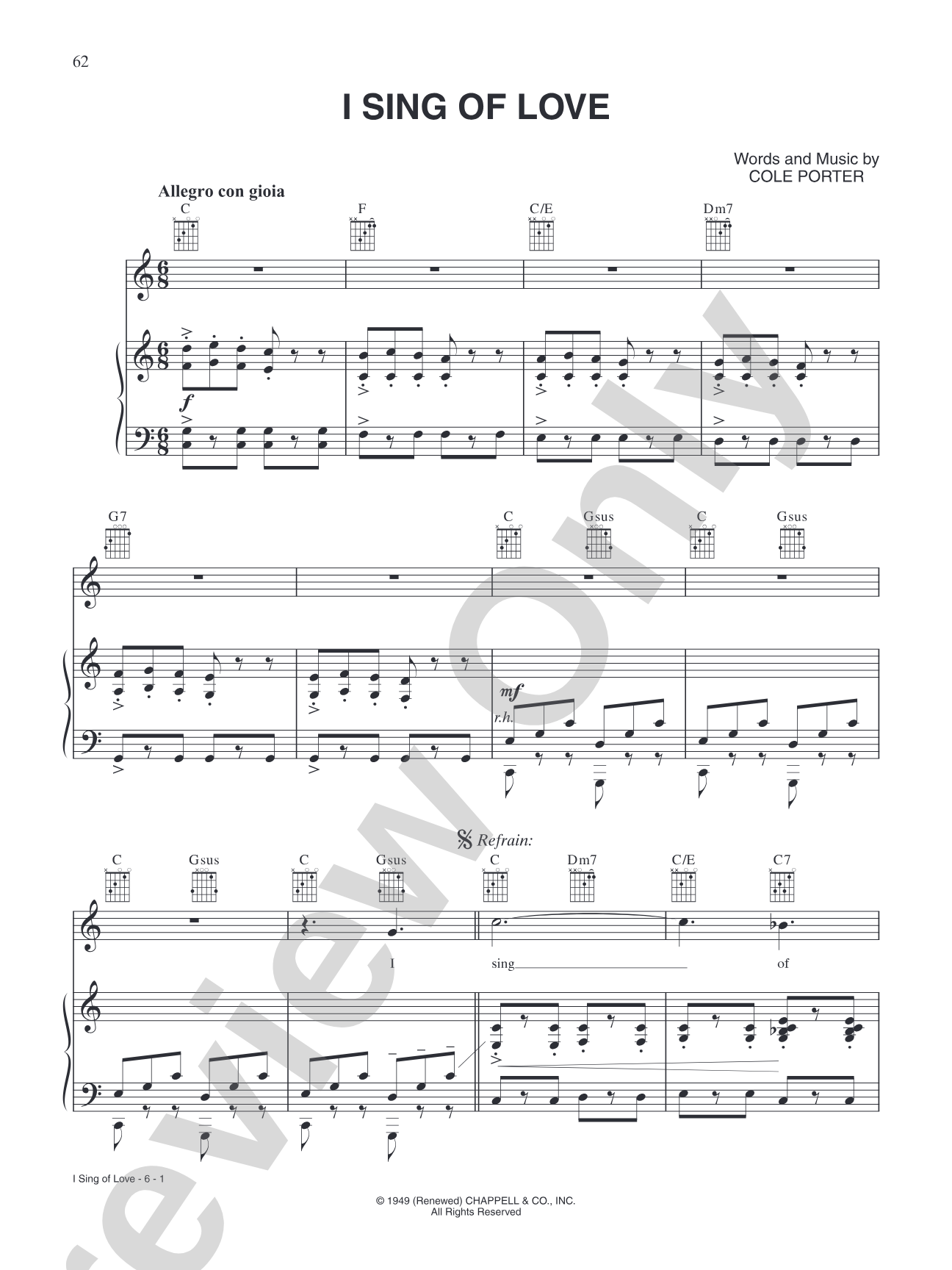
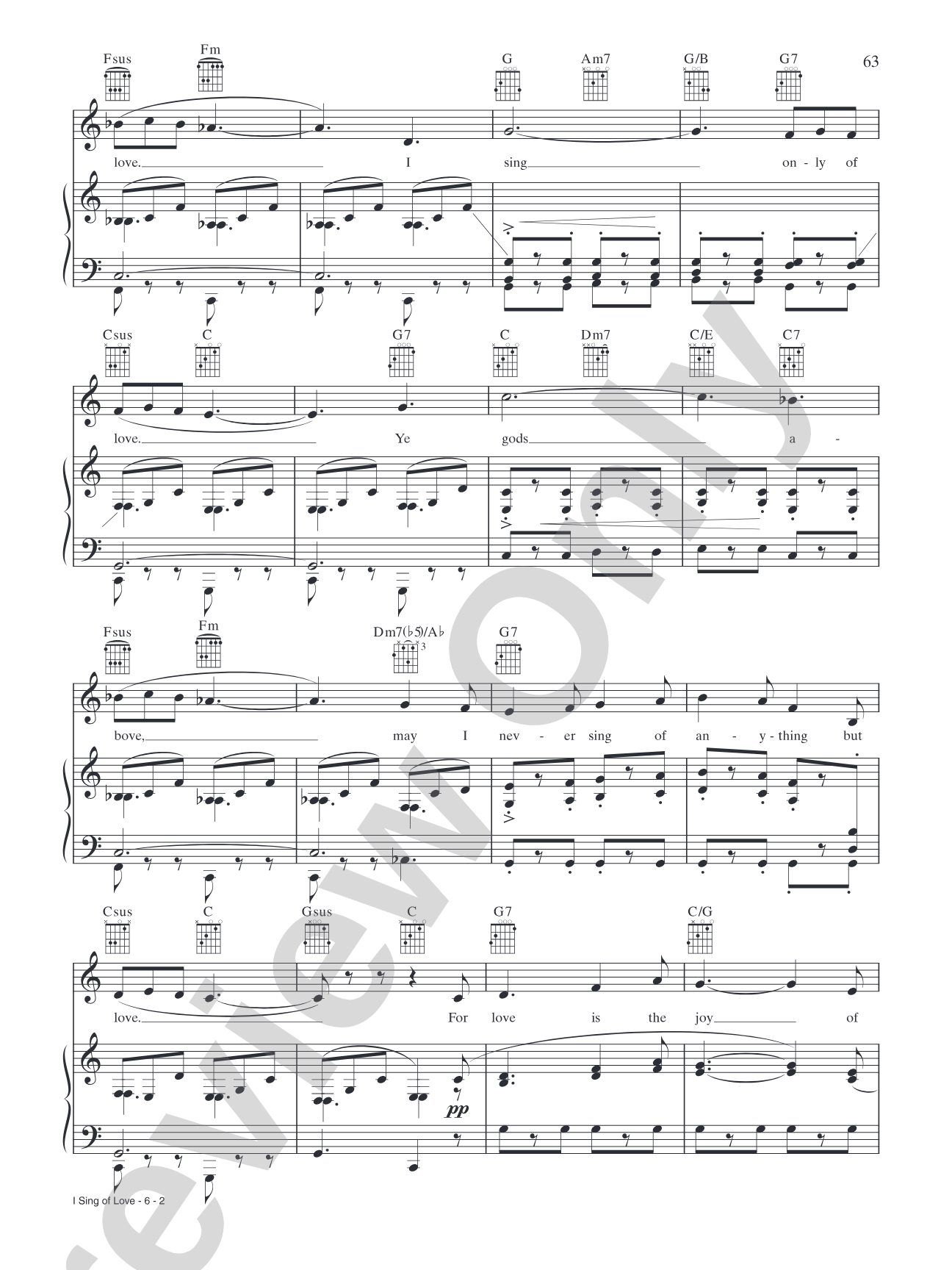

I Sing of Love (from "Kiss Me Kate"): Piano/Vocal/Chords
By Cole Porter
Item: 00-XS-0000186
$5.99
One moment…
Related Items
Tom, Dick or Harry: Piano/Vocal/Chords |
$5.99
|
View | |
I've Come to Wive It Wealthily in Padua: Piano/Vocal/Chords |
$5.99
|
View | |
Always True to You in My Fashion: Piano/Vocal/Chords |
$4.99
|
View | |
Another Op'nin', Another Show: Piano/Vocal/Chords |
$5.99
|
View | |
Why Can't You Behave?: Piano/Vocal/Chords |
$4.99
|
View | |
From This Moment On: Piano/Vocal/Chords |
$5.99
|
View | |
Brush up Your Shakespeare: Piano/Vocal/Chords |
$5.99
|
View | |
So In Love: Piano/Vocal/Chords |
$5.99
|
View | |
We Open In Venice (from "Kiss Me Kate"): Piano/Vocal/Chords |
$4.99
|
View | |
I Hate Men (from "Kiss Me Kate"): Piano/Vocal/Chords |
$4.99
|
View | |
Were Thine That Special Face (from "Kiss Me Kate"): Piano/Vocal/Chords |
$4.99
|
View | |
What Does Your Servant Dream About (from "Kiss Me Kate"): Piano/Vocal/Chords |
$4.99
|
View | |
We Shall Never Be Younger (from "Kiss Me Kate"): Piano/Vocal/Chords |
$4.99
|
View | |
I Am Ashamed That Women Are So Simple (from "Kiss Me Kate"): Piano/Vocal/Chords |
$4.99
|
View | |
Bianca (from "Kiss Me Kate"): Piano/Vocal/Chords |
$4.99
|
View | |
Wunderbar (from "Kiss Me Kate"): Piano/Vocal/Chords |
$4.99
|
View |
Description
This songbook contains all of the classic songs from Cole Porter's greatest success, the hilarious and tuneful Broadway production Kiss Me, Kate. A total of 19 songs are featured in the book, which includes two that were never used. The book also includes an essay about the history of the show, illustrations and memorabilia from its various productions, and a personal remembrance from Patricia Morison, who played Kate in the original Broadway run. Titles: Another Op'nin', Another Show * Why Can't You Behave? * Wunderbar * So in Love * We Open in Venice * Tom, Dick or Harry * I've Come to Wive It Wealthily in Padua * I Hate Men * Were Thine That Special Face * I Sing of Love * Too Darn Hot * Where Is the Life That Late I Led? * Always True to You in My Fashion * Bianca * Brush Up Your Shakespeare * From This Moment On * I Am Ashamed That Women Are So Simple * We Shall Never Be Younger * What Does Your Servant Dream Bout.


I Sing of Love (from "Kiss Me Kate"): Piano/Vocal/Chords isn't in MakeMusic Cloud just yet...but it could be. Let us know you'd like to see it, and you'll help shape what comes next. In the meantime, start a free trial and dive into thousands of interactive titles your students can play along with today.
Request This Title
Tell us you want it.
Start Your Free Trial
Explore everything that's ready to play right now.
Sample Audio
No sample audio found.
Sample Video
No sample videos found.
Additional Details
Publisher:
Alfred Music
Page Count:
120
SKU:
00-XS-0000186
More about this title
About the Composer: Cole Porter
Cole Porter (1891-1964) was an American composer and lyricist whose sophisticated wit, elegant melodies, and clever wordplay defined the golden age of Broadway musical theater. His songs became standards of the American popular repertoire, performed across jazz, cabaret, concert, and theatrical contexts. Porter's harmonic language was advanced for its time, featuring unexpected chord progressions and chromatic alterations that challenged musicians and delighted audiences alike.
Porter's work remains essential to music education because it bridges classical training with vernacular song. His melodies reward careful phrasing and interpretation; his lyrics demand clarity and comedic timing. Teachers and students encounter his music in jazz studies, music theory (where his chord changes are models of sophistication), and vocal performance classes. Kiss Me, Kate, which won the Tony Award for Best Musical in 1949, stands as one of his masterpieces and a cornerstone of the musical theater canon.
Why we love this
This collection captures the complete theatrical experience of one of Broadway's most consistently entertaining scores. Porter's melodies are instantly singable yet harmonically rich enough to reward repeated exploration, and the songs span a range of dramatic moments from comedic ensemble numbers to intimate ballads. Directors program from this score because nearly every song works as a standalone performance piece while also deepening understanding of how music serves storytelling.
What to expect
The music radiates intelligence and charm. You encounter elegant, conversational melodies that feel spontaneous despite their careful construction, supported by harmonies that are both sophisticated and warmly approachable. There's humor, romance, theatrical flair, and genuine musicality at every turn. Performing these songs feels like joining an exclusive conversation between composer and audience.
Who it's for
This book serves singers and pianists preparing solo material for recitals, auditions, or performances in jazz and cabaret settings. It's equally valuable for music students studying American song, music theater majors, and accompanists building a versatile repertoire of standards. Choral directors can extract ensemble numbers for concert programming.
How to get the most out of it
- Pay attention to Porter's chord changes, particularly chromatic movements and unexpected harmonic turns. These aren't ornamental; they shape the emotional arc of each song and demand precise intonation from singers and accompanists.
- Approach the comic numbers ("Brush Up Your Shakespeare," "Too Darn Hot") with rhythmic precision and clear diction. Porter's lyrics are weapons of wit, and they land only when delivered cleanly.
- Balance the sophistication of the music with accessibility. These are singable melodies; resist over-complicating interpretations. Let the natural charm and humor of the writing come through.
- Use the chord symbols to explore jazz voicings and reharmonization if working in a cabaret or jazz context. Porter's music invites creative accompaniment while maintaining the integrity of his original progressions.
How to use it
Draw from this score for variety in a vocal recital, pairing a Porter ballad with art songs and contemporary repertoire. Directors can stage a full Kiss Me, Kate production or program individual numbers in a musical theater concert or cabaret-style show. Academic settings use selections from this collection in jazz vocal classes, American song seminars, and accompaniment coaching.
Skills your students will build
- Interpreting chromatic harmony and unexpected chord progressions
- Singing with clarity and stylistic awareness across comedy, ballad, and ensemble contexts
- Understanding the relationship between lyrical content and musical phrasing in theatrical music
- Accompanying singers with idiomatic jazz voicings while respecting the composer's harmonic intent
- Performing standards with appropriate articulation, rhythm precision, and comedic timing