
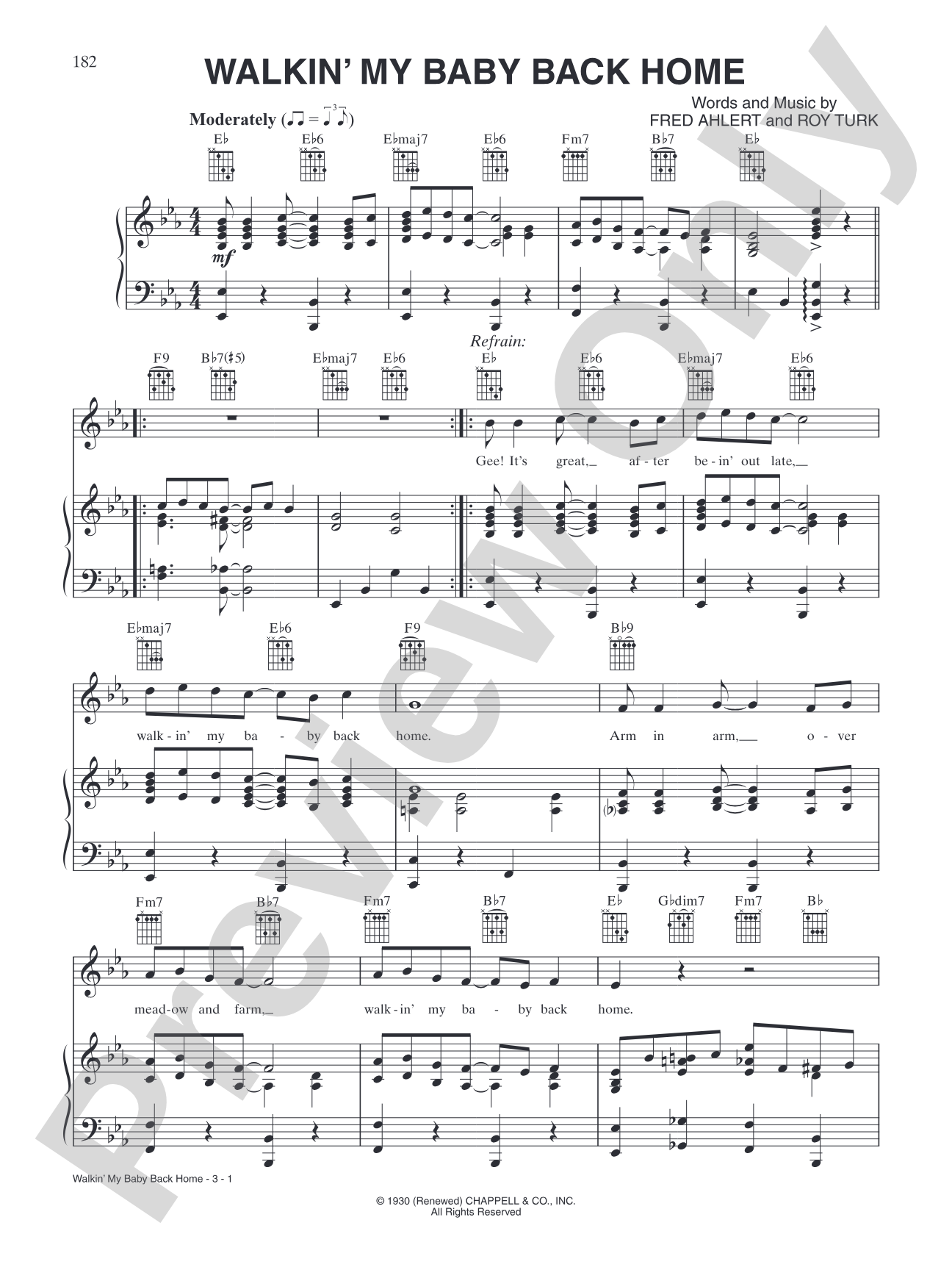

Walkin' My Baby Back Home: Piano/Vocal/Chords
Ten Years of Popular Sheet Music Bestsellers
Item: 00-PS-0010835
$4.99
One moment…
Related Items
Earth Angel: Piano/Vocal/Chords |
$4.99
|
View | |
Volare (Nel Blu, Dipinto di Blu): Piano/Vocal/Chords |
$4.99
|
View | |
Love is a Many Splendored Thing: Piano/Vocal/Chords |
$4.99
|
View | |
Peter Gunn (from "Peter Gunn"): Piano/Vocal/Chords |
$4.99
|
View | |
Mr. Lee: Piano/Vocal/Chords |
$4.99
|
View | |
Lipstick on Your Collar: Piano/Vocal/Chords |
$4.99
|
View | |
Shake Rattle and Roll: Piano/Vocal/Chords |
$4.99
|
View | |
Sh-Boom: Piano/Vocal/Chords |
$4.99
|
View | |
Three Coins in a Fountain (from "Three Coins in a Fountain"): Piano/Vocal/Chords |
$4.99
|
View | |
Summertime Blues: Piano/Vocal/Chords |
$4.99
|
View | |
Who's Sorry now: Piano/Vocal/Chords |
$4.99
|
View | |
See You in September: Piano/Vocal/Chords |
$4.99
|
View | |
The Best is Yet to Come: Piano/Vocal/Chords |
$4.99
|
View | |
You Send Me: Piano/Vocal/Chords |
$4.99
|
View | |
Splish Splash: Piano/Vocal/Chords |
$4.99
|
View | |
Orange Colored Sky: Piano/Vocal/Chords |
$4.99
|
View |
Description
This songbook contains more than 50 of the biggest hits of the 1950s. Each song is sure to spark a memory or create a new one for pianists or vocalists of all ages. For practice, performance, or pleasure, play and sing your way through your favorite decade in pop music history! Titles: A Teenager in Love (Dion and the Belmonts) * All I Have to Do Is Dream (The Everly Brothers) * Best Is Yet to Come (Frank Sinatra) * Bird Dog (Everly Brothers) * Blueberry Hill (Fats Domino) * Bye, Bye Love (Everly Brothers) * Chances Are (Johnny Mathis) * Crying in the Chapel (The Orioles) * Earth Angel (The Penguins) * Everybody Loves to Cha Cha Cha (Sam Cooke) * Everything's Coming Up Roses (from Gypsy) * From This Moment On (Cole Porter) * Great Balls of Fire (Jerry Lee Lewis) * Hey There (Rosemary Clooney) * Hold Me, Thrill Me, Kiss Me (Karen Chandler) * I Could Have Danced All Night (from My Fair Lady) * Just in Time (Tony Bennett) * Lipstick on Your Collar (Connie Francis) * Love and Marriage (Frank Sinatra) * Love Is a Many Splendored Thing (The Four Aces) * Misty (Johnny Mathis) * Mr. Lee (The Bobbettes) * My Special Angel (Bobby Helms) * On the Street Where You Live (from My Fair Lady) * Orange Colored Sky (Nat "King" Cole) * Peter Gunn (Henry Mancini) * Rock Around the Clock (We're Gonna) (Bill Haley and His Comets) * Satin Doll (Duke Ellington) * See You in September (The Tempos) * Shake, Rattle and Roll (Bill Haley and His Comets) * Sh-Boom (Life Could Be a Dream) (The Crew Cuts) * Sixteen Candles (The Crests) * Sixteen Tons (Tennessee Ernie Ford) * Sleigh Ride (Leroy Anderson) * Splish Splash (Bobby Darin) * Summertime Blues (Eddie Cochran) * Thank Heaven for Little Girls (Maurice Chevalier) * That's Entertainment! (Fred Astaire) * Three Coins in the Fountain (The Four Aces) * Till (Percy Faith) * Together Wherever We Go (from Gypsy) * True Love (Bing Crosby) * Volare (Bobby Rydell) * Wake Up, Little Susie (Everly Brothers) * Walkin' My Baby Back Home (Nat "King" Cole) * Whatever Lola Wants (Sarah Vaughan) * When I Fall in Love (Doris Day) * Whole Lotta Shakin' Goin' On (Jerry Lee Lewis) * Who's Sorry Now (Connie Francis) * You Send Me (Sam Cooke) * Your Cheatin' Heart (Hank Williams).


Walkin' My Baby Back Home: Piano/Vocal/Chords isn't in MakeMusic Cloud just yet...but it could be. Let us know you'd like to see it, and you'll help shape what comes next. In the meantime, start a free trial and dive into thousands of interactive titles your students can play along with today.
Request This Title
Tell us you want it.
Start Your Free Trial
Explore everything that's ready to play right now.
Sample Audio
No sample audio found.
Sample Video
No sample videos found.
Additional Details
Series:
Decade by Decade
Publisher:
Alfred Music
Page Count:
208
SKU:
00-PS-0010835
More about this title
About the Composer: Fred E. Ahlert
Fred E. Ahlert was a prolific composer and songwriter who shaped American popular music across the mid-twentieth century. His catalog spans jazz standards, pop hits, and theatrical music, often created in collaboration with lyricist Roy Turk. Ahlert's melodic gift and understanding of what audiences wanted to hear made his work accessible without sacrificing musical integrity.
Ahlert's contributions to 1950s pop culture remain embedded in the era's sound. His ability to craft memorable hooks and singable melodies meant his songs traveled quickly from radio to home piano, making them natural choices for family gatherings and amateur performers seeking the authentic soundtrack of their youth.
Why we love this
This collection captures the moment when pop music became genuinely democratic—when songs traveled from jukebox to radio to the family piano. Each title is instantly recognizable and genuinely fun to play, whether you're relearning the piece you performed at your high school talent show or discovering why your students' grandparents still hum these melodies. The folio balances standards by Sinatra and Ellington alongside novelty records and doo-wop classics, making it equally valuable for nostalgia and as a window into mid-century American popular culture.
What to expect
Opening this book is stepping into a jukebox frozen in time. There's the infectious energy of rock and roll, the smoothness of big band ballads, the sweetness of doo-wop harmonies, and the theatrical sweep of Broadway standards all living on the same pages. These songs carry the optimism and style of the 1950s—a moment when popular music felt fresh, singable, and made for social gathering around a piano or microphone.
Who it's for
Piano teachers and students looking to expand beyond classical repertoire will find immediate payoff here: 208 pages of songs students actually want to learn. Vocalists and accompanists preparing for auditions, recitals, or community performances can draw on dozens of performance-ready arrangements. Community pianists, retirement community musicians, and anyone dusting off piano skills after years away will rediscover the joy of playing music that shaped their teenage years.
How to get the most out of it
- Treat the chord symbols as a guide to improvisation and comping rather than a rigid blueprint. 1950s pop singers often bent phrasing over steady piano accompaniment, so leave room for the vocalist to breathe and shape the melody naturally.
- Pay attention to the rhythmic feel of each song. Rock and roll numbers like 'Great Balls of Fire' and 'Shake, Rattle and Roll' sit in a different groove than smooth ballads like 'Misty' or 'Chances Are,' and the piano's role shifts accordingly.
- Use these songs as a springboard for learning about different vocal styles and eras. Hearing how Fats Domino phrased differs from how Frank Sinatra phrased the same melody teaches more about interpretation than any rule book.
How to use it
Weave individual selections throughout a season: open a community concert with an upbeat novelty number, feature a vocalist on a Sinatra standard during an evening showcase, or build an entire program around 1950s hits for an intergenerational recital. This folio works equally well as a resource for solo practice and pleasure or as a source of accessible material for ensemble singing or piano lessons that need repertoire students genuinely enjoy learning.
Skills your students will build
- Reading and interpreting chord symbols for improvisation
- Understanding the relationship between melody, harmony, and accompaniment
- Performing across vocal styles (ballad, novelty, rock and roll, show tune)
- Developing fluency with mid-century jazz harmony and phrasing
- Learning the historical context of American popular music through performance