
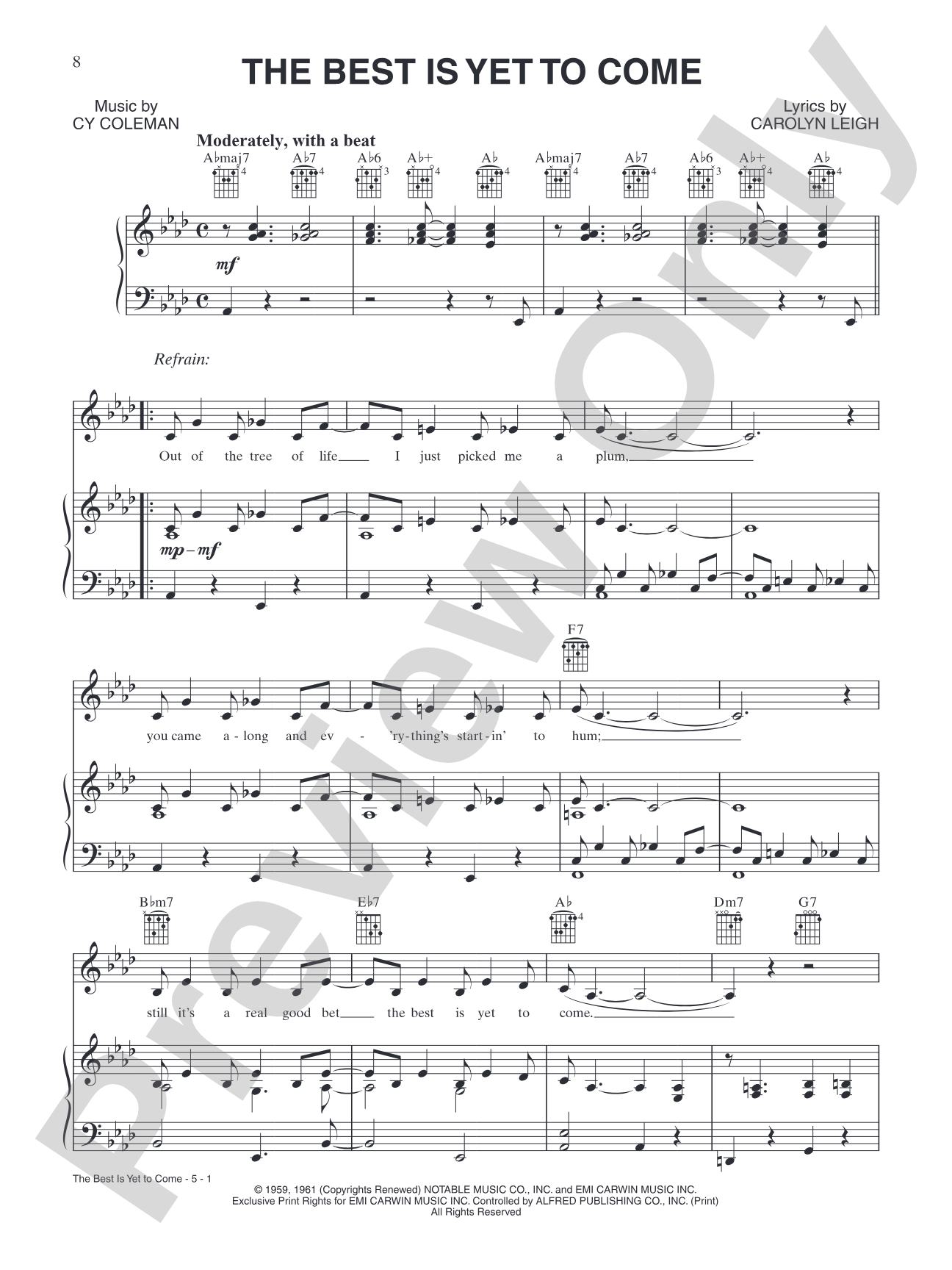

The Best is Yet to Come: Piano/Vocal/Chords
Ten Years of Popular Sheet Music Bestsellers
Item: 00-PS-0010871
$4.99
One moment…
Related Items
Earth Angel: Piano/Vocal/Chords |
$4.99
|
View | |
Volare (Nel Blu, Dipinto di Blu): Piano/Vocal/Chords |
$4.99
|
View | |
Love is a Many Splendored Thing: Piano/Vocal/Chords |
$4.99
|
View | |
Peter Gunn (from "Peter Gunn"): Piano/Vocal/Chords |
$4.99
|
View | |
Mr. Lee: Piano/Vocal/Chords |
$4.99
|
View | |
Lipstick on Your Collar: Piano/Vocal/Chords |
$4.99
|
View | |
Shake Rattle and Roll: Piano/Vocal/Chords |
$4.99
|
View | |
Sh-Boom: Piano/Vocal/Chords |
$4.99
|
View | |
Three Coins in a Fountain (from "Three Coins in a Fountain"): Piano/Vocal/Chords |
$4.99
|
View | |
Walkin' My Baby Back Home: Piano/Vocal/Chords |
$4.99
|
View | |
Summertime Blues: Piano/Vocal/Chords |
$4.99
|
View | |
Who's Sorry now: Piano/Vocal/Chords |
$4.99
|
View | |
See You in September: Piano/Vocal/Chords |
$4.99
|
View | |
You Send Me: Piano/Vocal/Chords |
$4.99
|
View | |
Splish Splash: Piano/Vocal/Chords |
$4.99
|
View | |
Orange Colored Sky: Piano/Vocal/Chords |
$4.99
|
View |
Description
This songbook contains more than 50 of the biggest hits of the 1950s. Each song is sure to spark a memory or create a new one for pianists or vocalists of all ages. For practice, performance, or pleasure, play and sing your way through your favorite decade in pop music history! Titles: A Teenager in Love (Dion and the Belmonts) * All I Have to Do Is Dream (The Everly Brothers) * Best Is Yet to Come (Frank Sinatra) * Bird Dog (Everly Brothers) * Blueberry Hill (Fats Domino) * Bye, Bye Love (Everly Brothers) * Chances Are (Johnny Mathis) * Crying in the Chapel (The Orioles) * Earth Angel (The Penguins) * Everybody Loves to Cha Cha Cha (Sam Cooke) * Everything's Coming Up Roses (from Gypsy) * From This Moment On (Cole Porter) * Great Balls of Fire (Jerry Lee Lewis) * Hey There (Rosemary Clooney) * Hold Me, Thrill Me, Kiss Me (Karen Chandler) * I Could Have Danced All Night (from My Fair Lady) * Just in Time (Tony Bennett) * Lipstick on Your Collar (Connie Francis) * Love and Marriage (Frank Sinatra) * Love Is a Many Splendored Thing (The Four Aces) * Misty (Johnny Mathis) * Mr. Lee (The Bobbettes) * My Special Angel (Bobby Helms) * On the Street Where You Live (from My Fair Lady) * Orange Colored Sky (Nat "King" Cole) * Peter Gunn (Henry Mancini) * Rock Around the Clock (We're Gonna) (Bill Haley and His Comets) * Satin Doll (Duke Ellington) * See You in September (The Tempos) * Shake, Rattle and Roll (Bill Haley and His Comets) * Sh-Boom (Life Could Be a Dream) (The Crew Cuts) * Sixteen Candles (The Crests) * Sixteen Tons (Tennessee Ernie Ford) * Sleigh Ride (Leroy Anderson) * Splish Splash (Bobby Darin) * Summertime Blues (Eddie Cochran) * Thank Heaven for Little Girls (Maurice Chevalier) * That's Entertainment! (Fred Astaire) * Three Coins in the Fountain (The Four Aces) * Till (Percy Faith) * Together Wherever We Go (from Gypsy) * True Love (Bing Crosby) * Volare (Bobby Rydell) * Wake Up, Little Susie (Everly Brothers) * Walkin' My Baby Back Home (Nat "King" Cole) * Whatever Lola Wants (Sarah Vaughan) * When I Fall in Love (Doris Day) * Whole Lotta Shakin' Goin' On (Jerry Lee Lewis) * Who's Sorry Now (Connie Francis) * You Send Me (Sam Cooke) * Your Cheatin' Heart (Hank Williams).


The Best is Yet to Come: Piano/Vocal/Chords isn't in MakeMusic Cloud just yet...but it could be. Let us know you'd like to see it, and you'll help shape what comes next. In the meantime, start a free trial and dive into thousands of interactive titles your students can play along with today.
Request This Title
Tell us you want it.
Start Your Free Trial
Explore everything that's ready to play right now.
Sample Audio
No sample audio found.
Sample Video
No sample videos found.
Additional Details
Series:
Decade by Decade
Publisher:
Alfred Music
Page Count:
208
SKU:
00-PS-0010871
More about this title
About the Composer: Cy Coleman
Cy Coleman was a composer, lyricist, and pianist who shaped the sound of American musical theater and popular song from the 1950s onward. Born in 1929, Coleman brought jazz sophistication and melodic invention to Broadway while simultaneously contributing to the Great American Songbook that defines mid-century pop music.
Coleman's gift for writing singable, memorable melodies made him a natural fit for both theater and commercial recording. His work spans from instrumental jazz compositions to full-scale Broadway scores, and his influence on how composers approach harmony and rhythm in popular music remains central to music education and performance.
Why we love this
This collection captures the genuine diversity of 1950s popular music, from doo-wop and rock and roll to Broadway standards and sophisticated ballads. The songbook balances well-known hits that audiences recognize instantly with deeper repertoire cuts, giving pianists and singers real agency in building a setlist that reflects their taste and the energy they want to create. The chord symbols are clean and straightforward, which means musicians at different reading levels can find their entry point without struggling through overly complex notation.
What to expect
The 1950s emerge in these pages as a decade of genuine stylistic range, from the infectious rhythmic bounce of early rock and roll to the lush, string-influenced ballads that dominated the charts. There's an optimism and directness in these melodies; they were written to be sung and remembered, and that clarity comes through on every page. Performing from this collection feels like stepping into a living jukebox that captures both the sophistication of Broadway and the raw energy of youth culture.
Who it's for
This songbook is designed for pianists and singers who want to perform or practice 1950s hits in an accessible format. It works equally well for solo pianists building a recital repertoire, vocalists preparing audition material or performance sets, and educators introducing students to the melodic and harmonic vocabulary of mid-century American popular music.
How to get the most out of it
- Approach the rhythm and feel of each song as a genre study. The rock and roll numbers (Great Balls of Fire, Rock Around the Clock) need driving energy and clear articulation, while the ballads (Misty, Chances Are) ask for rubato and restraint. Notice how the arrangement cues differ and shape your touch accordingly.
- Use the chord symbols as a foundation for improvisation and personalization. These songs belong in the oral tradition of American music; small variations in voicing, comping patterns, or vocal phrasing are not just acceptable but expected.
- Pay attention to the lyrical rhythm and how it sits against the piano part. 1950s songwriting is built on singability, so if a phrase feels awkward, check whether you're honoring the natural speech rhythm of the words.
- Pair songs thematically rather than chronologically when building a set. Grouping uptempo novelty songs together, or placing ballads in sequence, creates momentum and shapes the emotional arc of your performance.
How to use it
Program selections from this collection to span an entire concert or to anchor a themed set around American popular song. The sheer breadth means you can build an evening that moves between decades of style (early rock and roll, Broadway, crooner ballads) without repeating yourself. It also works beautifully as a resource for students learning to navigate chord symbols and lead sheet notation in a repertoire-based context rather than a method-book setting.
Skills your students will build
- Reading and interpreting chord symbols in a jazz lead sheet format
- Understanding melody-driven songwriting and memorization through well-crafted phrases
- Adapting keyboard voicing and comping patterns to different musical styles (rock and roll, ballad, novelty)
- Balancing melody and accompaniment when singing and playing simultaneously
- Recognizing 1950s harmonic conventions and their relationship to jazz vocabulary