
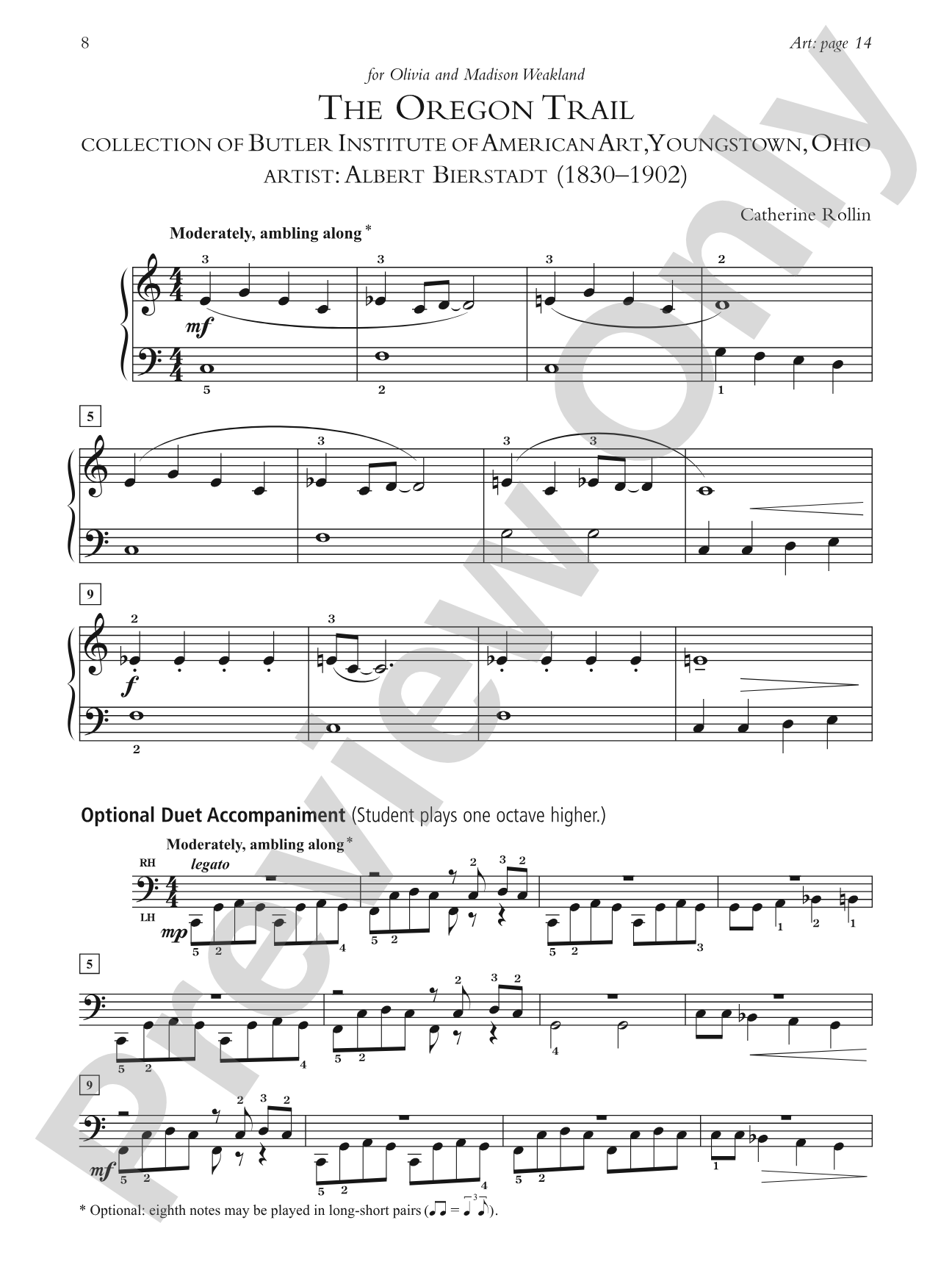

The Oregon Trail - Piano Solo (with Optional Duet Accompaniments): Piano Solo
10 Piano Solos Inspired by Great Works of Art
By Catherine Rollin
Level: Elementary/Late Elementary
Item: 00-PS-0017520
$4.99
Pickup currently not available
Related Items
A Maratha Hunting Party - Piano Solo (with Optional Duet Accompaniments): Piano Solo |
$4.99
|
View | |
At Sea - Piano Solo (with Optional Duet Accompaniments): Piano Solo |
$4.99
|
View | |
Butterflies - Piano Solo (with Optional Duet Accompaniments): Piano Solo |
$4.99
|
View | |
Feeding the Ducks - Piano Solo (with Optional Duet Accompaniments): Piano Solo |
$4.99
|
View | |
Napoleon Crossing the Alps - Piano Solo (with Optional Duet Accompaniments): Piano Solo |
$4.99
|
View | |
Portrait of Adele Bloch-Bauer I - Piano Solo (with Optional Duet Accompaniments): Piano Solo |
$4.99
|
View | |
Rain - Piano Solo (with Optional Duet Accompaniments): Piano Solo |
$4.99
|
View | |
The Swing - Piano Solo (with Optional Duet Accompaniments): Piano Solo |
$4.99
|
View | |
Tiger in a Tropical Storm - Piano Solo (with Optional Duet Accompaniments): Piano Solo |
$4.99
|
View | |
Museum Masterpieces, Book A: Piano Book |
$10.99
|
View |
Description
In Museum Masterpieces, Book A, composer Catherine Rollin has created musical expressions of some of the great works of art found in museums throughout the world. The paintings that inspired these pieces are beautifully displayed on a four-page color insert at the center of the book, along with historical notes about each painting. Titles: At Sea (Albert Edelfelt) * Butterflies (Odilon Redon) * Feeding the Ducks (Mary Cassatt) * A Maratha Hunting Party (Edwin Lord Weeks) * Napoleon Crossing the Alps (Jacques-Louis David) * The Oregon Trail (Albert Bierstadt) * Portrait of Adele Bloch-Bauer I (Gustav Klimt) * Rain (Vincent van Gogh) * The Swing (Pierre-Auguste Renoir) * Tiger in a Tropical Storm (Henri Rousseau). A Federation Festivals 2024-2028 selection.


The Oregon Trail - Piano Solo (with Optional Duet Accompaniments): Piano Solo isn't in MakeMusic Cloud just yet...but it could be. Let us know you'd like to see it, and you'll help shape what comes next. In the meantime, start a free trial and dive into thousands of interactive titles your students can play along with today.
Request This Title
Tell us you want it.
Start Your Free Trial
Explore everything that's ready to play right now.
Sample Audio
No sample audio found.
Sample Video
1 / 2
Additional Details
Series:
Museum Masterpieces
Publisher:
Alfred Music
Page Count:
28
SKU:
00-PS-0017520
More about this title
About the Composer: Catherine Rollin

Catherine Rollin balances an active performance schedule with mentoring accomplished students, having presented masterclasses and workshops across North America and Asia. She holds degrees from the University of Michigan and Oakland University School of Performing Arts, and her compositions have earned commissions from MTNA, the Michigan Music Teachers Association, and Clavier Companion magazine.
Why we love this
Rollin's approach to art-inspired composition gives students a genuine reason to care about the music they're learning. Rather than generic technical exercises, each piece connects to a specific masterwork, complete with historical context and color reproductions, which naturally deepens listening and interpretation skills.
What to expect
These pieces balance technical accessibility with genuine artistry. Each one captures a distinct mood, from the sweeping landscape drama of The Oregon Trail to the intimate charm of Feeding the Ducks, giving students varied emotional territory to navigate.
Who it's for
Elementary and late elementary pianists preparing for recitals or festival performances. This collection works equally well for students exploring classical repertoire independently or as part of a structured curriculum.
How to get the most out of it
- Study the included color reproductions and historical notes before diving into the score. Understanding what the painting conveys will shape how you approach dynamics, tempo flexibility, and character.
- The optional duet accompaniments aren't just padding; they're carefully voiced to support without overwhelming. If you're working with a student, the accompaniment can steady rhythmic confidence while they focus on musical phrasing.
- Resist rushing through the pianistic gestures. These pieces succeed when students play with purpose and clarity, letting each phrase breathe rather than racing through passages.
How to use it
Build a recital around the museum theme by programming several pieces from this collection in sequence, perhaps with brief spoken introductions about each painting. The Federation Festivals 2024-2028 selection status also makes this ideal for contest preparation at the elementary level.
Skills your students will build
- Translating visual imagery into musical expression and character choices
- Controlling touch and tone quality across varied textures
- Shaping phrases with intentional use of dynamics and tempo
- Sight-reading and performing across multiple keys and hand positions
- Collaborating with an accompanist (when using optional duet parts)