
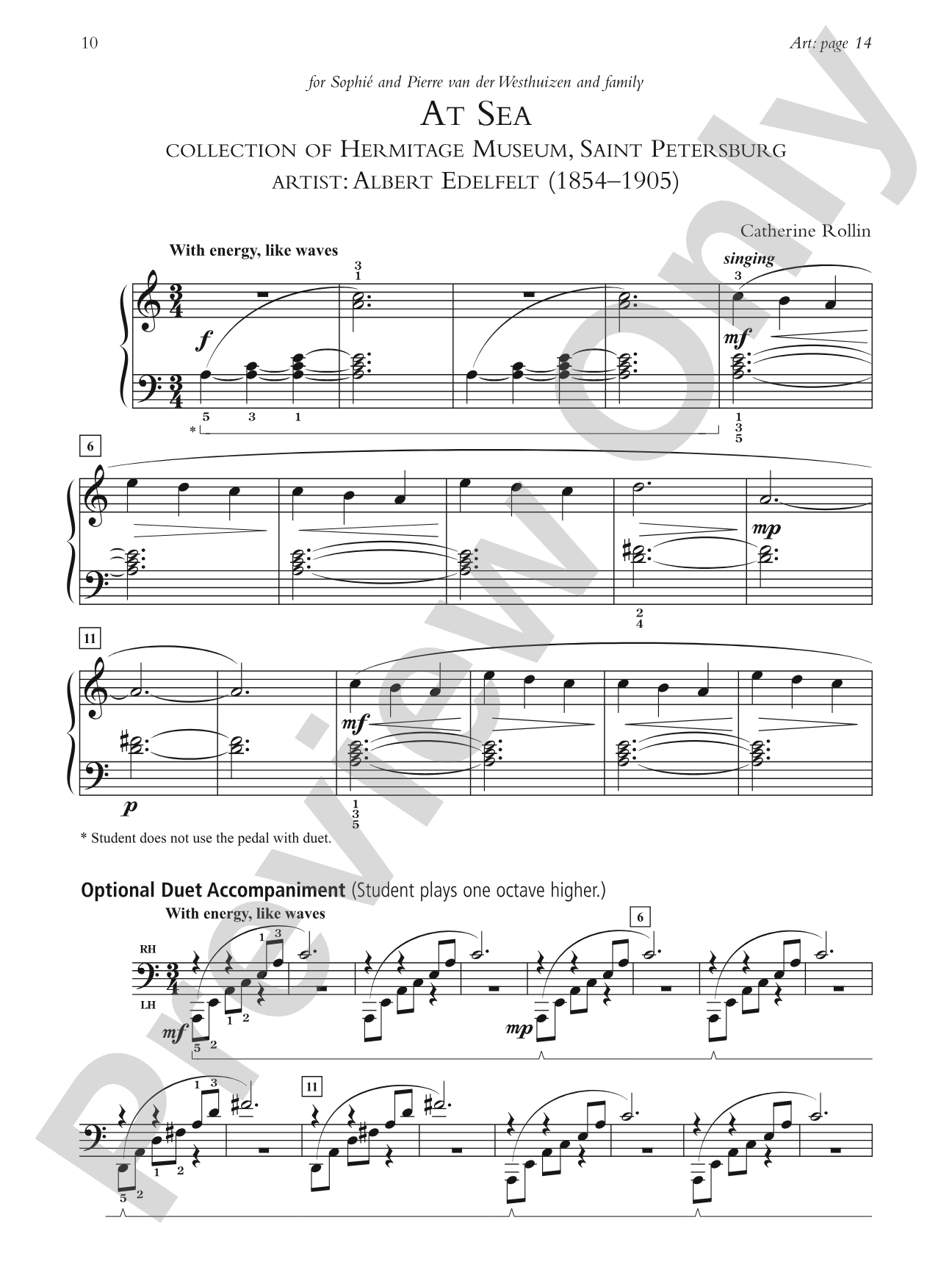

At Sea - Piano Solo (with Optional Duet Accompaniments): Piano Solo
10 Piano Solos Inspired by Great Works of Art
By Catherine Rollin
Level: Elementary/Late Elementary
Item: 00-PS-0017514
$4.99
Pickup currently not available
Related Items
A Maratha Hunting Party - Piano Solo (with Optional Duet Accompaniments): Piano Solo |
$4.99
|
View | |
Butterflies - Piano Solo (with Optional Duet Accompaniments): Piano Solo |
$4.99
|
View | |
Feeding the Ducks - Piano Solo (with Optional Duet Accompaniments): Piano Solo |
$4.99
|
View | |
Napoleon Crossing the Alps - Piano Solo (with Optional Duet Accompaniments): Piano Solo |
$4.99
|
View | |
Portrait of Adele Bloch-Bauer I - Piano Solo (with Optional Duet Accompaniments): Piano Solo |
$4.99
|
View | |
Rain - Piano Solo (with Optional Duet Accompaniments): Piano Solo |
$4.99
|
View | |
The Oregon Trail - Piano Solo (with Optional Duet Accompaniments): Piano Solo |
$4.99
|
View | |
The Swing - Piano Solo (with Optional Duet Accompaniments): Piano Solo |
$4.99
|
View | |
Tiger in a Tropical Storm - Piano Solo (with Optional Duet Accompaniments): Piano Solo |
$4.99
|
View | |
Museum Masterpieces, Book A: Piano Book |
$10.99
|
View |
Description
In Museum Masterpieces, Book A, composer Catherine Rollin has created musical expressions of some of the great works of art found in museums throughout the world. The paintings that inspired these pieces are beautifully displayed on a four-page color insert at the center of the book, along with historical notes about each painting. Titles: At Sea (Albert Edelfelt) * Butterflies (Odilon Redon) * Feeding the Ducks (Mary Cassatt) * A Maratha Hunting Party (Edwin Lord Weeks) * Napoleon Crossing the Alps (Jacques-Louis David) * The Oregon Trail (Albert Bierstadt) * Portrait of Adele Bloch-Bauer I (Gustav Klimt) * Rain (Vincent van Gogh) * The Swing (Pierre-Auguste Renoir) * Tiger in a Tropical Storm (Henri Rousseau). A Federation Festivals 2024-2028 selection.


Discover MakeMusic Cloud: thousands of interactive titles your students can play along with today.
Sample Audio
No sample audio found.
Sample Video
1 / 2
Additional Details
Series:
Museum Masterpieces
Publisher:
Alfred Music
Page Count:
28
SKU:
00-PS-0017514
More about this title
About the Composer: Catherine Rollin

Catherine Rollin balances an active performing schedule with mentoring young pianists who regularly advance to festival competitions. She holds degrees from the University of Michigan and Oakland University School of Performing Arts, and her work has earned commissions from the Music Teachers National Association, Clavier Companion, and the Michigan Music Teachers Association. Her compositions regularly appear on National Federation of Music Clubs festival selections.
Rollin's influence extends beyond composition into the national music education landscape. She has adjudicated the MTNA Student Composition Competition at the national level and served on the jury for the prestigious Lynn Freeman Olson Composition Contest. Her multimedia presentation of the Museum Masterpieces series earned an ASCAP award, and she was honored by the Steinway Society as both composer and pianist in 2018. The MTNA commissioned her trio for flute, alto saxophone, and piano, which premiered at their 2018 national conference.
Why we love this
Rollin anchors each piece to a real artwork, creating a natural bridge between visual and musical literacy that engages students who might otherwise feel disconnected from classical piano study. The optional duet accompaniments offer flexibility for studio teachers and group piano classes, allowing you to differentiate based on student progress without requiring separate repertoire purchases. These are genuinely musical arrangements, not simplifications, which means advanced students can explore interesting harmonic textures while accompanying younger players.
What to expect
The music captures the calm contemplation and movement of water, with textures that shimmer and shift beneath the melody. There's a painterly quality to the voicing, transparent in places, impressionistic in others, that invites pianists to think about color and atmosphere rather than just hitting the right notes.
Who it's for
Late elementary pianists ready to explore expressive playing and musical storytelling, as well as teachers seeking recital repertoire that connects to visual arts curriculum. The duet option also serves intermediate accompanists who benefit from realistic collaborative experience.
How to get the most out of it
- Spend time with the color reproductions and historical notes before teaching the piece. Students who understand what Edelfelt was painting will interpret the musical imagery with more conviction.
- If using the duet accompaniment, rehearse hands separately first; the accompanist's part creates a harmonic foundation that clarifies the solo line's relationship to the overall sound.
- Balance the narrative arc across the entire collection. These pieces work as standalone recital numbers, but programming several in sequence creates a gallery-walk experience that audiences find memorable.
How to use it
These pieces thrive in recitals organized around thematic programming or when paired with visual displays. They also work well in studio galas where multiple students perform pieces from the same collection, creating visual and musical continuity throughout the concert.
Skills your students will build
- Translating visual imagery into musical expression
- Playing with dynamic shaping and tonal color over simple harmonic progressions
- Sight-reading elementary repertoire at a steady tempo without stopping
- Collaborating as a soloist with an accompanist
- Understanding how historical context informs interpretation