
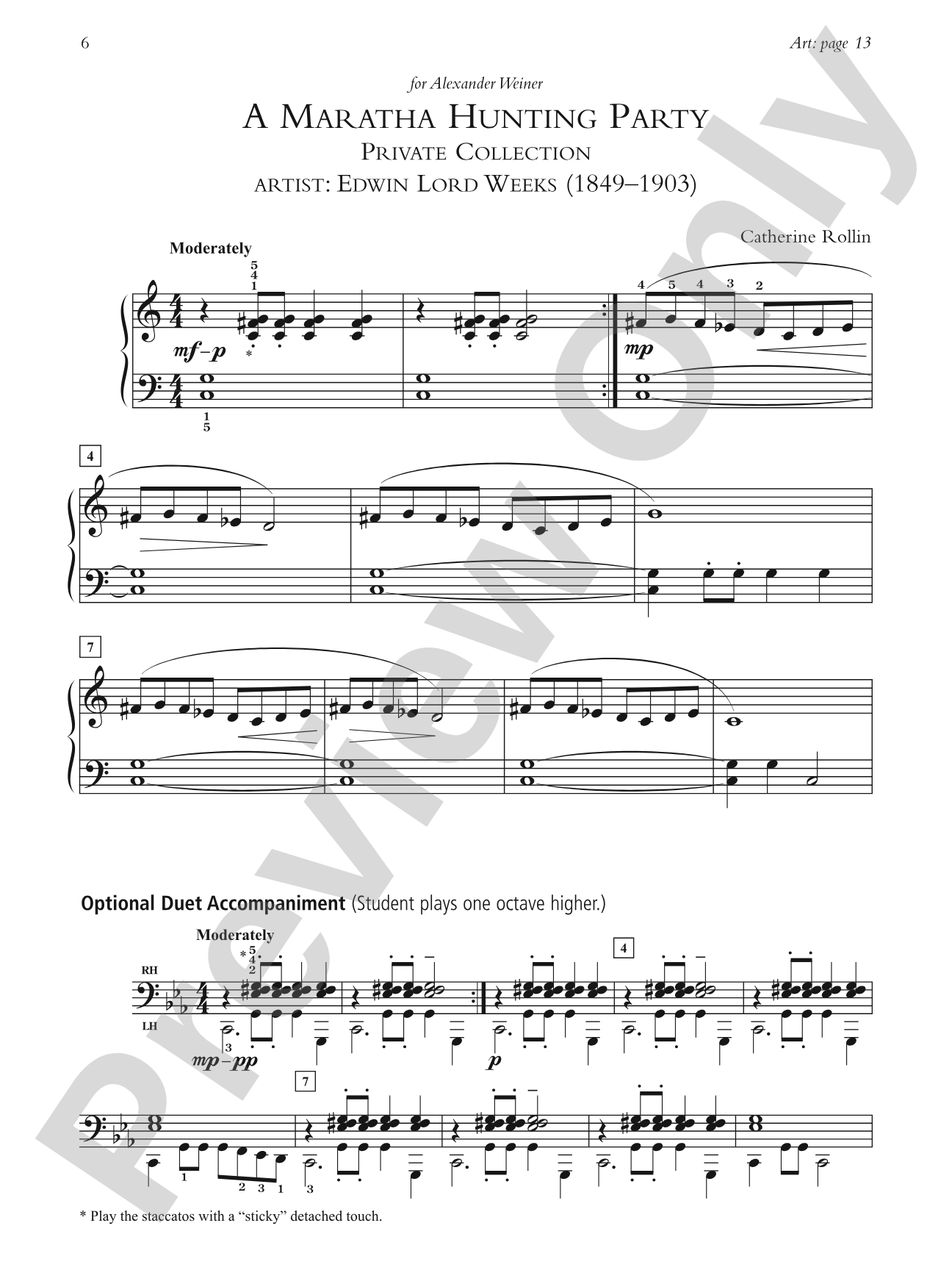

A Maratha Hunting Party - Piano Solo (with Optional Duet Accompaniments): Piano Solo
10 Piano Solos Inspired by Great Works of Art
By Catherine Rollin
Level: Elementary/Late Elementary
Item: 00-PS-0017513
$4.99
Pickup currently not available
Related Items
At Sea - Piano Solo (with Optional Duet Accompaniments): Piano Solo |
$4.99
|
View | |
Butterflies - Piano Solo (with Optional Duet Accompaniments): Piano Solo |
$4.99
|
View | |
Feeding the Ducks - Piano Solo (with Optional Duet Accompaniments): Piano Solo |
$4.99
|
View | |
Napoleon Crossing the Alps - Piano Solo (with Optional Duet Accompaniments): Piano Solo |
$4.99
|
View | |
Portrait of Adele Bloch-Bauer I - Piano Solo (with Optional Duet Accompaniments): Piano Solo |
$4.99
|
View | |
Rain - Piano Solo (with Optional Duet Accompaniments): Piano Solo |
$4.99
|
View | |
The Oregon Trail - Piano Solo (with Optional Duet Accompaniments): Piano Solo |
$4.99
|
View | |
The Swing - Piano Solo (with Optional Duet Accompaniments): Piano Solo |
$4.99
|
View | |
Tiger in a Tropical Storm - Piano Solo (with Optional Duet Accompaniments): Piano Solo |
$4.99
|
View | |
Museum Masterpieces, Book A: Piano Book |
$10.99
|
View |
Description
In Museum Masterpieces, Book A, composer Catherine Rollin has created musical expressions of some of the great works of art found in museums throughout the world. The paintings that inspired these pieces are beautifully displayed on a four-page color insert at the center of the book, along with historical notes about each painting. Titles: At Sea (Albert Edelfelt) * Butterflies (Odilon Redon) * Feeding the Ducks (Mary Cassatt) * A Maratha Hunting Party (Edwin Lord Weeks) * Napoleon Crossing the Alps (Jacques-Louis David) * The Oregon Trail (Albert Bierstadt) * Portrait of Adele Bloch-Bauer I (Gustav Klimt) * Rain (Vincent van Gogh) * The Swing (Pierre-Auguste Renoir) * Tiger in a Tropical Storm (Henri Rousseau). A Federation Festivals 2024-2028 selection.


A Maratha Hunting Party - Piano Solo (with Optional Duet Accompaniments): Piano Solo isn't in MakeMusic Cloud just yet...but it could be. Let us know you'd like to see it, and you'll help shape what comes next. In the meantime, start a free trial and dive into thousands of interactive titles your students can play along with today.
Request This Title
Tell us you want it.
Start Your Free Trial
Explore everything that's ready to play right now.
Sample Audio
No sample audio found.
Sample Video
1 / 2
Additional Details
Series:
Museum Masterpieces
Publisher:
Alfred Music
Page Count:
28
SKU:
00-PS-0017513
More about this title
About the Composer: Catherine Rollin

Catherine Rollin maintains an active dual career as both a performing pianist and a composition teacher whose students have earned numerous festival awards. She holds a Bachelor of Musical Arts with distinction from the University of Michigan and a Master of Music from Oakland University School of Performing Arts, and has conducted masterclasses and workshops across North America and Asia.
Rollin's compositional work has earned commissions from Clavier Companion, the Music Teachers National Association, and the Michigan Music Teachers Association. Her pieces appear regularly on National Federation of Music Clubs festival lists, and she has served as a judge for major national composition competitions including the MTNA Student Composition Competition and the Lynn Freeman Olson Contest. Her ASCAP award-winning Museum Masterpieces series, which pairs visual art with music, has been featured by the Steinway Society and premiered works like Suite Detroit at the 2018 MTNA national conference.
Why we love this
Rollin has engineered something genuinely thoughtful here: each piece in Museum Masterpieces captures a distinct visual and emotional quality from its source painting, so students actually learn how music translates pictorial detail into sound. The optional duet accompaniments make this flexible for solo recitals or chamber performance, giving you programming options within a single purchase.
What to expect
A snapshot of movement and energy caught in paint, now singing through the keyboard. The piece channels the vitality of its subject without becoming overly literal, inviting pianists to discover their own sense of action and momentum within Rollin's clear musical frame.
Who it's for
Elementary and late elementary pianists preparing for recitals or festival performances. Students benefit from the visual inspiration and historical context, which deepen engagement beyond typical technical study. Teachers will appreciate the optional duet accompaniments for flexible performance options and collaborative learning.
How to get the most out of it
- Reference the color reproductions and historical notes before learning the piece. Knowing what Weeks was depicting in the hunting scene will shape your interpretation of tempo and dynamic shaping throughout.
- If performing with duet accompaniment, establish a clear sound hierarchy early in rehearsal. The solo line should sing above the accompaniment without either part feeling secondary.
- Balance rhythmic energy with phrase direction. Hunting party music can feel scattered if each gesture lands separately; connect the melodic line through its natural arcs.
How to use it
Feature this alongside other pieces from Museum Masterpieces to create a thematic recital exploring art and music together. You might also pair it with a duet accompanist for a chamber performance that shows students how ensemble playing enriches solo repertoire. The festival selection designation makes it a reliable choice for spring competitions.
Skills your students will build
- Connecting visual imagery to musical interpretation and phrasing
- Playing with rhythmic clarity and forward momentum in moderately fast passages
- Balancing melody and accompaniment when duet parts are used
- Sustaining interest through repeated melodic figures while maintaining expressive variety
- Understanding rubato and tempo flexibility within a structured harmonic framework