
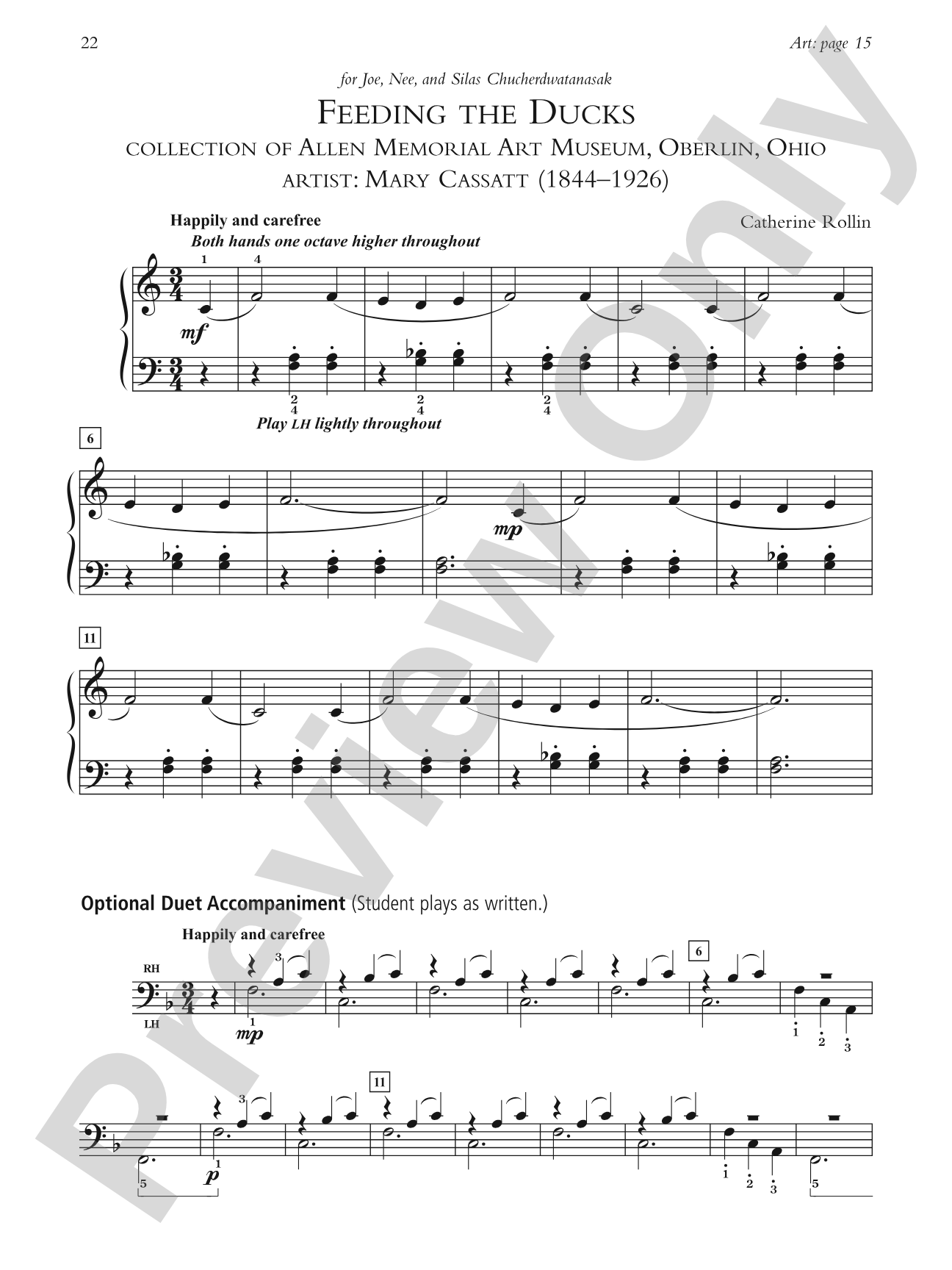

Feeding the Ducks - Piano Solo (with Optional Duet Accompaniments): Piano Solo
10 Piano Solos Inspired by Great Works of Art
By Catherine Rollin
Level: Elementary/Late Elementary
Item: 00-PS-0017516
$4.99
Pickup currently not available
Related Items
A Maratha Hunting Party - Piano Solo (with Optional Duet Accompaniments): Piano Solo |
$4.99
|
View | |
At Sea - Piano Solo (with Optional Duet Accompaniments): Piano Solo |
$4.99
|
View | |
Butterflies - Piano Solo (with Optional Duet Accompaniments): Piano Solo |
$4.99
|
View | |
Napoleon Crossing the Alps - Piano Solo (with Optional Duet Accompaniments): Piano Solo |
$4.99
|
View | |
Portrait of Adele Bloch-Bauer I - Piano Solo (with Optional Duet Accompaniments): Piano Solo |
$4.99
|
View | |
Rain - Piano Solo (with Optional Duet Accompaniments): Piano Solo |
$4.99
|
View | |
The Oregon Trail - Piano Solo (with Optional Duet Accompaniments): Piano Solo |
$4.99
|
View | |
The Swing - Piano Solo (with Optional Duet Accompaniments): Piano Solo |
$4.99
|
View | |
Tiger in a Tropical Storm - Piano Solo (with Optional Duet Accompaniments): Piano Solo |
$4.99
|
View | |
Museum Masterpieces, Book A: Piano Book |
$10.99
|
View |
Description
In Museum Masterpieces, Book A, composer Catherine Rollin has created musical expressions of some of the great works of art found in museums throughout the world. The paintings that inspired these pieces are beautifully displayed on a four-page color insert at the center of the book, along with historical notes about each painting. Titles: At Sea (Albert Edelfelt) * Butterflies (Odilon Redon) * Feeding the Ducks (Mary Cassatt) * A Maratha Hunting Party (Edwin Lord Weeks) * Napoleon Crossing the Alps (Jacques-Louis David) * The Oregon Trail (Albert Bierstadt) * Portrait of Adele Bloch-Bauer I (Gustav Klimt) * Rain (Vincent van Gogh) * The Swing (Pierre-Auguste Renoir) * Tiger in a Tropical Storm (Henri Rousseau). A Federation Festivals 2024-2028 selection.


Feeding the Ducks - Piano Solo (with Optional Duet Accompaniments): Piano Solo isn't in MakeMusic Cloud just yet...but it could be. Let us know you'd like to see it, and you'll help shape what comes next. In the meantime, start a free trial and dive into thousands of interactive titles your students can play along with today.
Request This Title
Tell us you want it.
Start Your Free Trial
Explore everything that's ready to play right now.
Sample Audio
No sample audio found.
Sample Video
1 / 2
Additional Details
Series:
Museum Masterpieces
Publisher:
Alfred Music
Page Count:
28
SKU:
00-PS-0017516
More about this title
About the Composer: Catherine Rollin

Catherine Rollin balances an active performance schedule with mentoring award-winning piano students. She has presented workshops and masterclasses across the United States, Canada, Japan, and Taiwan, earning her BMA with distinction from the University of Michigan and an MM from Oakland University School of Performing Arts.
Her compositions have garnered consistent recognition from major music organizations. Rollin has received commissions from Clavier Companion, MTNA, and the Michigan Music Teachers Association, with multiple works selected for the National Federation of Music Clubs Festivals Bulletin. She served as a national judge for the MTNA Student Composition Competition and sat on the panel for the prestigious Lynn Freeman Olson Composition Contest. In 2018, MTNA commissioned Suite Detroit, a trio for flute, alto saxophone, and piano, which premiered at the national conference. That same year, the Steinway Society featured her in concert as both composer and pianist, showcasing her ASCAP award-winning Museum Masterpieces series.
Why we love this
Rollin's approach here is refreshingly concrete: rather than abstract emotional concepts, students engage with actual paintings and the compositional choices that reflect them. The optional duet accompaniments give you flexible pedagogical options, whether you need motivating ensemble experiences or want to keep individual students focused on their own parts. This collection earned Federation selection because the writing respects young pianists' growing musicality without condescending to them.
What to expect
These pieces breathe with a gentle curiosity. Rollin's language is direct and pianistic, built on accessible harmonies that still surprise, with moments of descriptive color that feel earned rather than forced. The writing encourages students to listen for inner voice movement and tonal clarity rather than relying on pedal.
Who it's for
This collection works for elementary and late elementary pianists preparing for recitals or festivals. Teachers seeking repertoire that connects music to visual art will find this especially valuable for students who benefit from extra context and meaning beyond the notes.
How to get the most out of it
- Study the color insert alongside the score. Knowing what inspired each piece transforms a technical exercise into storytelling, which helps students find musical intention at an early level.
- If using the duet accompaniment, rehearse separately from the solo part first. Let students hear and feel the texture they're entering before combining it with their own line.
- Shape the phrasing with attention to how the painting's composition guides your eye. Rollin mirrors visual balance through harmonic movement and phrase length, rewarding students who think visually.
How to use it
Create a recital segment pairing several titles from this collection with a brief commentary on the paintings. Alternatively, weave one piece into a recital themed around a particular artist or museum. The Federation selection status makes these natural choices for festival preparation, and the optional accompaniments allow you to feature a particularly strong student with ensemble support if programming allows.
Skills your students will build
- Tone control and clarity in both hands through transparent textures
- Phrasing shaped by visual imagery and harmonic movement
- Sight-reading fluency across varied keys and harmonic contexts
- Collaborative listening when playing with optional duet accompaniment
- Musical communication through character pieces with narrative connection