
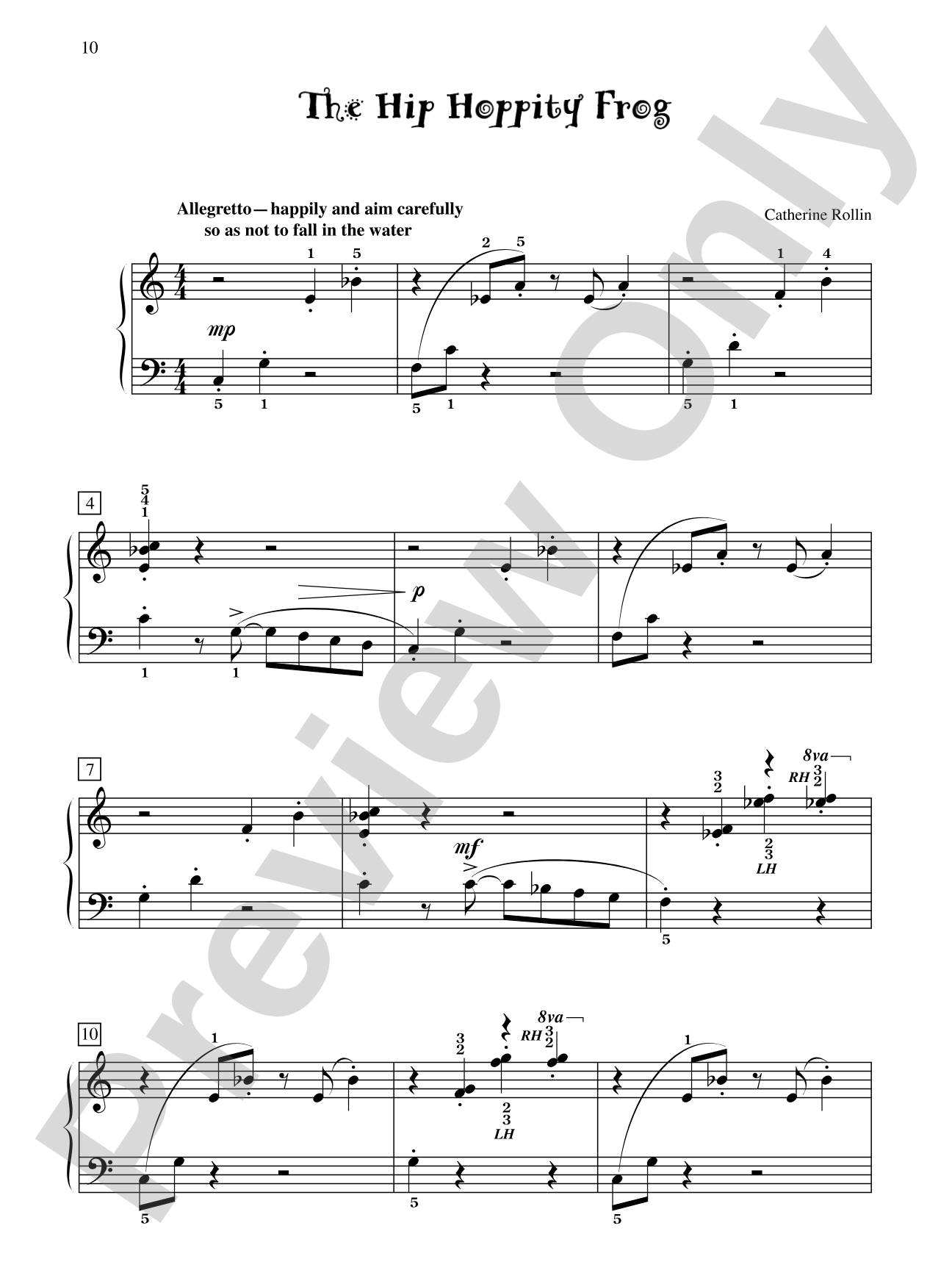

The Hip Hoppity Frog - Piano Solo: Piano Solo
7 Light-Hearted Solos in a Variety of Styles for the Late Elementary Pianist
By Catherine Rollin
Level: Late Elementary
Item: 00-PS-0017459
$4.99
Pickup currently not available
Related Items
Bear and Birdie Waltz - Piano Solo: Piano Solo |
$4.99
|
View | |
Camel's Back Blues - Piano Solo: Piano Solo |
$4.99
|
View | |
Parrot Blues - Piano Solo: Piano Solo |
$4.99
|
View | |
Penguin Waddle Rag - Piano Solo: Piano Solo |
$4.99
|
View | |
Tiger Boogie - Piano Solo: Piano Solo |
$4.99
|
View | |
Woodpecker's Peckin' Party - Piano Solo: Piano Solo |
$5.95
|
View | |
Jazz Menagerie, Book 1: Piano Book |
$5.95
|
View |
Description
These two collections draw upon animals as a wonderful source of inspiration for the musical imagination. Students will enjoy the hints of jazz sounds and rhythms, but most importantly, these pieces will entertain and spark their imagination. Book 1 is written at the late elementary level while Book 2 contains solos at the early intermediate level. A Federation Festivals 2024-2028 selection.


The Hip Hoppity Frog - Piano Solo: Piano Solo isn't in MakeMusic Cloud just yet...but it could be. Let us know you'd like to see it, and you'll help shape what comes next. In the meantime, start a free trial and dive into thousands of interactive titles your students can play along with today.
Request This Title
Tell us you want it.
Start Your Free Trial
Explore everything that's ready to play right now.
Sample Audio
No sample audio found.
Sample Video
No sample videos found.
Additional Details
Publisher:
Alfred Music
Page Count:
16
SKU:
00-PS-0017459
More about this title
About the Composer: Catherine Rollin

Catherine Rollin balances an active composing practice with mentoring high-achieving piano students, having conducted workshops and masterclasses in over 200 cities across the United States, Canada, Japan, and Taiwan. She holds a Bachelor of Musical Arts degree with distinction from the University of Michigan and a Master of Music degree from Oakland University School of Performing Arts. Her compositions have earned commissions from Clavier Companion magazine, the Music Teachers National Association (MTNA), and the Michigan Music Teachers Association, with multiple selections appearing in the National Federation of Music Clubs Festivals Bulletin.
Rollin has served as a judge for the MTNA Student Composition Competition at the national level and sat on the panel for the Lynn Freeman Olson Composition Contest. In 2018, she received a prestigious commission from MTNA's From the Pen to the Premiere series, resulting in Suite Detroit for flute, alto saxophone, and piano, which premiered at the MTNA national conference in Orlando. That same year, the Steinway Society featured her in concert as both composer and pianist, highlighting her ASCAP award-winning Museum Masterpieces series.
Why we love this
Rollin's use of animal characters as a springboard for jazz exploration gives students permission to be playful while tackling real rhythmic and harmonic vocabulary. The hints of swing feel and syncopation emerge naturally from the narrative rather than feeling imposed, which means students stay engaged with the musical work instead of fighting against the style.
What to expect
Bouncy and clever, with a lightness that comes from genuine jazz inflections rather than cartoon imitation. The piece captures the springing energy of its subject while inviting students to inhabit the character musically.
Who it's for
Late elementary pianists ready to explore jazz vocabulary without abandoning the accessibility of their level. Students who respond to character and storytelling will find the frog's personality a natural hook for sustained practice and performance confidence.
How to get the most out of it
- Emphasize the groove by letting the swing feel breathe in the offbeat accents; resist rushing the jazzy rhythms, which tend to tighten under performance nerves.
- Record yourself playing the piece at a comfortable tempo, then listen back to identify where the character of the frog comes through most clearly and where it gets muddied.
- Use the Federation Festivals context as motivation: this selection means your student is preparing repertoire that meets rigorous national standards, which changes how they approach practice.
How to use it
This works wonderfully as a spring recital closer or as part of a thematic concert pairing animal-inspired pieces with other contemporary works. The Federation Festivals 2024-2028 selection status also makes it ideal for students preparing for adjudicated events who need engaging repertoire that meets organizational standards.
Skills your students will build
- Reading and executing swing rhythms in a jazz style
- Interpreting syncopation and offbeat accents
- Sustaining a consistent groove while managing tempo
- Translating character and narrative into musical expression
- Familiarity with jazz harmony and rhythmic vocabulary at an accessible level