
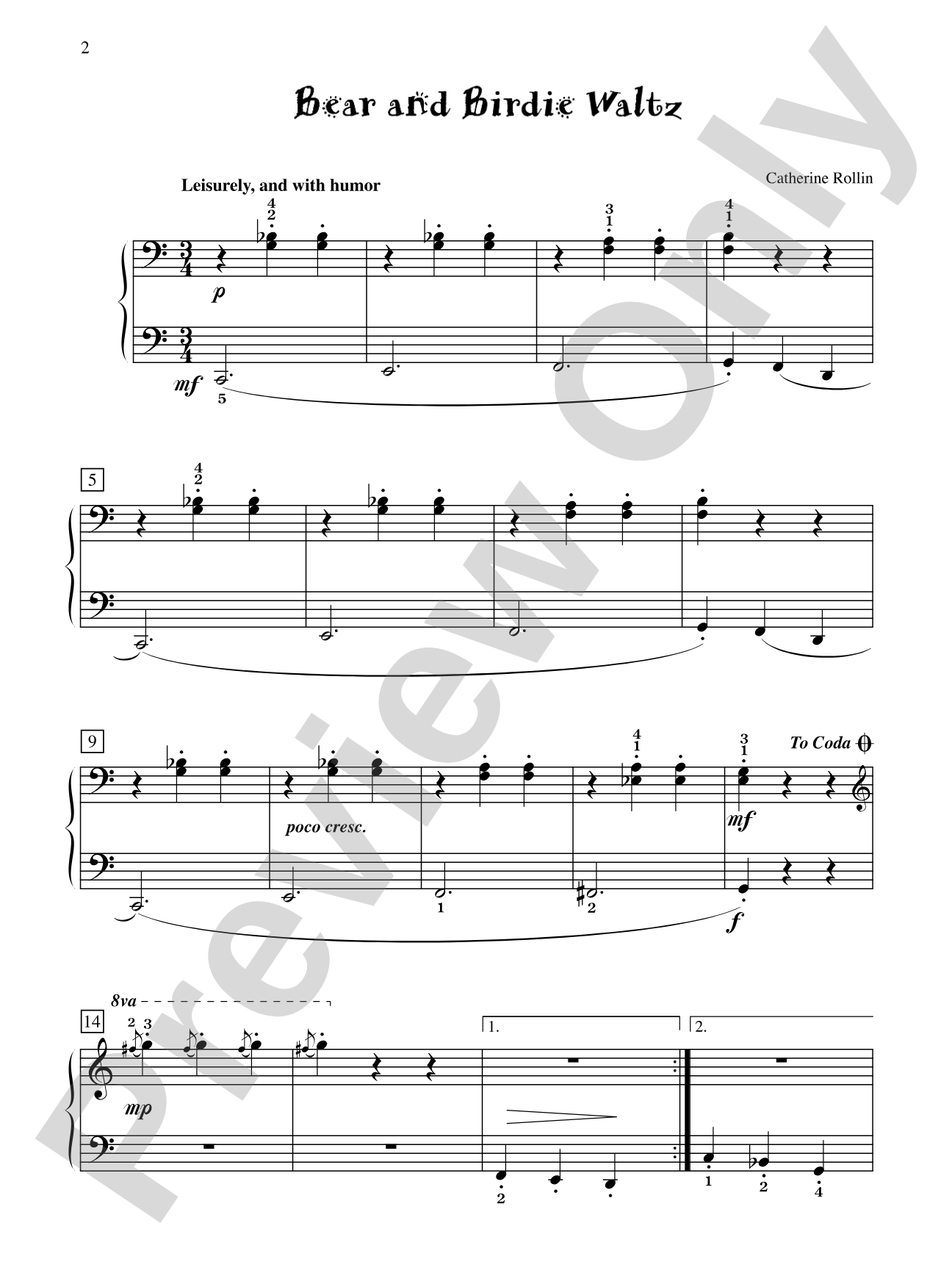

Bear and Birdie Waltz - Piano Solo: Piano Solo
7 Light-Hearted Solos in a Variety of Styles for the Late Elementary Pianist
By Catherine Rollin
Level: Late Elementary
Item: 00-PS-0017455
$4.99
Pickup currently not available
Related Items
Camel's Back Blues - Piano Solo: Piano Solo |
$4.99
|
View | |
Parrot Blues - Piano Solo: Piano Solo |
$4.99
|
View | |
Penguin Waddle Rag - Piano Solo: Piano Solo |
$4.99
|
View | |
The Hip Hoppity Frog - Piano Solo: Piano Solo |
$4.99
|
View | |
Tiger Boogie - Piano Solo: Piano Solo |
$4.99
|
View | |
Woodpecker's Peckin' Party - Piano Solo: Piano Solo |
$5.95
|
View | |
Jazz Menagerie, Book 1: Piano Book |
$5.95
|
View |
Description
These two collections draw upon animals as a wonderful source of inspiration for the musical imagination. Students will enjoy the hints of jazz sounds and rhythms, but most importantly, these pieces will entertain and spark their imagination. Book 1 is written at the late elementary level while Book 2 contains solos at the early intermediate level. A Federation Festivals 2024-2028 selection.


Bear and Birdie Waltz - Piano Solo: Piano Solo isn't in MakeMusic Cloud just yet...but it could be. Let us know you'd like to see it, and you'll help shape what comes next. In the meantime, start a free trial and dive into thousands of interactive titles your students can play along with today.
Request This Title
Tell us you want it.
Start Your Free Trial
Explore everything that's ready to play right now.
Sample Audio
No sample audio found.
Sample Video
No sample videos found.
Additional Details
Publisher:
Alfred Music
Page Count:
16
SKU:
00-PS-0017455
More about this title
About the Composer: Catherine Rollin

Catherine Rollin splits her time between the concert stage and the studio, where she develops students who consistently earn festival recognition. She holds degrees from the University of Michigan and Oakland University School of Performing Arts, and her compositional voice has earned commissions from MTNA, the Michigan Music Teachers Association, and Clavier Companion magazine.
Rollin's work appears regularly on National Federation of Music Clubs festival lists, and she has judged at the national level for MTNA competitions and the Lynn Freeman Olson Composition Contest. Her ASCAP award-winning Museum Masterpieces series showcases her gift for narrative music-making, while recent commissions like Suite Detroit (premiered at the 2018 MTNA national conference) demonstrate her range across genres and ensembles. She has presented workshops and masterclasses across North America and Asia.
Why we love this
Rollin writes music that students actually want to practice. The jazz inflections feel contemporary without requiring students to abandon classical technique, and the animal themes create narrative hooks that spark genuine musical curiosity rather than obligatory lesson-book playing. At late elementary level, this piece balances accessible melodic writing with enough harmonic interest to keep engaged students challenged.
What to expect
Jazz harmonies and playful rhythmic gestures create a warm, modern sound that never loses its lyrical center. The piece breathes with personality and humor, drawing the listener into a gentle narrative moment that feels more like storytelling than exercise.
Who it's for
Late elementary pianists ready to explore sounds beyond classical repertoire, but who still need strong foundational technique. Students preparing for festival competitions will find this especially valuable since it's a Federation Festivals 2024-2028 selection.
How to get the most out of it
- Listen through the recorded accompaniment first without the score to absorb the jazz groove before mapping out your own part. The rhythmic ease comes from internalizing the swing feel, not from strict metronome drilling.
- Experiment with pedal changes on the downbeats of harmonic shifts rather than holding throughout entire phrases. The jazz idiom benefits from clarity in the accompaniment texture.
- Shape the melody with dynamic contrast between registers. When the material moves to higher or lower octaves, let the registral change inform your touch and volume naturally.
How to use it
This works particularly well in recitals alongside other pieces from Rollin's animal collections, allowing you to program an entire suite with thematic coherence. It also serves as an excellent bridge repertoire for students transitioning from purely classical study into jazz and contemporary idioms.
Skills your students will build
- Jazz swing rhythm interpretation (eighth-note triplet feel)
- Reading and executing jazz chord symbols with voice leading
- Dynamic shaping across register changes
- Pedal technique with harmonic awareness rather than automatic sustain
- Balancing melody and accompaniment texture in a single hand