
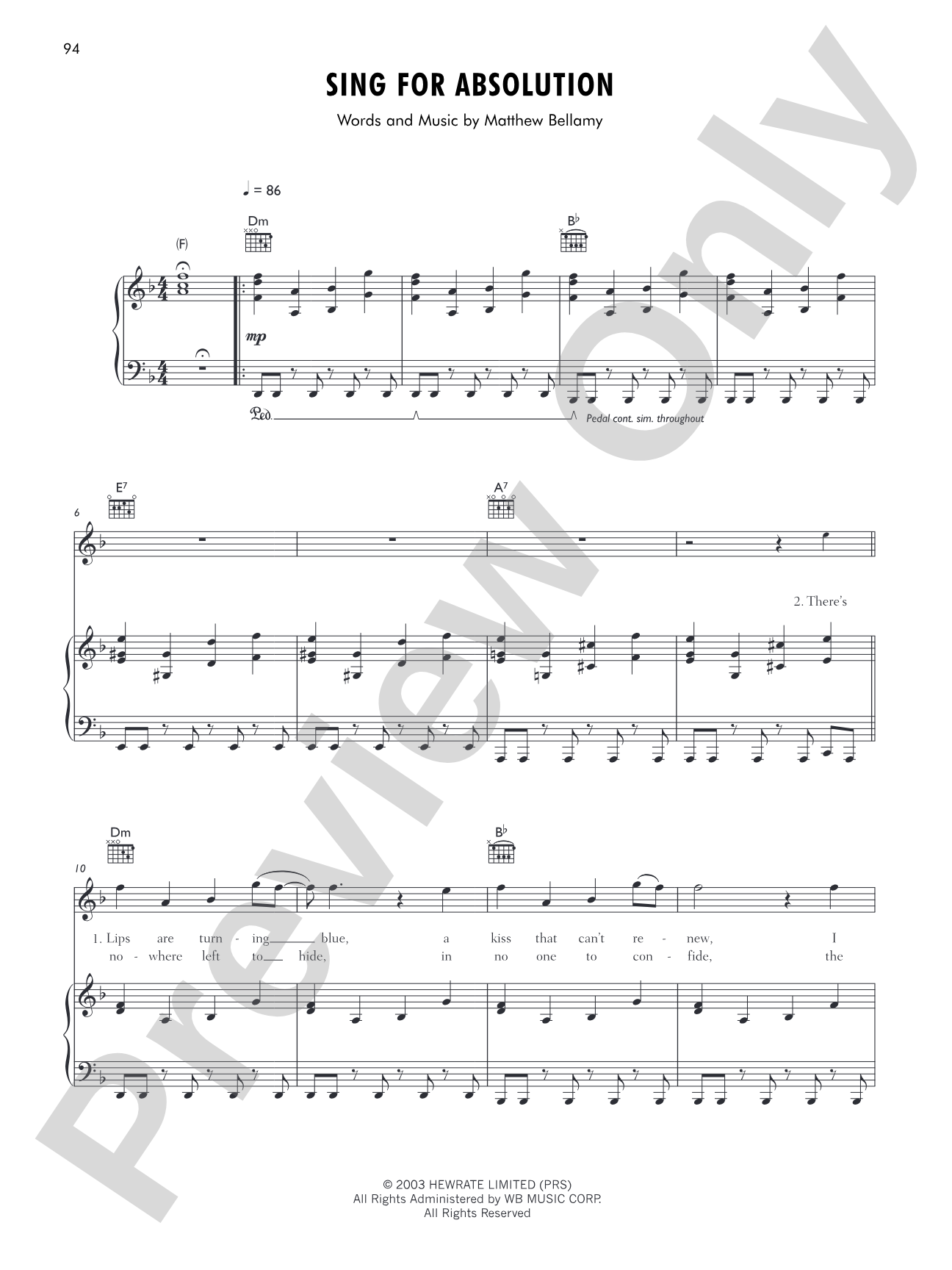

Sing for Absolution: Piano/Vocal/Chords
Muse
Item: 00-PS-0013330
$4.99
One moment…
Related Items
Space Demetia: Piano/Vocal/Chords |
$5.99
|
View | |
Sunburn: Piano/Vocal/Chords |
$5.99
|
View | |
Apocalypse Please: Piano/Vocal/Chords |
$4.99
|
View | |
Blackout: Piano/Vocal/Chords |
$4.99
|
View | |
Butterflies & Hurricanes: Piano/Vocal/Chords |
$5.99
|
View | |
Endlessly: Piano/Vocal/Chords |
$4.99
|
View | |
Ruled By Secrecy: Piano/Vocal/Chords |
$5.99
|
View | |
Neutron Star Collision (Love is Forever): Piano/Vocal/Chords |
$5.99
|
View |
Description
This songbook features piano sheet music for 22 songs selected from five albums by award-winning progressive hard rock band Muse. Note-for-note keyboard transcriptions are woven into arrangements that make each song playable on piano from start to finish. Complete vocal melodies and lyrics are included, along with basic chord grids for guitar. Titles: Apocalypse Please * Blackout * Butterflies & Hurricanes * Endlessly * Exogenesis: Symphony, Part 1 (Overture) * Exogenesis: Symphony, Part 2 (Cross-Pollination) * Exogenesis: Symphony, Part 3 (Redemption) * Feeling Good * Hoodoo * I Belong to You * Invincible * Neutron Star Collision * Resistance * Ruled by Secrecy * Sing for Absolution * Soldier's Poem * Space Dementia * Starlight * Sunburn * Take a Bow * Undisclosed Desires * United States of Eurasia / Collateral Damage.


Sing for Absolution: Piano/Vocal/Chords isn't in MakeMusic Cloud just yet...but it could be. Let us know you'd like to see it, and you'll help shape what comes next. In the meantime, start a free trial and dive into thousands of interactive titles your students can play along with today.
Request This Title
Tell us you want it.
Start Your Free Trial
Explore everything that's ready to play right now.
Sample Audio
No sample audio found.
Sample Video
No sample videos found.
Additional Details
Publisher:
Alfred Music
Page Count:
144
SKU:
00-PS-0013330
More about this title
About the Composer: Matthew Bellamy
Matthew Bellamy is the lead vocalist, keyboardist, and primary composer for Muse, a British rock band known for blending progressive rock, electronic music, and classical influences into expansive, architecturally complex compositions. Since the late 1990s, Bellamy has established himself as a distinctive voice in rock music through his virtuosic keyboard playing, soaring vocal range, and ambition to explore themes of existential struggle, political resistance, and cosmic wonder across multiple albums.
Why we love this
This collection spans a major period of Muse's catalog and captures the band's architectural approach to songwriting, where keyboard arrangements are integral to the composition rather than secondary layers. The note-for-note transcriptions preserve the harmonic sophistication and dynamic sweep of the originals while making them genuinely playable on piano, giving singers and pianists access to progressive rock material that typically feels out of reach. The range of moods (from intimate ballads like "Space Dementia" to arena-sized anthems like "Starlight" and "Resistance") makes this an invaluable resource for recitals, competitions, and contemporary music programming.
What to expect
Cinematic and urgent, with moments of crystalline beauty breaking through layers of synth texture and distortion. These arrangements capture Muse's signature blend of soaring melodicism, intricate keyboard work, and the sensation of vast emotional landscapes collapsing into intimate vulnerability.
Who it's for
Pianists and singers exploring contemporary rock repertoire, particularly those drawn to progressive and alternative rock with classical and electronic influences. This collection serves advanced high school students, college-age musicians, and adult learners seeking challenging, stylistically current material for recitals, auditions, and ensemble performance.
How to get the most out of it
- Study the original recordings alongside the sheet music to understand Bellamy's vocal phrasing and the layered keyboard textures that shape each arrangement; the written notes capture the skeleton, but the recordings show how time and dynamics bring songs like "Exogenesis" to life.
- Pay close attention to tempo and dynamic markings in the keyboard part, as many Muse songs build intensity through gradual textural accumulation rather than sudden shifts; resist the urge to rush through quieter passages.
- When singing over these arrangements, anchor your breathing to the vocal melody line rather than the piano's harmonic rhythm; some arrangements compress multiple keyboard layers into a single staff, which can create apparent rhythmic complexity that resolves once you lock into the vocal line.
- Balance vocal projection with the dynamic weight of the keyboard part; songs like "Take a Bow" and "Undisclosed Desires" rely on intimacy and control rather than volume, especially in lower tessituras.
How to use it
Feature individual songs in student recitals to showcase contemporary composition and arrangement; the variety of moods allows curators to build compelling solo voice or piano concerts. Use selections from the symphonic "Exogenesis" trilogy as a thematic bridge in programs exploring instrumental storytelling across genre boundaries.
Skills your students will build
- Reading and performing complex keyboard voicings with embedded melodic and harmonic information across multiple staves
- Navigating mixed meters and syncopated rhythms common in progressive rock
- Maintaining vocal projection and phrasing over active, densely textured accompaniment
- Interpreting performance markings that balance electronic and orchestral sensibilities
- Sight-reading chord grids for collaborative guitar accompaniment