
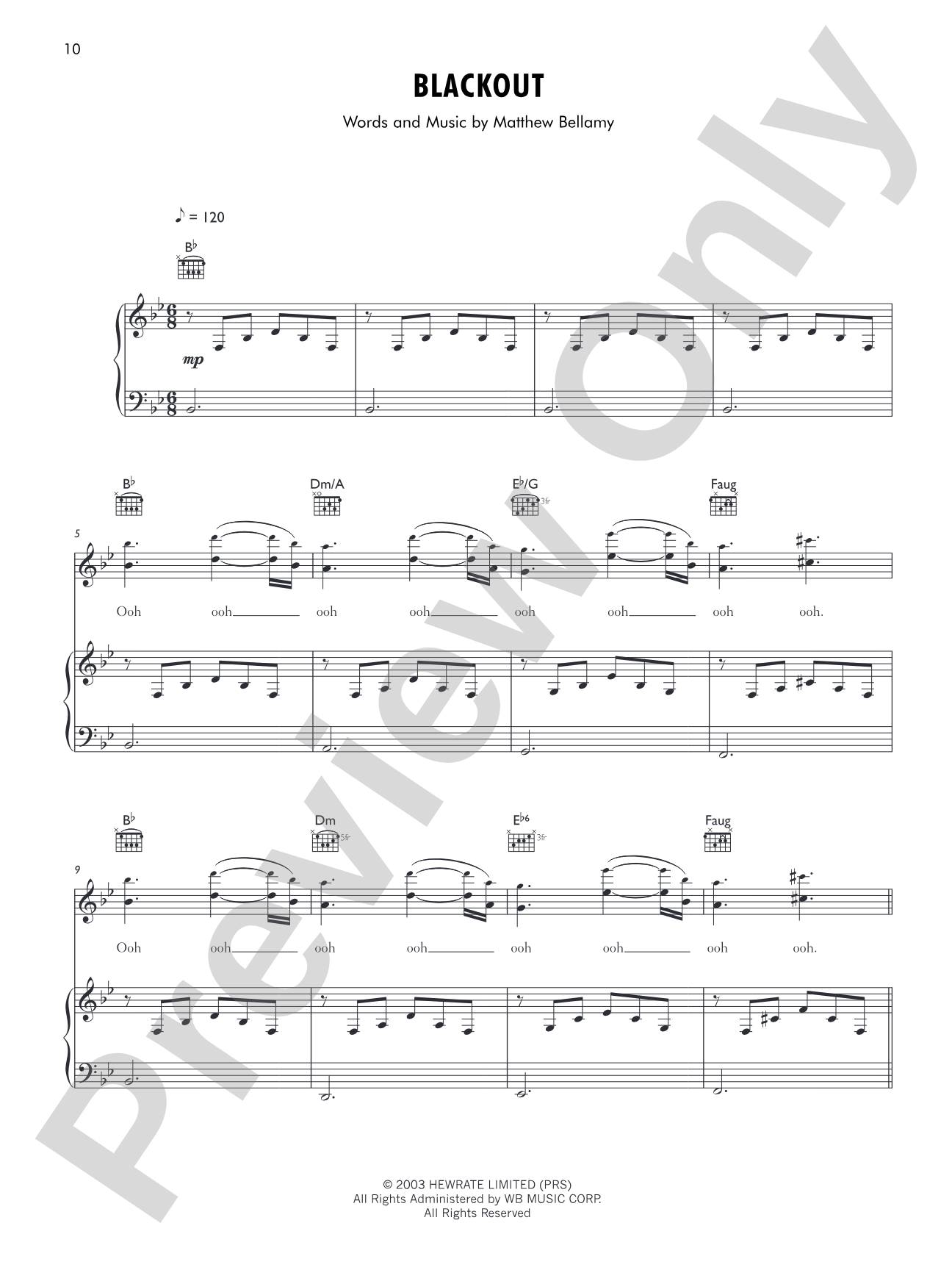

Blackout: Piano/Vocal/Chords
Muse
Item: 00-PS-0013331
$4.99
One moment…
Related Items
Space Demetia: Piano/Vocal/Chords |
$5.99
|
View | |
Sunburn: Piano/Vocal/Chords |
$5.99
|
View | |
Apocalypse Please: Piano/Vocal/Chords |
$4.99
|
View | |
Sing for Absolution: Piano/Vocal/Chords |
$4.99
|
View | |
Butterflies & Hurricanes: Piano/Vocal/Chords |
$5.99
|
View | |
Endlessly: Piano/Vocal/Chords |
$4.99
|
View | |
Ruled By Secrecy: Piano/Vocal/Chords |
$5.99
|
View | |
Neutron Star Collision (Love is Forever): Piano/Vocal/Chords |
$5.99
|
View |
Description
This songbook features piano sheet music for 22 songs selected from five albums by award-winning progressive hard rock band Muse. Note-for-note keyboard transcriptions are woven into arrangements that make each song playable on piano from start to finish. Complete vocal melodies and lyrics are included, along with basic chord grids for guitar. Titles: Apocalypse Please * Blackout * Butterflies & Hurricanes * Endlessly * Exogenesis: Symphony, Part 1 (Overture) * Exogenesis: Symphony, Part 2 (Cross-Pollination) * Exogenesis: Symphony, Part 3 (Redemption) * Feeling Good * Hoodoo * I Belong to You * Invincible * Neutron Star Collision * Resistance * Ruled by Secrecy * Sing for Absolution * Soldier's Poem * Space Dementia * Starlight * Sunburn * Take a Bow * Undisclosed Desires * United States of Eurasia / Collateral Damage.


Blackout: Piano/Vocal/Chords isn't in MakeMusic Cloud just yet...but it could be. Let us know you'd like to see it, and you'll help shape what comes next. In the meantime, start a free trial and dive into thousands of interactive titles your students can play along with today.
Request This Title
Tell us you want it.
Start Your Free Trial
Explore everything that's ready to play right now.
Sample Audio
No sample audio found.
Sample Video
No sample videos found.
Additional Details
Publisher:
Alfred Music
Page Count:
144
SKU:
00-PS-0013331
More about this title
About the Composer: Matthew Bellamy
Matthew Bellamy formed Muse in 1994 and has served as the band's primary composer, pianist, and vocalist throughout their career spanning three decades. His work blends classical training with progressive rock sensibilities, creating compositions that demand technical facility across multiple instruments and explore ambitious harmonic and structural territories.
Why we love this
This collection gives pianists access to songs built on genuinely interesting keyboard writing, not simplified arrangements. Each transcription preserves the orchestral density and harmonic complexity that defines Muse's sound, making these pieces rewarding both technically and musically for players who want substance.
What to expect
These songs occupy the space where art rock ambition meets accessible hooks. You'll move through lush, orchestral moments and tightly wound rhythmic passages; some pieces unfold with classical drama while others hit with driving, energetic momentum. The emotional range spans from introspective and contemplative to triumphant and defiant.
Who it's for
Pianists and keyboardists comfortable with advanced rock repertoire who want to expand beyond classical or jazz standards. This book also serves singers and guitarists looking for complete arrangements that honor the original instrumentation while remaining playable on a single instrument.
How to get the most out of it
- Study the vocal line independently first; the piano writing often mirrors or complements the melody in ways that become clearer when you know where the voice sits.
- Lean into the dynamic contrasts these songs demand. Muse compositions thrive on the tension between intimate, sustained passages and explosive sections; resist playing evenly throughout.
- The chord grids provide scaffolding if you're accompanying a vocalist or guitarist in rehearsal, but the transcribed keyboard parts often extend beyond what a chord grid can capture, so prioritize the written notation.
How to use it
Feature individual songs in student recitals or end-of-year showcases to broaden the stylistic palette beyond traditional classical programming. A multi-movement sequence like the three-part Exogenesis symphony works particularly well as a dramatic concert centerpiece. For teachers of advanced piano students, use these pieces as sight-reading challenges and as entry points into arranging, since the transcriptions demonstrate how to translate rock production concepts into written piano notation.
Skills your students will build
- Playing complex rhythmic figures over steady accompaniment patterns
- Managing wide keyboard spans and fast-moving passagework under both hands
- Balancing the demands of singing or accompanying vocalists while managing intricate keyboard parts
- Reading chord grids and translating harmonic symbols into improvisation and comping
- Interpreting rock dynamics and energy on a classical instrument