
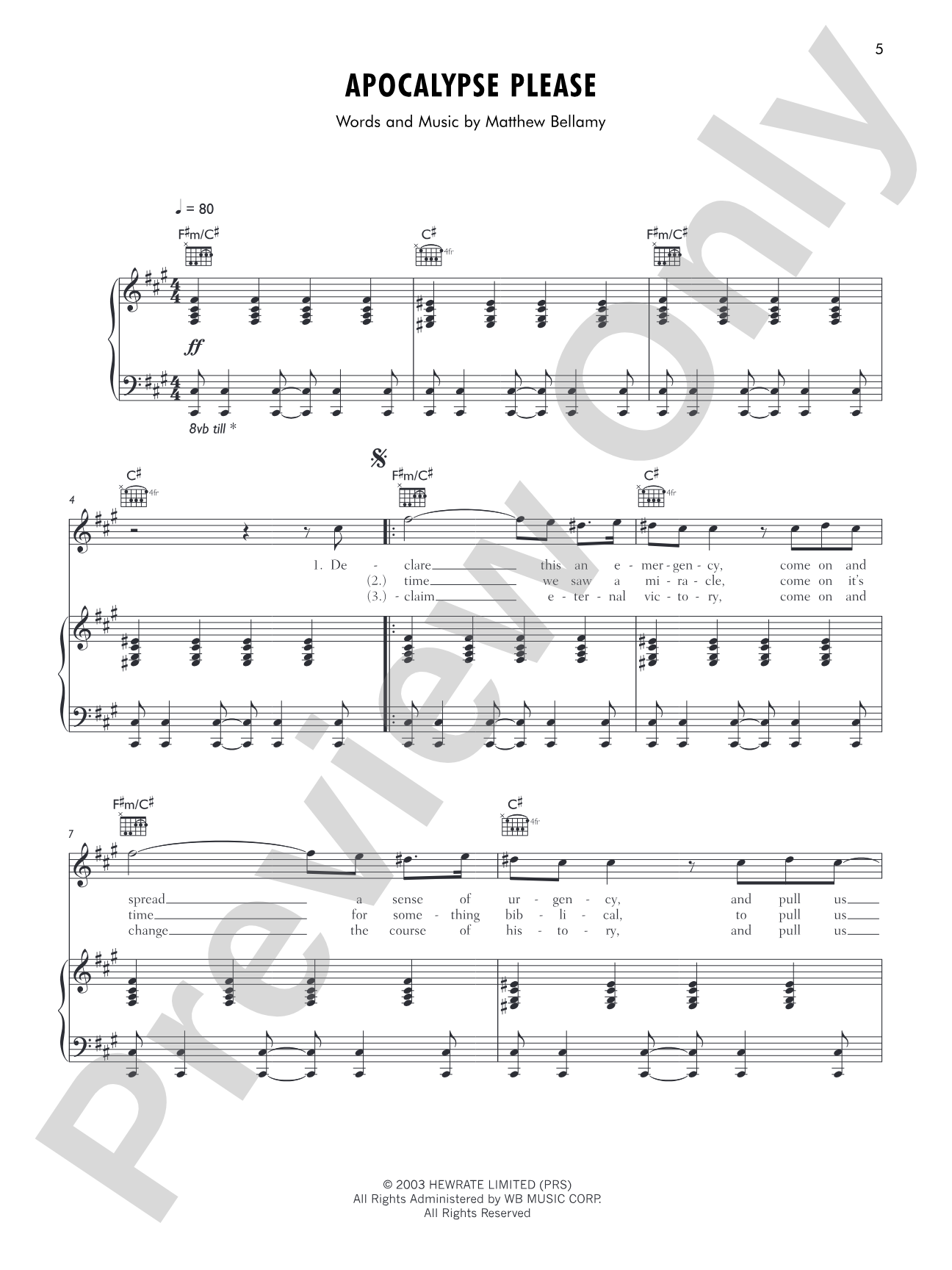

Apocalypse Please: Piano/Vocal/Chords
Muse
Item: 00-PS-0013329
$4.99
One moment…
Related Items
Space Demetia: Piano/Vocal/Chords |
$5.99
|
View | |
Sunburn: Piano/Vocal/Chords |
$5.99
|
View | |
Sing for Absolution: Piano/Vocal/Chords |
$4.99
|
View | |
Blackout: Piano/Vocal/Chords |
$4.99
|
View | |
Butterflies & Hurricanes: Piano/Vocal/Chords |
$5.99
|
View | |
Endlessly: Piano/Vocal/Chords |
$4.99
|
View | |
Ruled By Secrecy: Piano/Vocal/Chords |
$5.99
|
View | |
Neutron Star Collision (Love is Forever): Piano/Vocal/Chords |
$5.99
|
View |
Description
This songbook features piano sheet music for 22 songs selected from five albums by award-winning progressive hard rock band Muse. Note-for-note keyboard transcriptions are woven into arrangements that make each song playable on piano from start to finish. Complete vocal melodies and lyrics are included, along with basic chord grids for guitar. Titles: Apocalypse Please * Blackout * Butterflies & Hurricanes * Endlessly * Exogenesis: Symphony, Part 1 (Overture) * Exogenesis: Symphony, Part 2 (Cross-Pollination) * Exogenesis: Symphony, Part 3 (Redemption) * Feeling Good * Hoodoo * I Belong to You * Invincible * Neutron Star Collision * Resistance * Ruled by Secrecy * Sing for Absolution * Soldier's Poem * Space Dementia * Starlight * Sunburn * Take a Bow * Undisclosed Desires * United States of Eurasia / Collateral Damage.


Apocalypse Please: Piano/Vocal/Chords isn't in MakeMusic Cloud just yet...but it could be. Let us know you'd like to see it, and you'll help shape what comes next. In the meantime, start a free trial and dive into thousands of interactive titles your students can play along with today.
Request This Title
Tell us you want it.
Start Your Free Trial
Explore everything that's ready to play right now.
Sample Audio
No sample audio found.
Sample Video
No sample videos found.
Additional Details
Publisher:
Alfred Music
Page Count:
144
SKU:
00-PS-0013329
More about this title
About the Composer: Matthew Bellamy
Matthew Bellamy is the lead vocalist, guitarist, and keyboardist for Muse, the British rock band that has defined progressive hard rock for two decades. His compositional voice blends classical training with electronic experimentation, complex time signatures, and dramatic dynamic shifts. Bellamy's work as a composer spans stadium anthems, intricate instrumental passages, and deeply personal ballads, making him a significant figure in contemporary rock music education.
Why we love this
This collection captures the full scope of Muse's studio brilliance in a single, playable piano volume. Each transcription preserves Bellamy's signature keyboard arrangements while remaining idiomatic to the instrument, so pianists can own these songs rather than approximate them. The mix of high-energy rockers, orchestral movements, and intimate ballads gives teachers genuine flexibility in programming and students real incentive to practice.
What to expect
Orchestral ambition meets raw rock energy. These songs sweep from intimate space-age ballads to explosive stadium moments, with classical architecture underneath it all. Playing through this collection feels like commanding a full ensemble from the keyboard alone.
Who it's for
Pianists in upper-intermediate to advanced territory who want to own contemporary rock repertoire with serious compositional depth. Singers preparing a recital of modern art songs will find rich piano accompaniments that elevate their practice beyond backing tracks. Guitar players learning chord voicings and songwriting craft can study how Bellamy balances harmonic complexity with accessibility.
How to get the most out of it
- Study the chord grids alongside the piano transcriptions to understand the harmonic architecture. Muse's progressions often embrace modal interchange and borrowed chords; seeing the guitar voicings clarifies voice leading that might otherwise feel abstract on the keyboard.
- Approach dynamic range as compositional material, not decoration. Songs like Apocalypse Please and Resistance demand that you shape energy through contrast rather than uniform intensity.
- Lock rhythm sections that shift between straight eighths and shuffle feels (common in these arrangements) by playing along with the original recordings first. Your internal pulse will anchor the transcription's nuance.
- Balance vocal melody with keyboard texture. Because these are note-for-note transcriptions, the temptation to play every note equally is real. Let accompaniment figures breathe while bringing the vocal line forward.
How to use it
Feature standout moments like the Exogenesis trilogy as a thematic sequence in a concert of contemporary piano music or progressive rock, or scatter individual songs across multiple recitals to show the breadth of Bellamy's writing. Singers can draw single pieces for art song contexts, letting modern rock sit naturally alongside classical and contemporary art song.
Skills your students will build
- Reading and executing complex keyboard transcriptions that preserve original arrangements
- Managing metric modulation and shifting time signatures within a single piece
- Voice leading across wide keyboard ranges and octaves
- Balancing left-hand textural patterns with right-hand melodic or harmonic content
- Interpreting dynamic notation as expressive intention rather than volume alone
- Coordinating melody, harmony, and accompaniment across hands in arrangements written for multi-instrument originals