
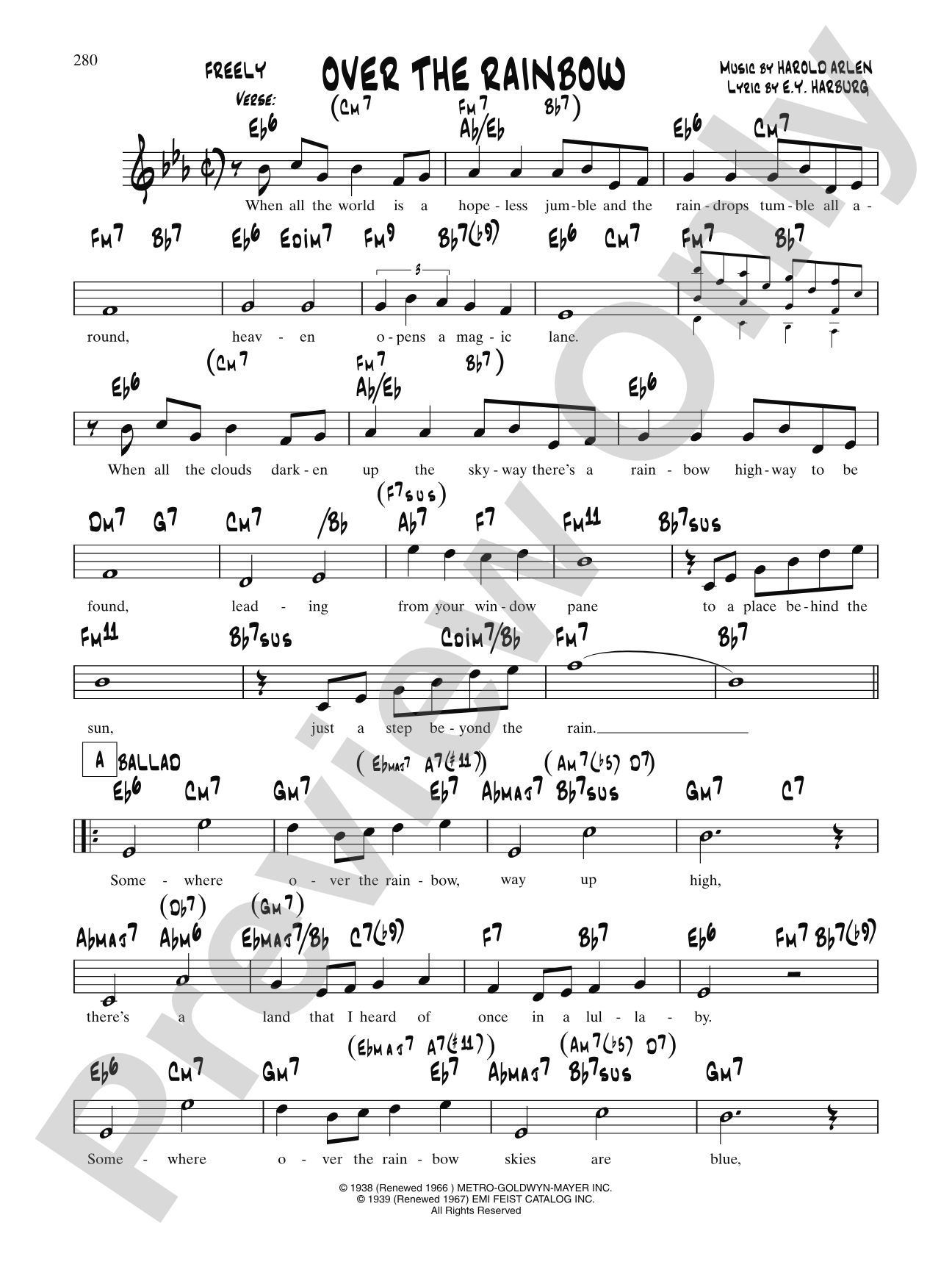

Over The Rainbow (From "The Wizard Of Oz"): Lead Sheet
Item: 00-PSL-000177
$4.99
One moment…
Related Items
What A Wonderful World: Lead Sheet |
$4.99
|
View | |
Laura: Lead Sheet |
$4.99
|
View | |
Skylark: Lead Sheet |
$4.99
|
View | |
The Shadow Of Your Smile (From "The Sandpiper"): Lead Sheet |
$4.99
|
View | |
Taking A Chance On Love: Lead Sheet |
$4.99
|
View | |
Temptation: Lead Sheet |
$4.99
|
View | |
Have Yourself A Merry Little Christmas: Lead Sheet |
$4.99
|
View | |
Ebb Tide: Lead Sheet |
$4.99
|
View | |
I'm In The Mood For Love: Lead Sheet |
$4.99
|
View | |
Moonlight Serenade: Lead Sheet |
$4.99
|
View | |
Blue Moon: Lead Sheet |
$4.99
|
View | |
Love Is A Many Splendored Thing: Lead Sheet |
$4.99
|
View | |
How About You?: Lead Sheet |
$4.99
|
View | |
Ain't Misbehavin': Lead Sheet |
$4.99
|
View | |
Bewitched, Bothered And Bewildered (From "Pal Joey"): Lead Sheet |
$4.99
|
View | |
A Foggy Day (In London Town): Lead Sheet |
$4.99
|
View | |
My Funny Valentine (From "Babes In Arms"): Lead Sheet |
$4.99
|
View | |
Summertime (From "Porgy And Bess"): Lead Sheet |
$4.99
|
View | |
Love For Sale: Lead Sheet |
$4.99
|
View | |
As Time Goes By (From "Casablanca"): Lead Sheet |
$4.99
|
View | |
You Go To My Head: Lead Sheet |
$4.99
|
View | |
Am I Blue?: Lead Sheet |
$4.99
|
View | |
What's New?: Lead Sheet |
$4.99
|
View | |
The Days Of Wine And Roses: Lead Sheet |
$4.99
|
View | |
But Not For Me (From "Girl Crazy"): Lead Sheet |
$4.99
|
View | |
I Got Rhythm: Lead Sheet |
$4.99
|
View | |
I've Got A Crush On You: Lead Sheet |
$4.99
|
View | |
Someone To Watch Over Me (From "Oh, Kay!"): Lead Sheet |
$4.99
|
View | |
The Wind Beneath My Wings (From "Beaches"): Lead Sheet |
$4.99
|
View | |
What Are You Doing The Rest Of Your Life?: Lead Sheet |
$4.99
|
View | |
Satin Doll (Vocal Version): Lead Sheet |
$4.99
|
View | |
When I Fall In Love: Lead Sheet |
$4.99
|
View |
Description
The Just Standards Real Book contains 250 classic songs, from show tunes to jazz standards, that are the core required repertoire for musicians all over the world. Production teams in both the U.S. and the U.K. took great care to ensure the accuracy and usability of each arrangement and original composer sources were consulted to ensure that the arrangements remained true to the composers' intentions. Plus, useful and important chord substitutions are indicated for each arrangement, allowing the user to pick from the original chords or the more popular jazz versions. Each book in the series is extensively cross-referenced with a complete composer index, discography of suggested recorded versions for each song, a section on how to play from a fakebook, chord theory reference pages, and a section on how to create interesting chord substitutions. Comb bound, approx. 400 pages.


Over The Rainbow (From "The Wizard Of Oz"): Lead Sheet isn't in MakeMusic Cloud just yet...but it could be. Let us know you'd like to see it, and you'll help shape what comes next. In the meantime, start a free trial and dive into thousands of interactive titles your students can play along with today.
Request This Title
Tell us you want it.
Start Your Free Trial
Explore everything that's ready to play right now.
Sample Audio
No sample audio found.
Sample Video
No sample videos found.
Additional Details
Series:
Just Real Books Series
Publisher:
Alfred Music
Page Count:
416
SKU:
00-PSL-000177
More about this title
About the Composer: Harold Arlen
Harold Arlen (1905-1986) shaped American musical theater with melodies that bridge jazz sensibility and popular song. His collaborations with lyricist E.Y. Harburg produced some of the most recorded standards in the jazz repertoire, including "Over the Rainbow," "Stormy Weather," and "As Long as I Live."
Arlen's harmonic language drew from blues, stride piano, and jazz idioms, making his songs natural vehicles for jazz interpretation and reharmonization. His work remains central to the jazz curriculum because his melodies are singable and memorable while his chord changes invite creative exploration.
Why we love this
This lead sheet captures one of the most essential standards in jazz education, a song musicians encounter across every instrument and voice type. Arlen's melody is memorable enough for beginners to grasp immediately, yet the harmonic language offers enough depth to sustain serious study of jazz reharmonization and voice leading.
What to expect
The melody sits in a sweet spot between simplicity and sophistication; it's instantly recognizable yet offers enough harmonic space for genuine musical exploration. Arlen's writing gives the tune a wistful quality that invites both straightforward interpretation and deeper jazz treatment.
Who it's for
Jazz musicians at all levels benefit from this lead sheet—beginners learning to read changes from a fakebook, intermediate players exploring reharmonization options, and experienced performers needing a reliable reference for a standard they may not have played recently. It's equally useful for jazz combos, big band sections, vocalists, and instrumentalists working solo or in ensemble.
How to get the most out of it
- Study both the original chords and the suggested jazz substitutions listed in the fakebook; playing the head with the original changes first establishes the melody's identity before exploring altered versions.
- Pay attention to the phrasing implied by Arlen's original melody line; the ascending phrase structure creates natural dynamic shaping opportunities whether you're playing or singing.
- Use the chord tones as your melodic anchor when improvising; this melody's simplicity becomes an asset during soloing, allowing you to navigate changes confidently.
How to use it
Program this as a foundation piece in any jazz curriculum or ensemble rehearsal; it works equally well as a full ensemble feature, a section soli moment, or a vehicle for student soloists. Because it's immediately recognizable to audiences and technically accessible across instruments and skill levels, it functions well in student concerts and informal jam sessions.
Skills your students will build
- Reading lead sheet notation and chord symbols
- Understanding chord substitution and reharmonization
- Navigating changes in a jazz standard
- Balancing melody with harmonic interpretation
- Playing or singing from a fakebook without full notation