
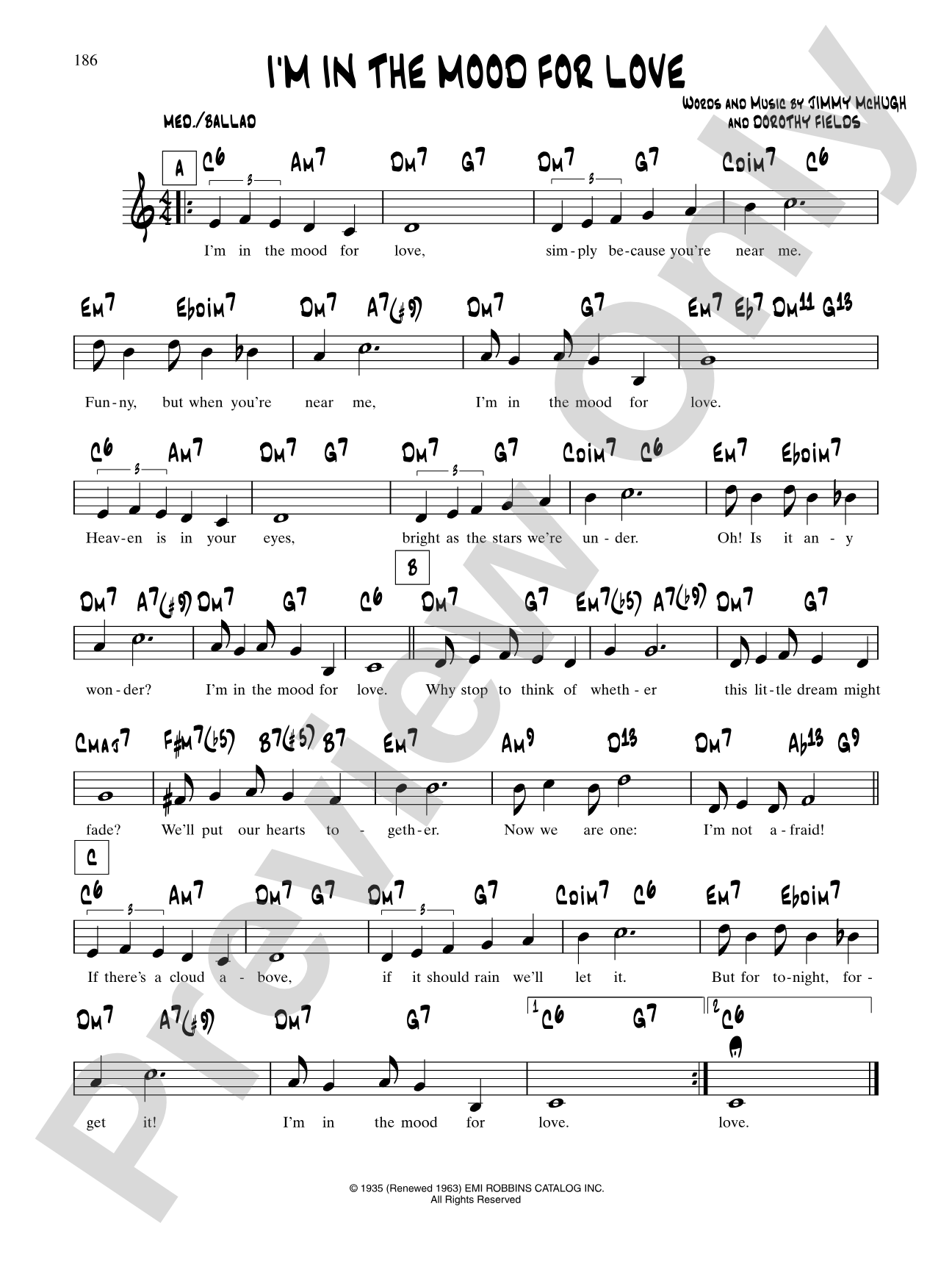

I'm In The Mood For Love: Lead Sheet
Item: 00-PSL-000161
$4.99
One moment…
Related Items
What A Wonderful World: Lead Sheet |
$4.99
|
View | |
Laura: Lead Sheet |
$4.99
|
View | |
Skylark: Lead Sheet |
$4.99
|
View | |
The Shadow Of Your Smile (From "The Sandpiper"): Lead Sheet |
$4.99
|
View | |
Taking A Chance On Love: Lead Sheet |
$4.99
|
View | |
Temptation: Lead Sheet |
$4.99
|
View | |
Have Yourself A Merry Little Christmas: Lead Sheet |
$4.99
|
View | |
Ebb Tide: Lead Sheet |
$4.99
|
View | |
Moonlight Serenade: Lead Sheet |
$4.99
|
View | |
Blue Moon: Lead Sheet |
$4.99
|
View | |
Love Is A Many Splendored Thing: Lead Sheet |
$4.99
|
View | |
How About You?: Lead Sheet |
$4.99
|
View | |
Over The Rainbow (From "The Wizard Of Oz"): Lead Sheet |
$4.99
|
View | |
Ain't Misbehavin': Lead Sheet |
$4.99
|
View | |
Bewitched, Bothered And Bewildered (From "Pal Joey"): Lead Sheet |
$4.99
|
View | |
A Foggy Day (In London Town): Lead Sheet |
$4.99
|
View | |
My Funny Valentine (From "Babes In Arms"): Lead Sheet |
$4.99
|
View | |
Summertime (From "Porgy And Bess"): Lead Sheet |
$4.99
|
View | |
Love For Sale: Lead Sheet |
$4.99
|
View | |
As Time Goes By (From "Casablanca"): Lead Sheet |
$4.99
|
View | |
You Go To My Head: Lead Sheet |
$4.99
|
View | |
Am I Blue?: Lead Sheet |
$4.99
|
View | |
What's New?: Lead Sheet |
$4.99
|
View | |
The Days Of Wine And Roses: Lead Sheet |
$4.99
|
View | |
But Not For Me (From "Girl Crazy"): Lead Sheet |
$4.99
|
View | |
I Got Rhythm: Lead Sheet |
$4.99
|
View | |
I've Got A Crush On You: Lead Sheet |
$4.99
|
View | |
Someone To Watch Over Me (From "Oh, Kay!"): Lead Sheet |
$4.99
|
View | |
The Wind Beneath My Wings (From "Beaches"): Lead Sheet |
$4.99
|
View | |
What Are You Doing The Rest Of Your Life?: Lead Sheet |
$4.99
|
View | |
Satin Doll (Vocal Version): Lead Sheet |
$4.99
|
View | |
When I Fall In Love: Lead Sheet |
$4.99
|
View |
Description
The Just Standards Real Book contains 250 classic songs, from show tunes to jazz standards, that are the core required repertoire for musicians all over the world. Production teams in both the U.S. and the U.K. took great care to ensure the accuracy and usability of each arrangement and original composer sources were consulted to ensure that the arrangements remained true to the composers' intentions. Plus, useful and important chord substitutions are indicated for each arrangement, allowing the user to pick from the original chords or the more popular jazz versions. Each book in the series is extensively cross-referenced with a complete composer index, discography of suggested recorded versions for each song, a section on how to play from a fakebook, chord theory reference pages, and a section on how to create interesting chord substitutions. Comb bound, approx. 400 pages.


I'm In The Mood For Love: Lead Sheet isn't in MakeMusic Cloud just yet...but it could be. Let us know you'd like to see it, and you'll help shape what comes next. In the meantime, start a free trial and dive into thousands of interactive titles your students can play along with today.
Request This Title
Tell us you want it.
Start Your Free Trial
Explore everything that's ready to play right now.
Sample Audio
No sample audio found.
Sample Video
No sample videos found.
Additional Details
Series:
Just Real Books Series
Publisher:
Alfred Music
Page Count:
416
SKU:
00-PSL-000161
More about this title
About the Composer: Jimmy McHugh
Jimmy McHugh (1894-1969) was one of the most prolific American songwriters of the 20th century, composing hundreds of songs across Broadway shows, Hollywood films, and popular records. Working frequently with lyricist Dorothy Fields, McHugh created melodies that balanced sophisticated harmonic language with accessibility, earning him a place among the most recorded composers in jazz and popular music.
McHugh's compositions became foundational to the jazz standards repertoire. His gift for writing memorable, singable melodies with rich harmonic possibilities made his work ideal for interpretation by musicians across genres. Standards like this one remain teaching tools for understanding American songwriting craft and the relationship between composition and improvisation.
Why we love this
This lead sheet captures one of the most musically satisfying standards in the repertoire. The melody is instantly recognizable yet sits beautifully across different instruments, and the chord progression offers enough harmonic depth to support both straightforward comping and adventurous reharmonization. Jazz musicians at all levels return to this tune repeatedly because it rewards both careful listening and creative exploration.
What to expect
Warm, unhurried, and romantic without sentimentality. The tune moves with conversational ease, its phrasing natural and its harmonic rhythm accessible. There's an inherent swing to the melody that invites a relaxed, singing approach regardless of tempo.
Who it's for
Pianists, guitarists, saxophonists, and other lead instrumentalists who work from fakebooks in jazz combos, big bands, or informal jam sessions. Educators teaching jazz arranging, chord substitution, or stylistic interpretation will find this standard essential for building student understanding of how American songwriting conventions work.
How to get the most out of it
- Study the original melody phrase by phrase before exploring variations. McHugh's writing is deceptively simple; understanding where the phrase naturally breathes will inform your phrasing whether you're stating the head or taking a solo.
- Use the indicated chord substitutions as a starting point for reharmonization, not the endpoint. Compare each suggested alt chord to the original and listen to recordings to hear which versions sit best in your arrangement.
- Lock the basic changes into your muscle memory across multiple keys before performing. This standard appears in countless bandstand settings, so transposability becomes a practical necessity.
- Balance the melody's directness with attention to the harmonic implications underneath. Even in a straightforward statement of the head, the chord progression beneath deserves thoughtful voice leading and dynamic shaping.
How to use it
Feature this in a jazz combo or trio segment of a concert program where students can demonstrate their ability to interpret a classic with both reverence for the original and creative independence. It works equally well as a vehicle for a single soloist with rhythm section accompaniment or as a full big band arrangement with the ensemble stating the theme in harmony.
Skills your students will build
- Reading and interpreting jazz chord symbols and lead sheet notation
- Identifying and applying chord substitutions in context
- Balancing melodic statement with harmonic accompaniment
- Transposing melodies and changes to different keys
- Understanding the relationship between composed melody and jazz comping conventions