
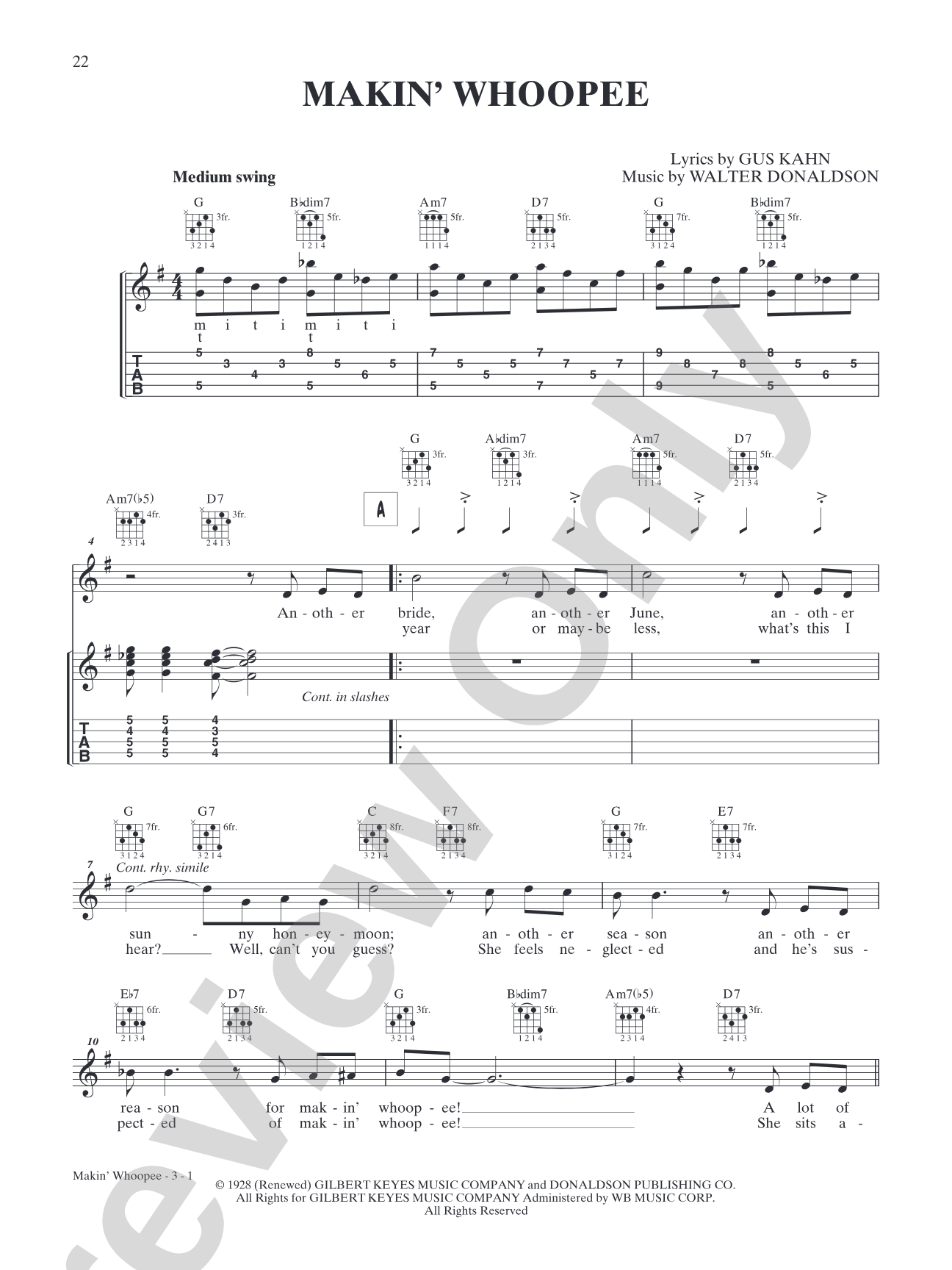

Makin' Whoopee: Banjo TAB
12 Great Songs of the '20s & '30s
Item: 00-PS-0011777
$4.99
One moment…
Related Items
Five Foot Two, Eyes of Blue: Banjo TAB |
$4.99
|
View | |
Ain't Misbehavin': Banjo TAB |
$4.99
|
View | |
It Don't Mean a Thing: Banjo TAB |
$4.99
|
View | |
Tonight You Belong to Me: Banjo TAB |
$4.99
|
View | |
As Time Goes By: Banjo TAB |
$4.99
|
View | |
It Had to Be You: Banjo TAB |
$4.99
|
View | |
Sweet Georgia Brown: Banjo TAB |
$4.99
|
View | |
Ain't She Sweet: Banjo TAB |
$4.99
|
View | |
I'll See You in My Dreams: Banjo TAB |
$4.99
|
View | |
Dream a Little Dream of Me: Banjo TAB |
$4.99
|
View |
Description
Swingin' Jazz Banjo is designed for your total enjoyment. Each song is arranged in a fun and lively way with a strum-and-sing approach. The chords are simple, yet entirely appropriate to the jazz-age style of the '20s and '30s. We've also included classic intros, endings, and turnarounds that will make you sound like an authentic early jazzer. Titles: Ain't Misbehavin' * Ain't She Sweet * As Time Goes By * Bye Bye Blackbird * Dream a Little Dream of Me * Five Foot Two, Eyes of Blue * I'll See You in My Dreams * It Don't Mean a Thing (If It Ain't Got That Swing) * It Had to Be You * Makin' Whoopee * Sweet Georgia Brown * Tonight You Belong to Me.


Makin' Whoopee: Banjo TAB isn't in MakeMusic Cloud just yet...but it could be. Let us know you'd like to see it, and you'll help shape what comes next. In the meantime, start a free trial and dive into thousands of interactive titles your students can play along with today.
Request This Title
Tell us you want it.
Start Your Free Trial
Explore everything that's ready to play right now.
Sample Audio
No sample audio found.
Sample Video
No sample videos found.
Additional Details
Series:
Just for Fun
Publisher:
Alfred Music
Page Count:
40
SKU:
00-PS-0011777
More about this title
About the Composer: Gus Kahn
Gus Kahn (1886-1941) was one of the most prolific lyricists of the Jazz Age, crafting witty, singable words for some of the era's most enduring standards. Though he wrote lyrics rather than melodies, his partnership with composers like Walter Donaldson produced songs that defined the sound of the 1920s and 1930s. His gift for clever rhymes and conversational phrasing made popular songs feel both sophisticated and accessible to everyday listeners.
Kahn's catalog spans nearly three decades and includes "Ain't Misbehavin'," "Sweet Georgia Brown," and the title track of this collection. His influence on American songwriting extended far beyond the jazz age; many of his songs remain staples in contemporary jazz education and performance.
Why we love this
This collection captures the infectious spirit of early jazz in a format that doesn't demand classical technique. The arrangements stay true to the jazz-age idiom with period-appropriate intros, endings, and turnarounds, so your students play authentic language rather than simplified approximations. For banjo players hungry for repertoire beyond bluegrass and folk traditions, these 12 standards open a whole genre.
What to expect
Stepping into a speakeasy in the 1920s where the piano player knows every standard and the rhythm section swings tight. These arrangements capture that casual sophistication of the jazz age, where melody and harmony glide over a steady, infectious pulse. Songs like "Makin' Whoopee" and "Sweet Georgia Brown" bounce with humor and warmth.
Who it's for
Banjo players with basic chord knowledge who want to explore jazz standards without the reading demands of full notation. This works equally well for solo recital repertoire, informal jam sessions, or as a bridge for banjo students curious about genres beyond traditional folk and bluegrass styles.
How to get the most out of it
- Lean into the strum-and-sing approach by letting chord shapes breathe. Don't rush the rhythm; the syncopation lands harder when you give it space.
- Study the recorded versions of these standards to absorb the swing feel. Your ear will guide your rhythm more reliably than counting.
- Work the classic turnarounds and intros slowly first. Once they become muscle memory, they'll launch each tune with authentic swagger.
How to use it
Perfect for a jazz history concert or a semester exploring American popular song across genres. These pieces also work as engaging solo features during informal recitals or community performances where audiences recognize and enjoy the melodies. Banjo students can pick one or two as a special addition to a spring recital program.
Skills your students will build
- Chord melody arrangement and comping patterns characteristic of early jazz
- Swing rhythm and syncopation
- Jazz-era turnarounds, intros, and endings
- Sight-reading chord charts and TAB notation
- Stylistic interpretation of jazz standards