
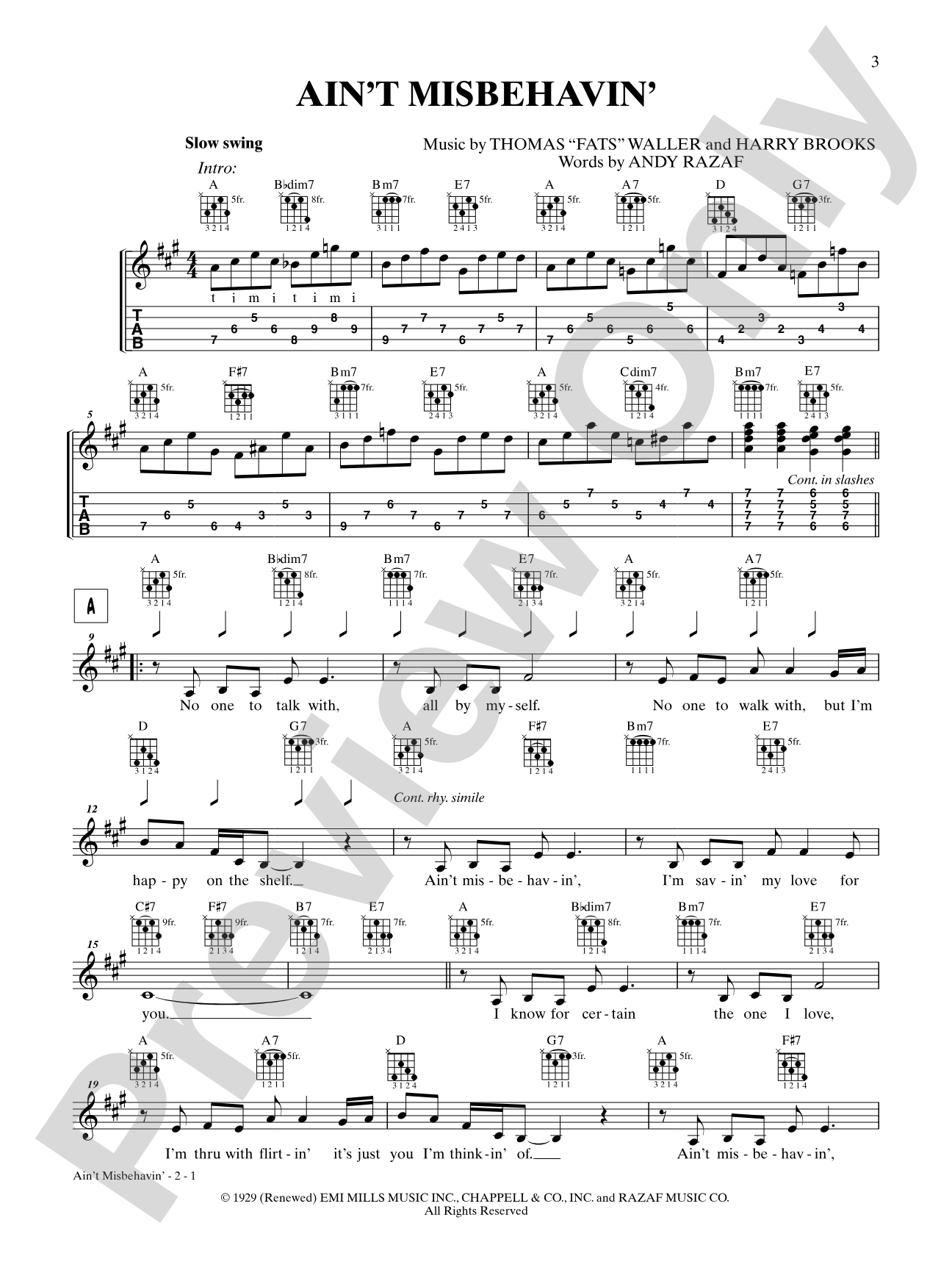

Ain't Misbehavin': Banjo TAB
12 Great Songs of the '20s & '30s
Item: 00-PS-0011794
$4.99
Pickup currently not available
Related Items
Makin' Whoopee: Banjo TAB |
$4.99
|
View | |
Five Foot Two, Eyes of Blue: Banjo TAB |
$4.99
|
View | |
It Don't Mean a Thing: Banjo TAB |
$4.99
|
View | |
Tonight You Belong to Me: Banjo TAB |
$4.99
|
View | |
As Time Goes By: Banjo TAB |
$4.99
|
View | |
It Had to Be You: Banjo TAB |
$4.99
|
View | |
Sweet Georgia Brown: Banjo TAB |
$4.99
|
View | |
Ain't She Sweet: Banjo TAB |
$4.99
|
View | |
I'll See You in My Dreams: Banjo TAB |
$4.99
|
View | |
Dream a Little Dream of Me: Banjo TAB |
$4.99
|
View |
Description
Swingin' Jazz Banjo is designed for your total enjoyment. Each song is arranged in a fun and lively way with a strum-and-sing approach. The chords are simple, yet entirely appropriate to the jazz-age style of the '20s and '30s. We've also included classic intros, endings, and turnarounds that will make you sound like an authentic early jazzer. Titles: Ain't Misbehavin' * Ain't She Sweet * As Time Goes By * Bye Bye Blackbird * Dream a Little Dream of Me * Five Foot Two, Eyes of Blue * I'll See You in My Dreams * It Don't Mean a Thing (If It Ain't Got That Swing) * It Had to Be You * Makin' Whoopee * Sweet Georgia Brown * Tonight You Belong to Me.


Ain't Misbehavin': Banjo TAB isn't in MakeMusic Cloud just yet...but it could be. Let us know you'd like to see it, and you'll help shape what comes next. In the meantime, start a free trial and dive into thousands of interactive titles your students can play along with today.
Request This Title
Tell us you want it.
Start Your Free Trial
Explore everything that's ready to play right now.
Sample Audio
No sample audio found.
Sample Video
No sample videos found.
Additional Details
Series:
Just for Fun
Publisher:
Alfred Music
Page Count:
40
SKU:
00-PS-0011794
More about this title
About the Composer: Fats Waller
Fats Waller (1904-1943) was a pianist, organist, composer, and entertainer who became one of jazz's most distinctive voices. His rhythmic vitality, harmonic sophistication, and comedic timing made him a dominant figure in swing-era jazz, and his compositions remain standards in the jazz repertoire.
Waller's gift for melody combined with his ability to infuse popular songs with jazz sensibility made him an ideal voice for the stride piano and early swing movements. His work spans theater music, film scores, and countless instrumental and vocal recordings that showcase his technical mastery and infectious personality.
Why we love this
This collection captures the essence of swing-era banjo in a way that actually teaches the style rather than just noting it. The strum-and-sing approach combined with period-appropriate intros, endings, and turnarounds gives players real tools to sound authentic, not just play the melody. For educators, it's a practical way to introduce jazz history through an instrument often overlooked in early jazz repertoire.
What to expect
Stepping into a 1920s jazz club where the energy is infectious and playful. The melodies are instantly recognizable, the harmonies snap with period charm, and there's an invitation to swing, not just read notes. This is music designed to be enjoyed, with enough harmonic sophistication to keep experienced players engaged while remaining accessible to those new to jazz.
Who it's for
Banjo players with basic chord knowledge who want to explore jazz standards beyond bluegrass and folk traditions. This collection suits players working toward authentic jazz interpretation or those seeking to understand how the banjo fits into early jazz history. It's equally valuable for hobbyists building a repertoire of recognizable standards and for students wanting to explore styles beyond their primary instrumental tradition.
How to get the most out of it
- Let the rhythmic feels breathe. The swing-age style depends on loose, buoyant phrasing rather than metronomic precision; listen to recordings from the 1920s and 1930s to internalize how relaxed the time feel should be.
- Study the intros and turnarounds provided in the arrangement. These aren't decoration; they're the vocabulary that signals to listeners you understand the era and the idiom.
- Balance your chord work with the melody line. Since these are arranged for strumming, keep your rhythmic accompaniment supporting rather than competing with the tune.
- Experiment with the dynamic range available on banjo. Swing-era players used articulation and volume shifts to shape phrases, so look for places to dial back or push forward within each tune.
How to use it
Slot these pieces into jazz concert programming or jazz history units where instrumental variety is welcome. They work well as opening or closing numbers that immediately signal style and era to the audience. For recitals, individual tunes can anchor a set exploring early American popular song, or the collection can serve as a semester's worth of repertoire for a banjo student deepening their musical vocabulary.
Skills your students will build
- Reading banjo tablature and chord diagrams together
- Swing phrasing and rhythmic flexibility in jazz idiom
- Comping technique (accompanying with chords rather than playing all melody notes)
- Recognizing and executing period-appropriate intros, turnarounds, and endings
- Understanding early jazz harmony and its relationship to 1920s popular music
- Balancing melodic and rhythmic roles in a single-line instrument