
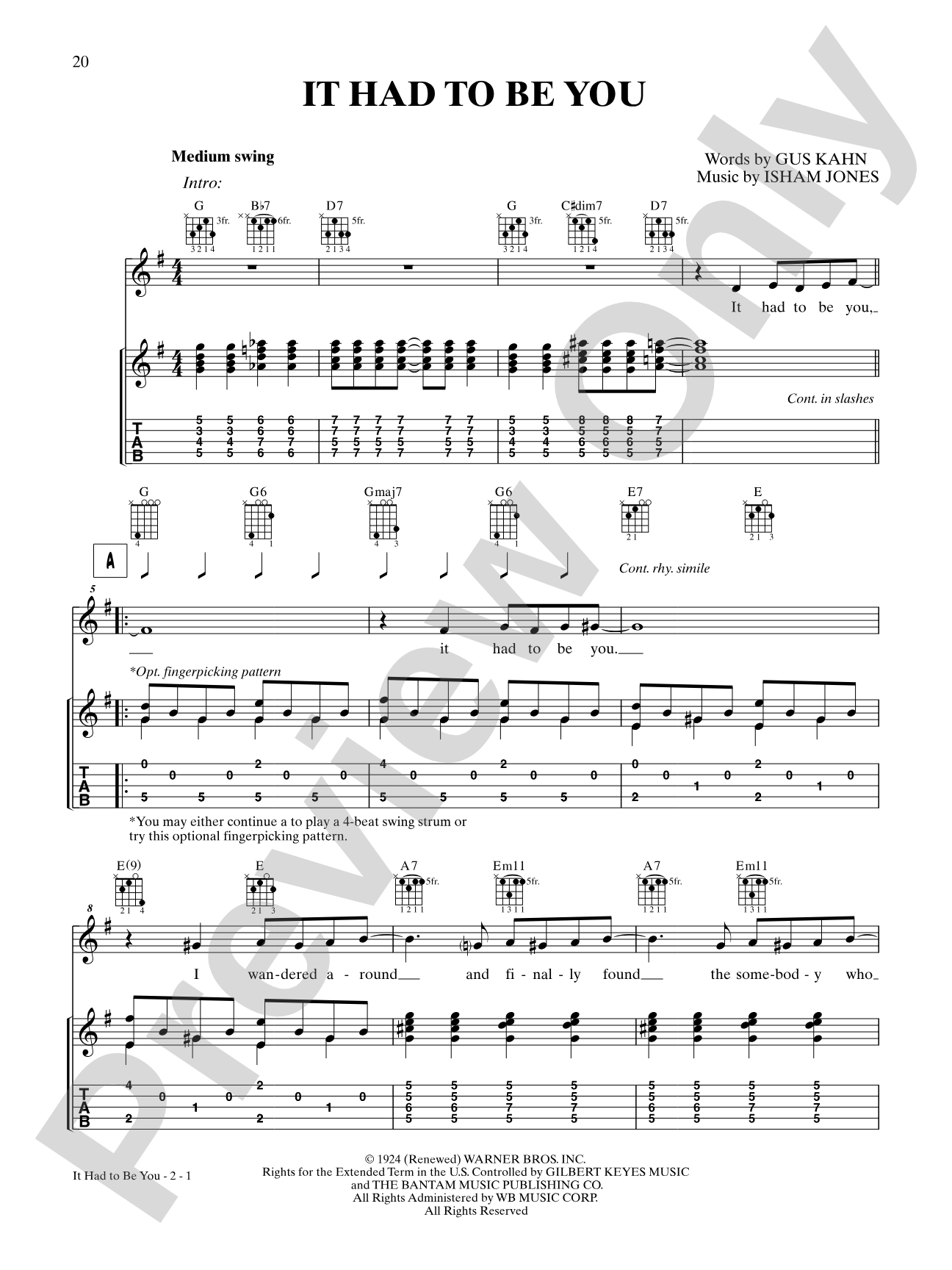

It Had to Be You: Banjo TAB
12 Great Songs of the '20s & '30s
Item: 00-PS-0011844
$4.99
One moment…
Related Items
Makin' Whoopee: Banjo TAB |
$4.99
|
View | |
Five Foot Two, Eyes of Blue: Banjo TAB |
$4.99
|
View | |
Ain't Misbehavin': Banjo TAB |
$4.99
|
View | |
It Don't Mean a Thing: Banjo TAB |
$4.99
|
View | |
Tonight You Belong to Me: Banjo TAB |
$4.99
|
View | |
As Time Goes By: Banjo TAB |
$4.99
|
View | |
Sweet Georgia Brown: Banjo TAB |
$4.99
|
View | |
Ain't She Sweet: Banjo TAB |
$4.99
|
View | |
I'll See You in My Dreams: Banjo TAB |
$4.99
|
View | |
Dream a Little Dream of Me: Banjo TAB |
$4.99
|
View |
Description
Swingin' Jazz Banjo is designed for your total enjoyment. Each song is arranged in a fun and lively way with a strum-and-sing approach. The chords are simple, yet entirely appropriate to the jazz-age style of the '20s and '30s. We've also included classic intros, endings, and turnarounds that will make you sound like an authentic early jazzer. Titles: Ain't Misbehavin' * Ain't She Sweet * As Time Goes By * Bye Bye Blackbird * Dream a Little Dream of Me * Five Foot Two, Eyes of Blue * I'll See You in My Dreams * It Don't Mean a Thing (If It Ain't Got That Swing) * It Had to Be You * Makin' Whoopee * Sweet Georgia Brown * Tonight You Belong to Me.


It Had to Be You: Banjo TAB isn't in MakeMusic Cloud just yet...but it could be. Let us know you'd like to see it, and you'll help shape what comes next. In the meantime, start a free trial and dive into thousands of interactive titles your students can play along with today.
Request This Title
Tell us you want it.
Start Your Free Trial
Explore everything that's ready to play right now.
Sample Audio
No sample audio found.
Sample Video
No sample videos found.
Additional Details
Series:
Just for Fun
Publisher:
Alfred Music
Page Count:
40
SKU:
00-PS-0011844
More about this title
About the Composer: Gus Kahn
Gus Kahn (1886-1941) was a lyricist and songwriter who shaped the sound of American popular music across three decades. Working with composers like Isham Jones, Walter Donaldson, and Harry Akst, Kahn crafted lyrics that balanced wit, sentiment, and singability, establishing himself as one of the most recorded songwriters of the jazz age.
Kahn's catalog includes standards that remain central to jazz repertoire and American musical theater. His ability to write clever, conversational lyrics that fit naturally over jazz harmonies made him instrumental in creating the Great American Songbook. Many of his compositions became signature pieces for jazz musicians and continue to define the early jazz era in popular imagination.
Why we love this
This folio captures the authentic sound of 1920s and '30s jazz without requiring advanced harmonic or technical knowledge. The inclusion of period-appropriate intros, endings, and turnarounds teaches genuine early jazz vocabulary, so banjo players absorb real stylistic practices rather than playing generic arrangements. It's a genuinely fun way to develop jazz sensibility on an instrument that belongs in this era's sound.
What to expect
Stepping into a 1920s jazz club on a Friday night. The arrangements breathe with the casual elegance of early jazz, where every note serves the song and the groove sways without forcing. There's a lightness here, a sense of playfulness that honors the era without trying too hard.
Who it's for
Banjo players seeking to move beyond folk or bluegrass into jazz history will find accessible entry points in these twelve standards. Whether you're learning to swing for the first time or looking to expand your jazz repertoire, the tab notation and straightforward chord changes make these pieces playable without years of jazz study.
How to get the most out of it
- Study the recorded versions of these standards to internalize the swing feel and phrasing. Early jazz banjo sits between rhythm and melody, so listening to how soloists navigate these tunes will clarify your role.
- Practice the intros and turnarounds as distinct musical phrases, not throwaway connectors. These transitions are where banjo players establish authenticity and personality.
- Keep the strum steady and conversational, resisting the urge to fill every space with activity. The joy of these arrangements comes from the space between notes and the clarity of the harmonic progression.
- Pair these melodies with simple melodic improvisation over the given chords. These jazz-age tunes are built for gentle solo flights that sit comfortably within a few scale tones.
How to use it
Slot individual tunes into informal recitals, community events, or coffee-house settings where the conversational, intimate tone of early jazz resonates. These pieces also work beautifully as interludes between classical or contemporary repertoire, offering audiences a tonal shift that feels both nostalgic and inviting. Consider pairing them with jazz standards for other instruments to build a period-authentic jazz showcase.
Skills your students will build
- Reading banjo TAB with jazz harmony notation
- Swing rhythm and early jazz phrasing
- Comping patterns and harmonic listening
- Improvisation within a jazz chord framework
- Period-appropriate jazz articulation and ornamentation