
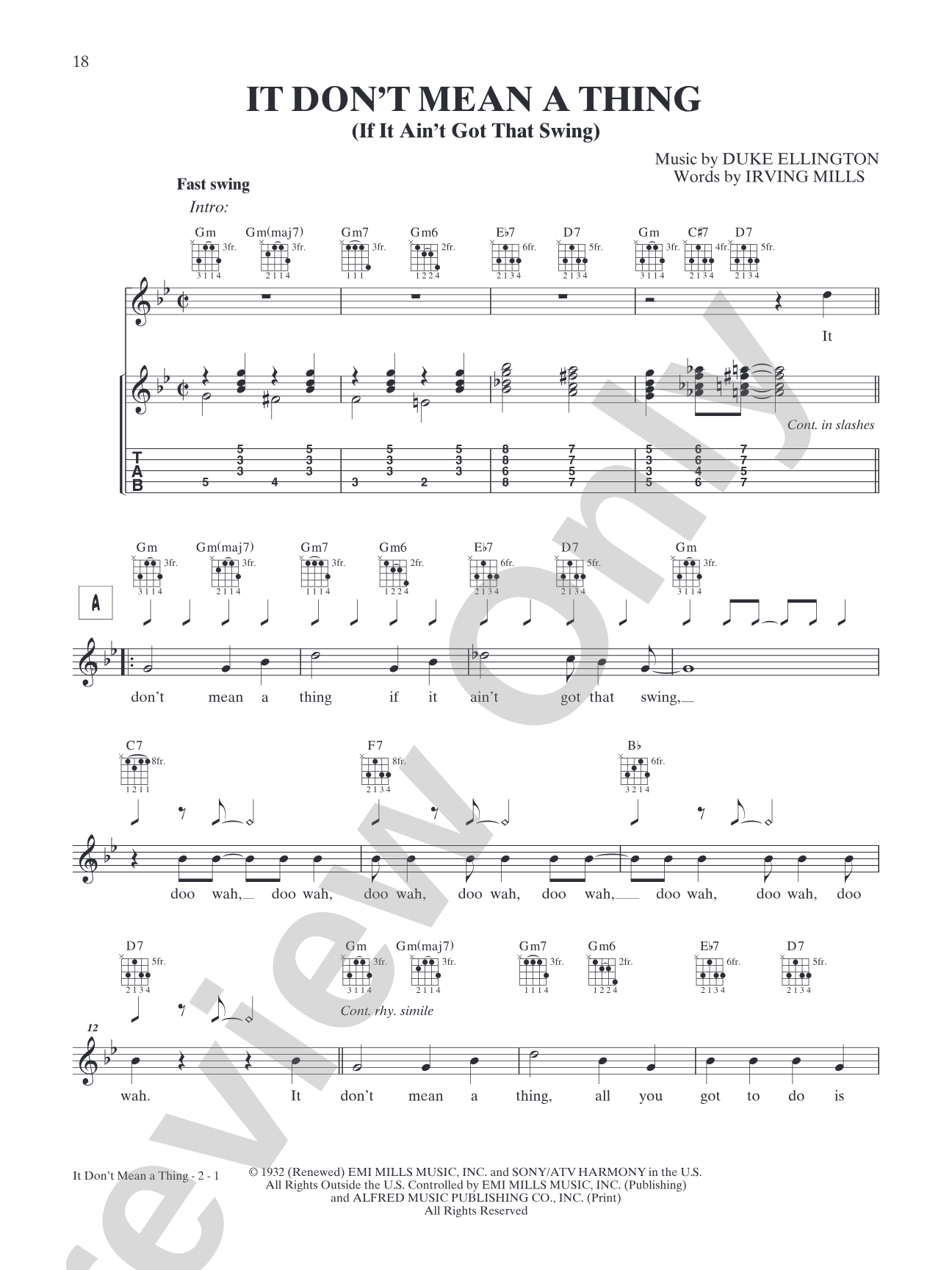

It Don't Mean a Thing: Banjo TAB
12 Great Songs of the '20s & '30s
Item: 00-PS-0011800
$4.99
One moment…
Related Items
Makin' Whoopee: Banjo TAB |
$4.99
|
View | |
Five Foot Two, Eyes of Blue: Banjo TAB |
$4.99
|
View | |
Ain't Misbehavin': Banjo TAB |
$4.99
|
View | |
Tonight You Belong to Me: Banjo TAB |
$4.99
|
View | |
As Time Goes By: Banjo TAB |
$4.99
|
View | |
It Had to Be You: Banjo TAB |
$4.99
|
View | |
Sweet Georgia Brown: Banjo TAB |
$4.99
|
View | |
Ain't She Sweet: Banjo TAB |
$4.99
|
View | |
I'll See You in My Dreams: Banjo TAB |
$4.99
|
View | |
Dream a Little Dream of Me: Banjo TAB |
$4.99
|
View |
Description
Swingin' Jazz Banjo is designed for your total enjoyment. Each song is arranged in a fun and lively way with a strum-and-sing approach. The chords are simple, yet entirely appropriate to the jazz-age style of the '20s and '30s. We've also included classic intros, endings, and turnarounds that will make you sound like an authentic early jazzer. Titles: Ain't Misbehavin' * Ain't She Sweet * As Time Goes By * Bye Bye Blackbird * Dream a Little Dream of Me * Five Foot Two, Eyes of Blue * I'll See You in My Dreams * It Don't Mean a Thing (If It Ain't Got That Swing) * It Had to Be You * Makin' Whoopee * Sweet Georgia Brown * Tonight You Belong to Me.


It Don't Mean a Thing: Banjo TAB isn't in MakeMusic Cloud just yet...but it could be. Let us know you'd like to see it, and you'll help shape what comes next. In the meantime, start a free trial and dive into thousands of interactive titles your students can play along with today.
Request This Title
Tell us you want it.
Start Your Free Trial
Explore everything that's ready to play right now.
Sample Audio
No sample audio found.
Sample Video
No sample videos found.
Additional Details
Series:
Just for Fun
Publisher:
Alfred Music
Page Count:
40
SKU:
00-PS-0011800
More about this title
About the Composer: Duke Ellington
Duke Ellington (1899-1974) fundamentally changed how jazz could be written, arranged, and performed. His compositions moved far beyond the dance hall; they established jazz as a legitimate concert music while maintaining its swing and accessibility. Ellington's gift for melody, harmonic sophistication, and orchestration across ensembles of all sizes made him one of the most recorded composers in American music.
For banjo and fretted-string players, Ellington's work offers a direct connection to the jazz tradition. His pieces preserve the spirit of the 1920s and 1930s, when banjo was central to jazz rhythm sections. Playing his melodies and harmonies teaches not just technique, but the language of a musical revolutionary.
Why we love this
These arrangements capture the authentic sound of early jazz without burying the banjo player in unnecessary complexity. The strum-and-sing approach keeps the focus on swinging the rhythm and landing the melody, while period-accurate intros, turnarounds, and endings give players the tools to sound genuinely idiomatic. A collection this historically grounded and this much fun to play is rare.
What to expect
Stepping into a jazz club in the 1920s. The rhythm stays light and swinging, the melodies are memorable enough to sing, and the harmonic world is entirely familiar once you learn the basic changes. Every tune carries genuine warmth and playfulness, inviting you to relax into the groove rather than fight against it.
Who it's for
Banjo players who want to explore jazz standards beyond folk or bluegrass contexts. Intermediate players with basic chord knowledge will find these arrangements immediately playable while still offering authentic style to develop. Anyone interested in the history of banjo in American jazz will value this collection.
How to get the most out of it
- Focus on keeping the pulse steady and relaxed through the chord changes. Early jazz rhythm lives in consistency, not flashiness.
- Study the classic turnarounds and intros included here as standalone phrases. Practice them in different keys so they become muscle memory you can deploy in jam sessions.
- Let the swing feel come from slightly delayed pickstrokes and a loose, swaying approach to tempo rather than mechanical precision.
- Balance melody against the chords. The arrangement works best when the lead line sits clearly above the harmonic foundation you're providing.
How to use it
Program these standards alongside other period jazz material for a themed concert or showcase centered on American songwriting from the jazz age. They work equally well as solo performance material for informal settings, recitals, or jam session preparation. Use individual titles as study pieces to build jazz chord literacy and rhythmic phrasing in a practice routine.
Skills your students will build
- Reading banjo TAB with jazz chord symbols
- Swinging rhythmic feel and relaxed pulse
- Jazz-era harmonic progressions and turnaround vocabulary
- Authentic early jazz articulation and phrasing
- Memorization and stylistic interpretation of standards