
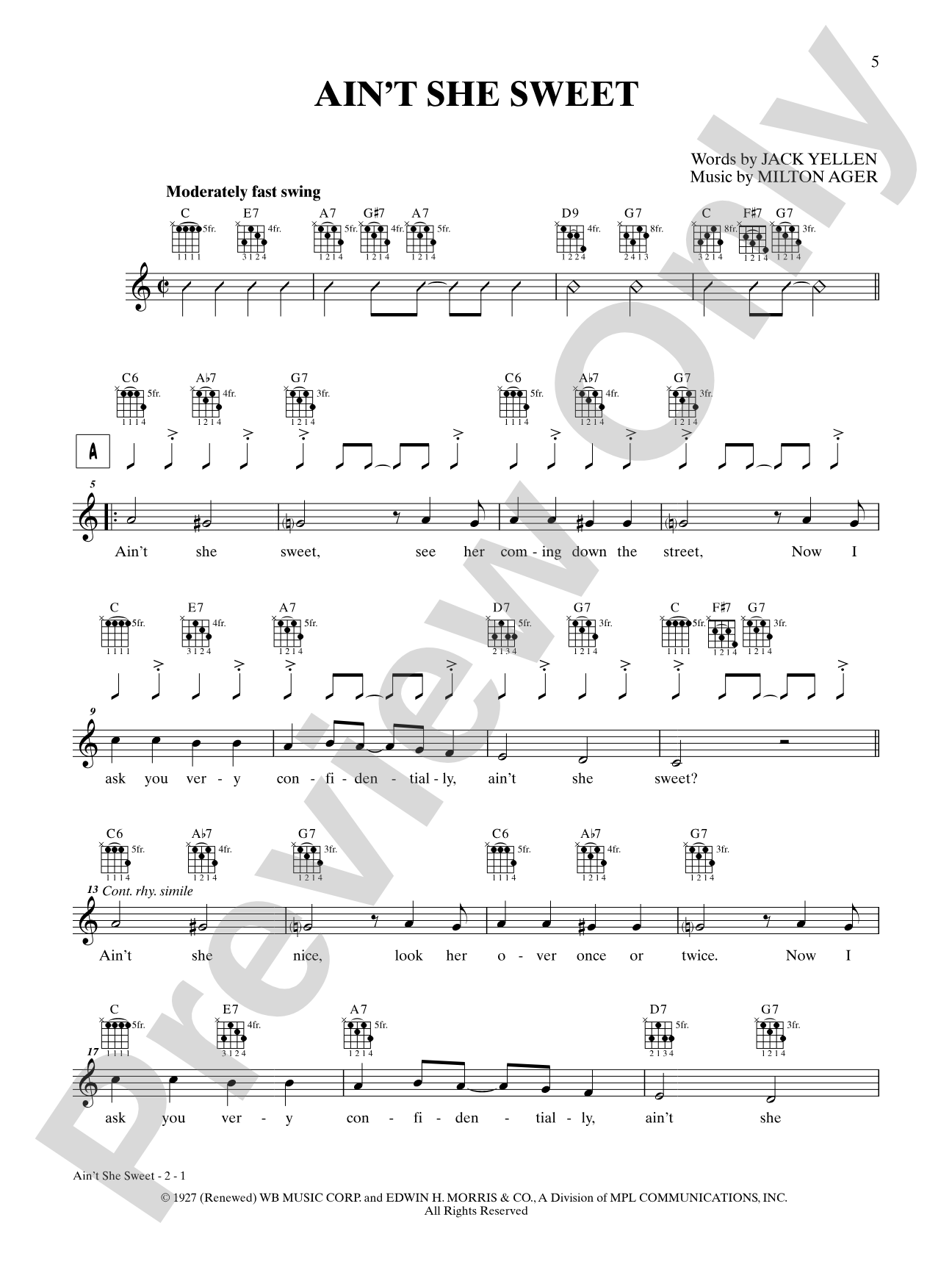

Ain't She Sweet: Banjo TAB
12 Great Songs of the '20s & '30s
Item: 00-PS-0011862
$4.99
One moment…
Related Items
Makin' Whoopee: Banjo TAB |
$4.99
|
View | |
Five Foot Two, Eyes of Blue: Banjo TAB |
$4.99
|
View | |
Ain't Misbehavin': Banjo TAB |
$4.99
|
View | |
It Don't Mean a Thing: Banjo TAB |
$4.99
|
View | |
Tonight You Belong to Me: Banjo TAB |
$4.99
|
View | |
As Time Goes By: Banjo TAB |
$4.99
|
View | |
It Had to Be You: Banjo TAB |
$4.99
|
View | |
Sweet Georgia Brown: Banjo TAB |
$4.99
|
View | |
I'll See You in My Dreams: Banjo TAB |
$4.99
|
View | |
Dream a Little Dream of Me: Banjo TAB |
$4.99
|
View |
Description
Swingin' Jazz Banjo is designed for your total enjoyment. Each song is arranged in a fun and lively way with a strum-and-sing approach. The chords are simple, yet entirely appropriate to the jazz-age style of the '20s and '30s. We've also included classic intros, endings, and turnarounds that will make you sound like an authentic early jazzer. Titles: Ain't Misbehavin' * Ain't She Sweet * As Time Goes By * Bye Bye Blackbird * Dream a Little Dream of Me * Five Foot Two, Eyes of Blue * I'll See You in My Dreams * It Don't Mean a Thing (If It Ain't Got That Swing) * It Had to Be You * Makin' Whoopee * Sweet Georgia Brown * Tonight You Belong to Me.


Ain't She Sweet: Banjo TAB isn't in MakeMusic Cloud just yet...but it could be. Let us know you'd like to see it, and you'll help shape what comes next. In the meantime, start a free trial and dive into thousands of interactive titles your students can play along with today.
Request This Title
Tell us you want it.
Start Your Free Trial
Explore everything that's ready to play right now.
Sample Audio
No sample audio found.
Sample Video
No sample videos found.
Additional Details
Series:
Just for Fun
Publisher:
Alfred Music
Page Count:
40
SKU:
00-PS-0011862
More about this title
About the Composer: Milton Ager
Milton Ager was a prolific American composer and songwriter who shaped popular music throughout the early twentieth century. Born in 1893, he wrote hundreds of songs that became standards of the jazz age, many in collaboration with lyricist Jack Yellen. His melodies captured the spirit of the 1920s and 1930s, blending catchy hooks with the rhythmic vitality that defined the era.
Ager's gifts as a composer lay in his ability to craft tunes that were both sophisticated and immediately memorable. His works remained central to American popular music for decades, recorded by countless artists and performed in every jazz and popular music setting imaginable. For music educators, his catalog represents some of the finest early jazz standards available for student performance.
Why we love this
This collection gives banjo players authentic jazz-age material arranged specifically for their instrument, complete with period-appropriate intros, endings, and turnarounds that actually teach how the instrument functioned in early jazz ensembles. The strum-and-sing approach keeps things accessible while the chord progressions remain true to the original jazz idiom, avoiding the oversimplification that plagues many simplified jazz arrangements.
What to expect
These 12 standards swing with the infectious energy and optimism of the jazz age. Every arrangement bounces with rhythmic vitality, from the roaring high-note melody of "Sweet Georgia Brown" to the wistful, slower-tempo reflection in "As Time Goes By." You'll feel the spirit of speakeasies and small-group jazz right under your fingers.
Who it's for
This collection serves banjo players at the intermediate level who want to build fluency with jazz standards and understand how the banjo functioned as both a rhythm and solo voice in early jazz. It's ideal for players looking to expand beyond folk and bluegrass repertoire into the jazz tradition, whether for recital performance, ensemble work, or informal jam sessions.
How to get the most out of it
- Lean into the swing feel on tunes marked with jazz rhythms; banjo's percussive nature thrives when you commit to the groove rather than playing metronomically.
- Study the classic intros and turnarounds included in this folio and memorize them as standard vocabulary. These phrases show up across multiple standards, building your toolkit for improvisation and arrangement.
- Use the chord symbols as a springboard for comping behind a singer or another musician; banjo's rhythmic punch makes it an ideal rhythm instrument in small jazz combos.
- Pay attention to the dynamics and articulation within each strum pattern. Jazz-age banjo was as much about conversation and interplay as it was about driving time.
How to use it
Program individual pieces from this folio for a jazz-themed recital segment or student showcase. The strum-and-sing format makes these accessible for mixed-ability evenings where banjo players perform alongside vocalists. These standards also work beautifully in community performance settings where audiences recognize and love this familiar repertoire.
Skills your students will build
- Jazz chord voicings and comping patterns appropriate to the 1920s-1930s style
- Reading banjo TAB fluently while maintaining jazz phrasing and swing feel
- Recognizing and executing classic jazz intros, turnarounds, and endings
- Balancing melody and rhythm in a jazz ensemble context
- Understanding the banjo's historical role in early jazz ensembles