
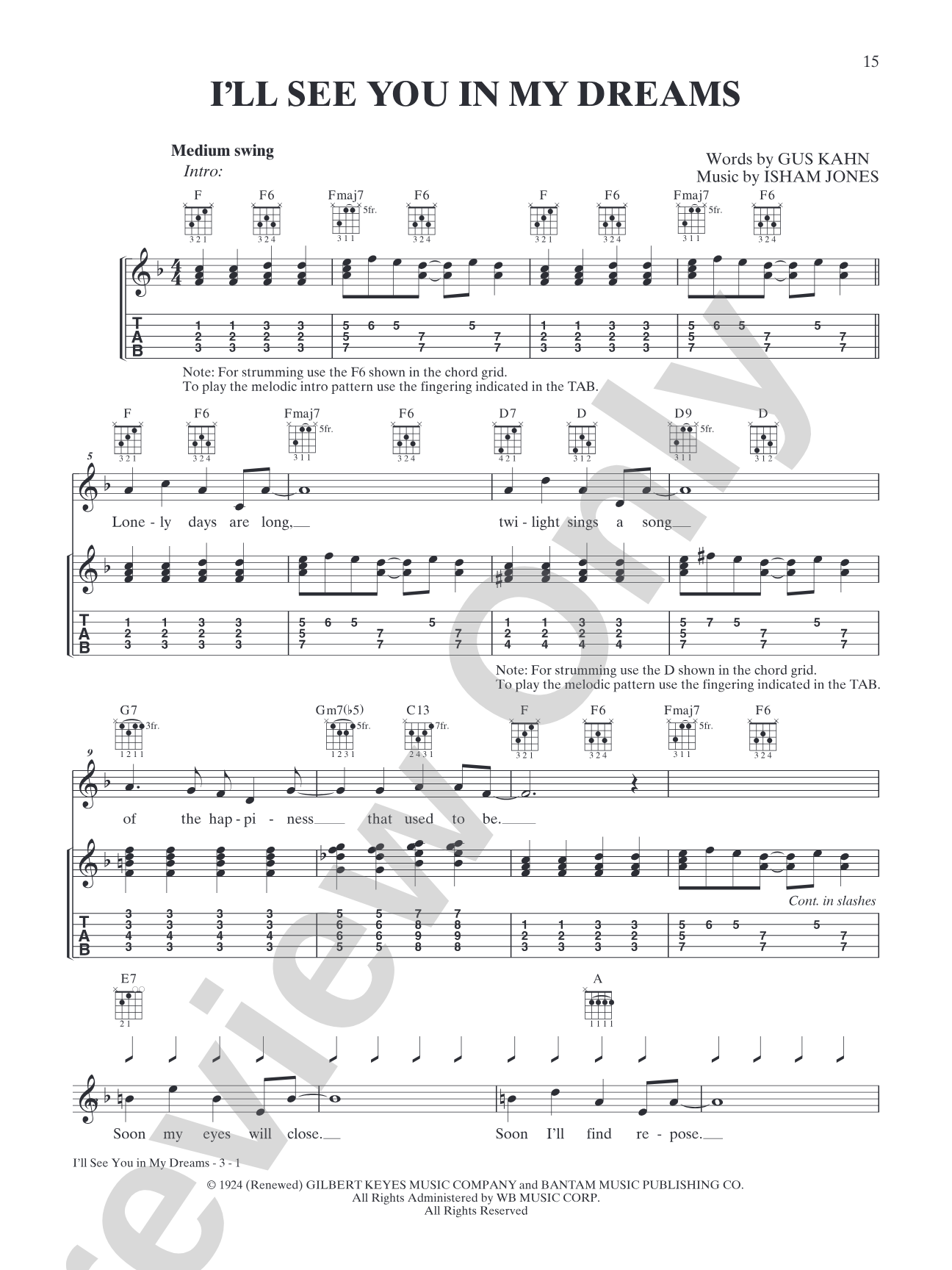

I'll See You in My Dreams: Banjo TAB
12 Great Songs of the '20s & '30s
Item: 00-PS-0011937
$4.99
Pickup currently not available
Related Items
Makin' Whoopee: Banjo TAB |
$4.99
|
View | |
Five Foot Two, Eyes of Blue: Banjo TAB |
$4.99
|
View | |
Ain't Misbehavin': Banjo TAB |
$4.99
|
View | |
It Don't Mean a Thing: Banjo TAB |
$4.99
|
View | |
Tonight You Belong to Me: Banjo TAB |
$4.99
|
View | |
As Time Goes By: Banjo TAB |
$4.99
|
View | |
It Had to Be You: Banjo TAB |
$4.99
|
View | |
Sweet Georgia Brown: Banjo TAB |
$4.99
|
View | |
Ain't She Sweet: Banjo TAB |
$4.99
|
View | |
Dream a Little Dream of Me: Banjo TAB |
$4.99
|
View |
Description
Swingin' Jazz Banjo is designed for your total enjoyment. Each song is arranged in a fun and lively way with a strum-and-sing approach. The chords are simple, yet entirely appropriate to the jazz-age style of the '20s and '30s. We've also included classic intros, endings, and turnarounds that will make you sound like an authentic early jazzer. Titles: Ain't Misbehavin' * Ain't She Sweet * As Time Goes By * Bye Bye Blackbird * Dream a Little Dream of Me * Five Foot Two, Eyes of Blue * I'll See You in My Dreams * It Don't Mean a Thing (If It Ain't Got That Swing) * It Had to Be You * Makin' Whoopee * Sweet Georgia Brown * Tonight You Belong to Me.


I'll See You in My Dreams: Banjo TAB isn't in MakeMusic Cloud just yet...but it could be. Let us know you'd like to see it, and you'll help shape what comes next. In the meantime, start a free trial and dive into thousands of interactive titles your students can play along with today.
Request This Title
Tell us you want it.
Start Your Free Trial
Explore everything that's ready to play right now.
Sample Audio
No sample audio found.
Sample Video
No sample videos found.
Additional Details
Series:
Just for Fun
Publisher:
Alfred Music
Page Count:
40
SKU:
00-PS-0011937
More about this title
About the Composer: Gus Kahn
Gus Kahn (1886-1941) was one of the most prolific and successful lyricists of the early 20th century, crafting memorable words for some of jazz age's most enduring standards. While best known for his songwriting partnership with composer Isham Jones and others, Kahn's contribution to American popular music shaped the sound and sensibility of an entire era, making his work essential listening for anyone exploring the roots of jazz and swing.
Kahn's gift lay in his ability to capture the spirit of the 1920s and 1930s—romantic, playful, and rhythmically sophisticated—in lyrics that singers and musicians have been interpreting for generations. His songs remain touchstones for jazz education and performance because they demand both technical skill and stylistic understanding from the musicians who play them.
Why we love this
This collection captures the essence of early jazz banjo culture without overwhelming players with complex chord voicings or obscure changes. The arrangements balance authenticity (genuine jazz-age sensibility, period-appropriate turnarounds and intros) with accessibility, making it genuinely fun to learn rather than frustrating. A banjo player working through these twelve standards gets to sound like a legitimate early jazz musician from day one.
What to expect
The energy is bright and conversational, with the warmth of a small club in the 1920s where the music served as the glue holding the evening together. These are tunes designed for people to enjoy themselves while listening and playing, balancing sincerity with infectious good humor. The TAB format removes reading barriers, letting you focus on the feel and character that made these songs timeless.
Who it's for
Banjo players at the early intermediate level who want to explore jazz repertoire without tackling advanced chord substitutions or bebop harmony. This is ideal for musicians in informal jazz combos, community jam sessions, or those looking to build a repertoire of standards that will serve them for years. Solo players will find these arrangements rewarding for recital or coffeehouse performance.
How to get the most out of it
- Lean into the strum-and-sing framework by finding the rhythmic pocket early in rehearsal; the accompaniment does much of the heavy lifting, so focus on your comping feel rather than filling every beat.
- Study the recorded intros and endings provided in the arrangement before you play through the full tune; these details are what transform a competent reading into an authentic jazz-age performance.
- Keep your tempo relaxed and conversational, especially on ballads like "As Time Goes By" and "Dream a Little Dream of Me," letting the swing feel emerge from your playing rather than fighting against it.
- Practice the turnarounds at half speed until the harmonic movement becomes muscle memory; they're small moments but they signal musicianship and keep the band listening to you.
How to use it
Program one or two of these standards in a concert as a palate cleanser alongside more formal repertoire, or build an entire jazz-themed recital around them. They work beautifully in community performances and informal settings where audience familiarity with the melodies creates immediate connection. Consider pairing selections from this book with a vocalist or small instrumental ensemble if your performance space allows.
Skills your students will build
- Reading TAB and chord symbols in a jazz context
- Authentic jazz-age strumming patterns and rhythmic feel
- Chord-based comping rather than single-note melody playing
- Interpreting period-appropriate intros, turnarounds, and endings
- Building solo repertoire from standard jazz repertoire