
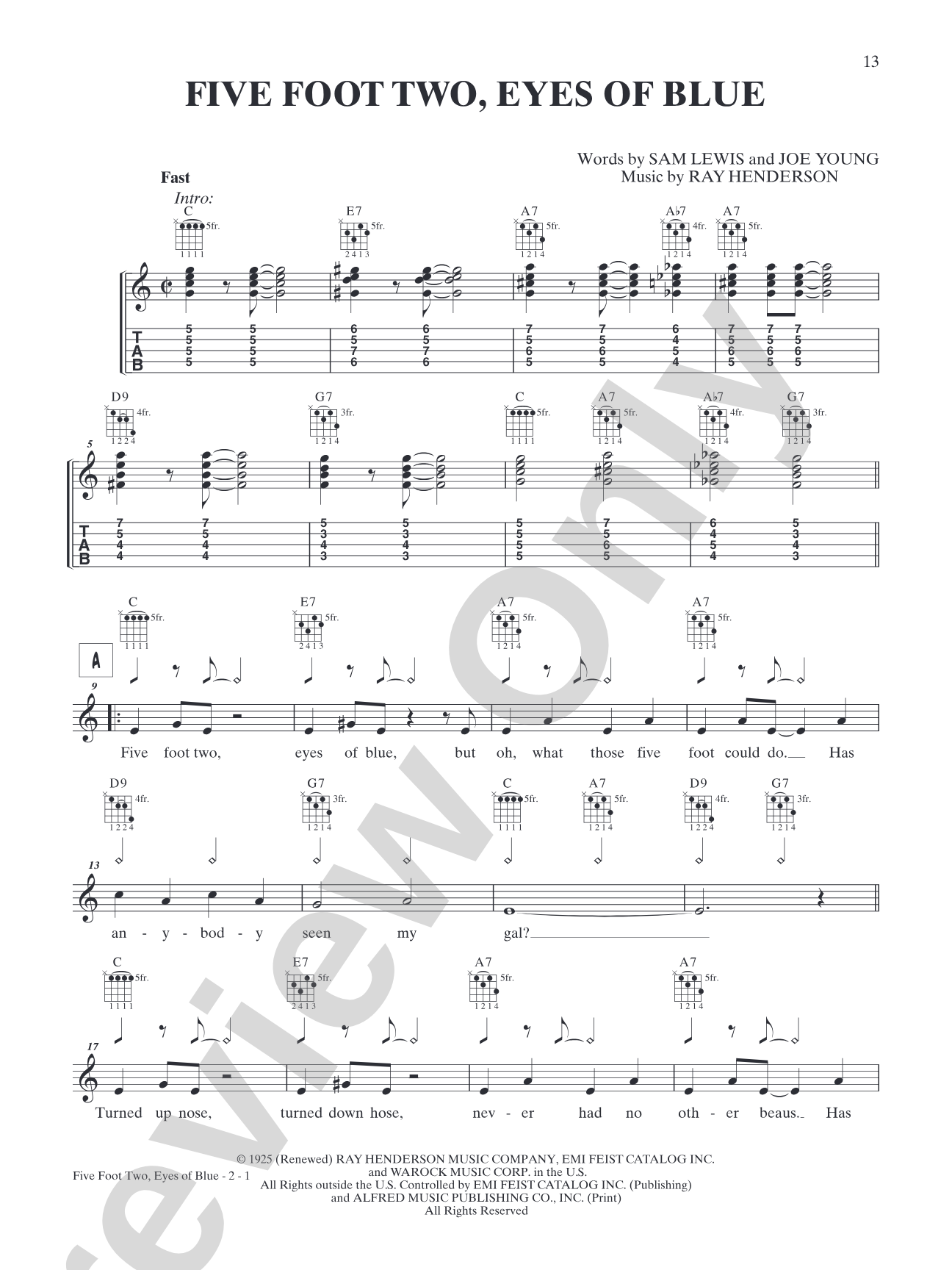

Five Foot Two, Eyes of Blue: Banjo TAB
12 Great Songs of the '20s & '30s
Item: 00-PS-0011779
$4.99
One moment…
Related Items
Makin' Whoopee: Banjo TAB |
$4.99
|
View | |
Ain't Misbehavin': Banjo TAB |
$4.99
|
View | |
It Don't Mean a Thing: Banjo TAB |
$4.99
|
View | |
Tonight You Belong to Me: Banjo TAB |
$4.99
|
View | |
As Time Goes By: Banjo TAB |
$4.99
|
View | |
It Had to Be You: Banjo TAB |
$4.99
|
View | |
Sweet Georgia Brown: Banjo TAB |
$4.99
|
View | |
Ain't She Sweet: Banjo TAB |
$4.99
|
View | |
I'll See You in My Dreams: Banjo TAB |
$4.99
|
View | |
Dream a Little Dream of Me: Banjo TAB |
$4.99
|
View |
Description
Swingin' Jazz Banjo is designed for your total enjoyment. Each song is arranged in a fun and lively way with a strum-and-sing approach. The chords are simple, yet entirely appropriate to the jazz-age style of the '20s and '30s. We've also included classic intros, endings, and turnarounds that will make you sound like an authentic early jazzer. Titles: Ain't Misbehavin' * Ain't She Sweet * As Time Goes By * Bye Bye Blackbird * Dream a Little Dream of Me * Five Foot Two, Eyes of Blue * I'll See You in My Dreams * It Don't Mean a Thing (If It Ain't Got That Swing) * It Had to Be You * Makin' Whoopee * Sweet Georgia Brown * Tonight You Belong to Me.


Five Foot Two, Eyes of Blue: Banjo TAB isn't in MakeMusic Cloud just yet...but it could be. Let us know you'd like to see it, and you'll help shape what comes next. In the meantime, start a free trial and dive into thousands of interactive titles your students can play along with today.
Request This Title
Tell us you want it.
Start Your Free Trial
Explore everything that's ready to play right now.
Sample Audio
No sample audio found.
Sample Video
No sample videos found.
Additional Details
Series:
Just for Fun
Publisher:
Alfred Music
Page Count:
40
SKU:
00-PS-0011779
More about this title
About the Composer: Ray Henderson
Ray Henderson (1896-1970) was one of the most prolific songwriters of the Jazz Age and early sound era. A composer with an instinctive gift for melody and rhythm, Henderson penned dozens of standards that defined the sound of the 1920s and 1930s, often collaborating with lyricists like Buddy DeSylva and Lew Brown. His songs captured the energy and optimism of the era and remain central to the jazz repertoire today.
Henderson's ability to write music that was both sophisticated and immediately singable made his work ideal for both concert performance and casual entertainment. Many of his compositions became vehicles for famous singers and jazz musicians and continue to appear regularly in jazz education and community music settings.
Why we love this
This collection brings authentic jazz-age repertoire within reach of early banjo players without sacrificing the real harmonic and stylistic flavor of the era. The inclusion of period-appropriate intros, endings, and turnarounds teaches students how to frame a song like a working jazz musician rather than simply playing it straight. These 12 standards are recordings that actually exist in countless forms, so students who learn them here can immediately seek out professional interpretations and understand their own playing in context.
What to expect
Stepping into a speakeasy or a 1920s dance hall: these arrangements pulse with the optimism, humor, and rhythmic zip of the Jazz Age. The melodies are immediately memorable, the harmonies are sophisticated enough to stay interesting, and the overall sound is one of genuine joy and musical conversation rather than display.
Who it's for
Banjo players with basic chord knowledge and a desire to move beyond folk or bluegrass into jazz-age repertoire. This is equally suited for hobbyists wanting authentic early jazz material and for students in jazz studies programs looking for accessible vehicles to develop jazz vocabulary and swing feel.
How to get the most out of it
- Anchor your sense of swing in the bass line and chord progression first, then layer your melodic interpretation on top. These tunes live and die on groove, not technical display.
- Study the recorded intros, endings, and turnarounds provided before you improvise your own. Copying the language of early jazz banjoists will develop your ear faster than inventing from scratch.
- Keep your strumming pattern consistent within a tune but vary your dynamic shape across the form. Let the song breathe by pulling back on verses and opening up on hits.
- Lean into the 'strum-and-sing' approach rather than fighting it. This isn't a concert etude book; it's a guide to being a functional jazz musician who can accompany themselves or others.
How to use it
Pair these standards with a small jazz ensemble or vocalist if you're building a jazz history or American songbook concert. They're also ideal for casual community performances, community college jazz classes, or private studio recitals where you want to showcase authentic repertoire with real historical and musical substance. A single tune or medley drawn from this collection will sit naturally alongside other early jazz standards.
Skills your students will build
- Reading banjo TAB with jazz-style chord changes and turnarounds
- Executing period-appropriate jazz intros and endings
- Distinguishing and maintaining swing feel across different tempos
- Accompanying a melody or vocalist in a traditional jazz context
- Understanding jazz-age harmonic language and its resolution patterns