
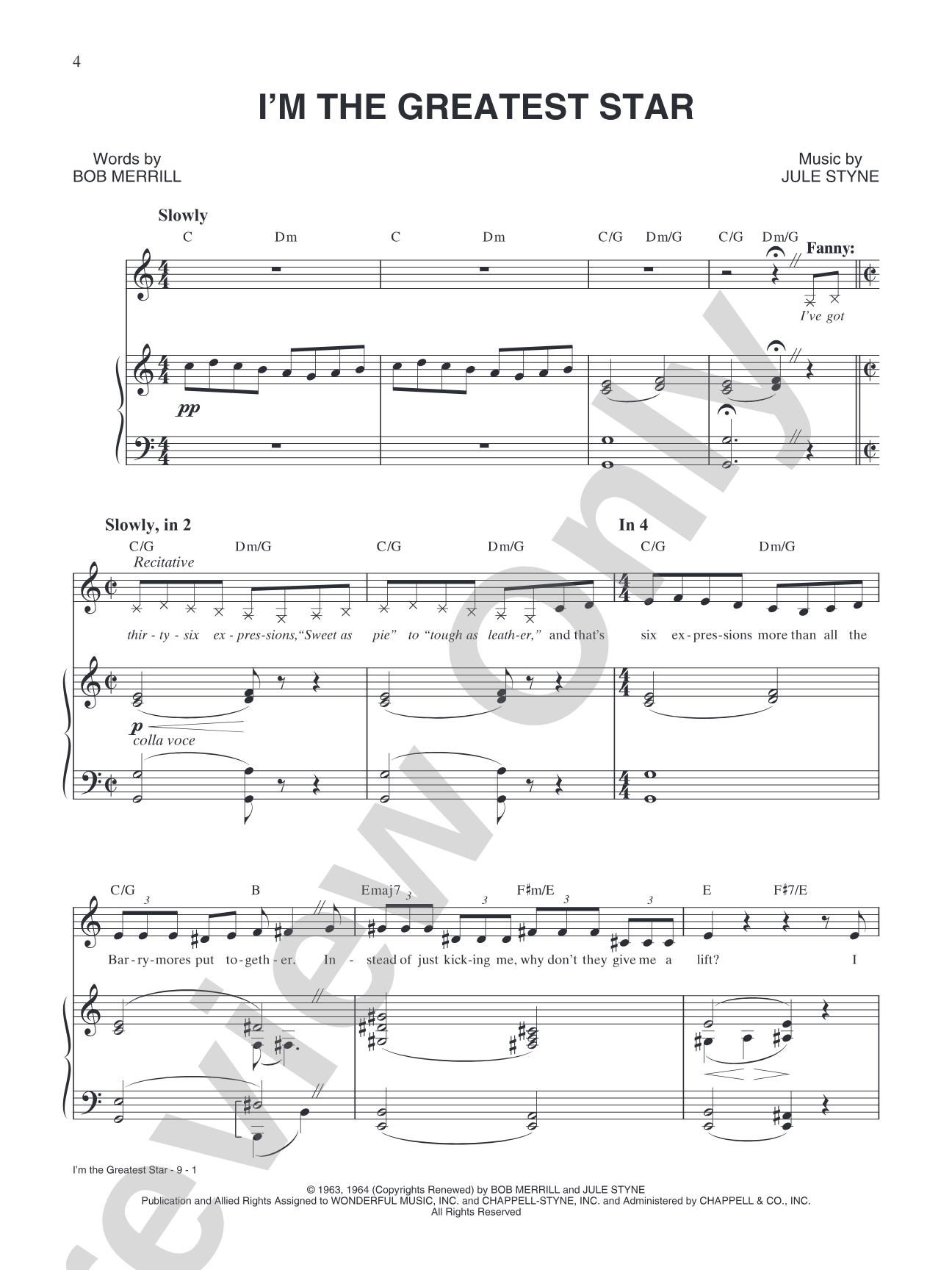
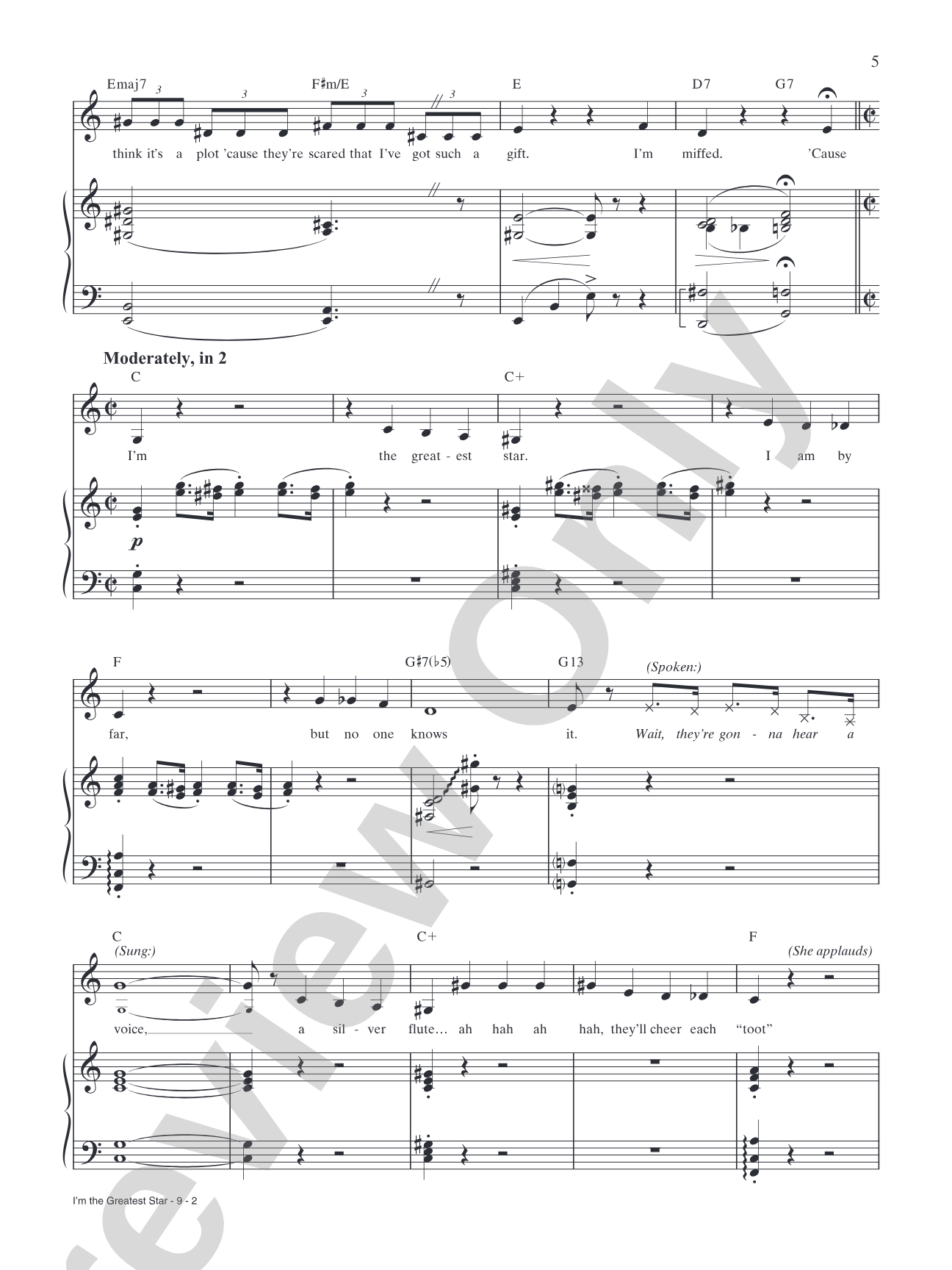

I'm the Greatest Star (from "Funny Girl"): Piano/Vocal/Chords
Music by Jule Styne, lyrics by Bob Merrill
Item: 00-XS-0000470
$5.99
One moment…
Related Items
Funny Girl (from "Funny Girl"): Piano/Vocal/Chords |
$4.99
|
View | |
The Music That Makes Me Dance (from "Funny Girl"): Piano/Vocal/Chords |
$4.99
|
View | |
Sadie, Sadie (from "Funny Girl"): Piano/Vocal/Chords |
$4.99
|
View | |
Who Are You Now? (from "Funny Girl"): Piano/Vocal/Chords |
$4.99
|
View | |
His Love Makes Me Beautiful (from "Funny Girl"): Piano/Vocal/Chords |
$4.99
|
View | |
I Want to be Seen with You Tonight (from "Funny Girl"): Piano/Vocal/Chords |
$4.99
|
View | |
Henry Street (from "Funny Girl"): Piano/Vocal/Chords |
$4.99
|
View | |
Cornet Man (from "Funny Girl"): Piano/Vocal/Chords |
$4.99
|
View | |
Don't Rain On My Parade (from "Funny Girl"): Piano/Vocal/Chords |
$5.99
|
View | |
You Are Woman, I Am Man (from "Funny Girl"): Piano/Vocal/Chords |
$4.99
|
View | |
People (from "Funny Girl"): Piano/Vocal/Chords |
$4.99
|
View |
Description
Funny Girl is Broadway's classic rags-to-riches love story about legendary entertainer Fanny Brice during Ziegfeld's Golden Era of burlesque. Its beloved score by Jule Styne and Bob Merrill is filled with unforgettable songs like "Don't Rain on My Parade," "I'm the Greatest Star," "The Music That Makes Me Dance," and the iconic hit "People." Barbra Streisand first immortalized these songs in the original 1964 Broadway smash, and yet again in the famous movie adaptation several years later. The show continues to enjoy immense popularity today with a major Broadway revival and countless productions worldwide. Pianists and singers will delight in this updated piano/vocal selections folio, in which the arrangements of several songs have been upgraded to better reflect the familiar original cast recordings compared to earlier printed editions. Also added is the song "Funny Girl," which Styne and Merrill wrote for the 1968 movie adaptation. Contents: * I'm the Greatest Star * Cornet Man * His Love Makes Me Beautiful * I Want to Be Seen with You Tonight * Henry Street * People * You Are Woman, I Am Man * Don't Rain on My Parade * Sadie, Sadie * Who Are You Now? * The Music That Makes Me Dance * Funny Girl.


I'm the Greatest Star (from "Funny Girl"): Piano/Vocal/Chords isn't in MakeMusic Cloud just yet...but it could be. Let us know you'd like to see it, and you'll help shape what comes next. In the meantime, start a free trial and dive into thousands of interactive titles your students can play along with today.
Request This Title
Tell us you want it.
Start Your Free Trial
Explore everything that's ready to play right now.
Sample Audio
No sample audio found.
Sample Video
No sample videos found.
Additional Details
Publisher:
Alfred Music
Page Count:
52
SKU:
00-XS-0000470
More about this title
About the Composer: Jule Styne
Jule Styne (1905-1975) was one of Broadway's most prolific and commercially successful composers, with a gift for writing melodies that stick with audiences long after the curtain falls. His collaborations with lyricist Bob Merrill on Funny Girl produced some of the American musical theater's most enduring standards, songs that have been performed countless times across concert halls, cabarets, and recitals worldwide.
Styne's approach to songwriting balanced accessibility with theatrical sophistication. He understood how to write for star performers while creating material that could sustain repeated listenings and reinterpretations. His influence on musical theater composition extends far beyond Funny Girl; educators and performers continue to turn to his catalog as essential material for teaching songcraft, phrasing, and the architecture of a great theater song.
Why we love this
This folio captures the infectious energy and character-driven storytelling that make Funny Girl such a rewarding show to perform. The arrangements reflect the original cast recordings, so singers can connect directly to Streisand's iconic interpretations while pianists get accompaniments that sit comfortably under the voice and support dramatic pacing without overshadowing the lyric.
What to expect
These songs pulse with the optimism and determination of a performer climbing toward stardom. Whether it's the brash confidence of 'I'm the Greatest Star' or the aching sincerity of 'People,' the score captures a world of vaudeville glamour, romantic longing, and the hunger to succeed. The music feels both of its era and timelessly appealing.
Who it's for
Singers preparing for auditions, recitals, or performances in Funny Girl productions will find these piano/vocal arrangements essential. Pianists accompanying singers in musical theater contexts, as well as those exploring the Great American Songbook, will appreciate material that sounds both theatrical and intimate.
How to get the most out of it
- Study the rhythm of the lyric first. Styne's melodies often sit slightly ahead of or behind the beat in ways that feel conversational; letting the words shape your phrasing will make the music feel natural rather than metrically rigid.
- Balance the piano's rhythmic content with vocal storytelling in uptempo numbers like 'Don't Rain on My Parade.' The accompaniment drives the energy, but your voice should feel in command of the narrative.
- Explore the vulnerability in the ballads like 'The Music That Makes Me Dance.' These songs reward singers who find the emotional specificity beneath the big melody.
- Pay attention to where Styne uses silence or sparse accompaniment. The contrast between full sections and stripped-down moments creates drama and makes the singing shine.
How to use it
Feature individual songs in recital programs that pair well with other theater standards or contemporary song cycles. Use 'People' and 'The Music That Makes Me Dance' as ballad vehicles for students developing legit soprano technique. Programs built around stories of resilience and ambition can frame several songs from this collection together.
Skills your students will build
- Phrasing lyrical melodies across long phrases while maintaining vocal legit technique
- Interpreting rhythmic flexibility and swing within a composed score
- Coordinating vocal expression with piano accompaniment texture and harmonic support
- Building character and emotional stakes within uptempo comedic numbers
- Reading and performing in styles ranging from sentimental ballad to theatrical belt