
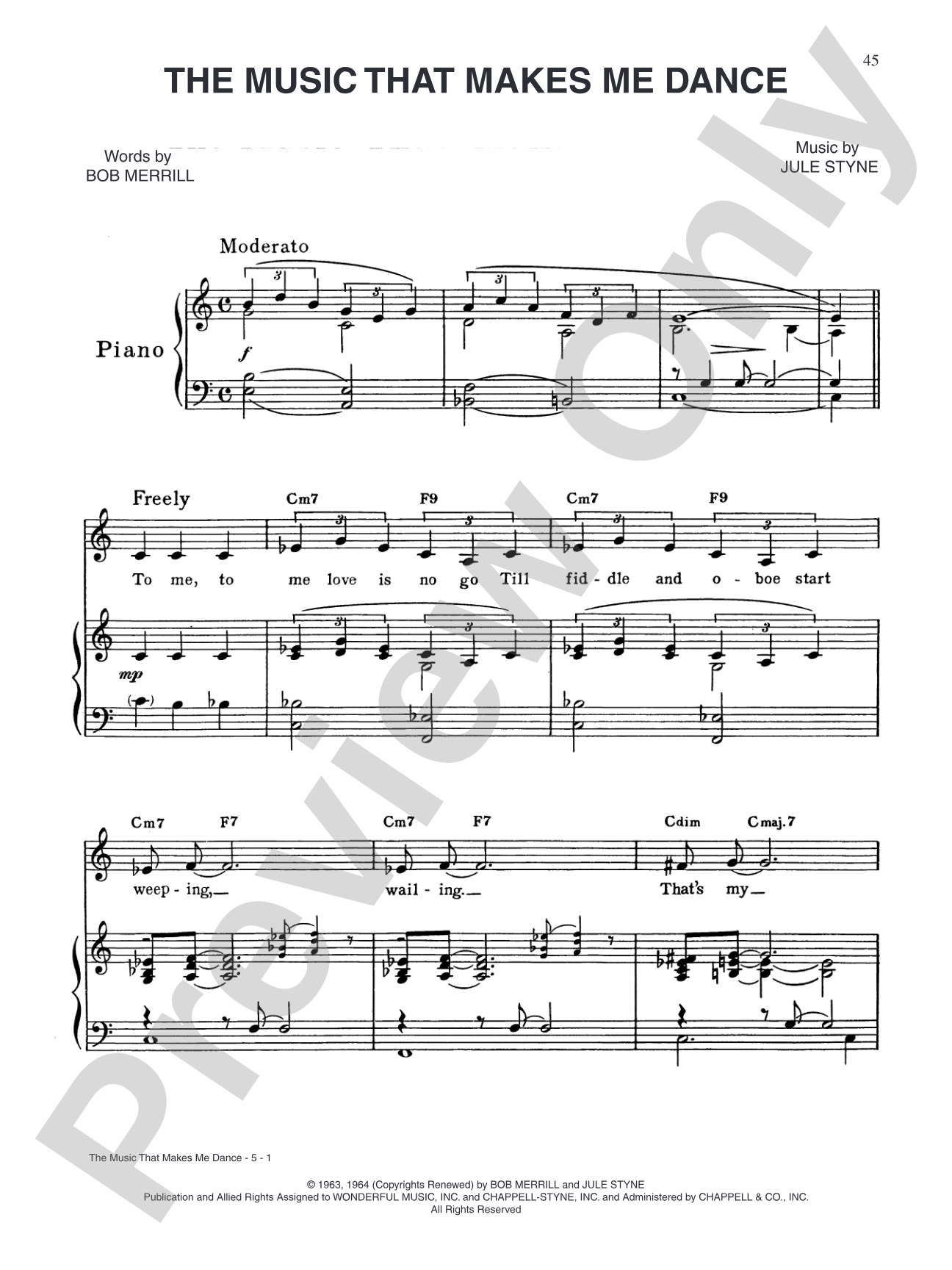

The Music That Makes Me Dance (from "Funny Girl"): Piano/Vocal/Chords
Music by Jule Styne, lyrics by Bob Merrill
Item: 00-PS-0013444
$4.99
One moment…
Related Items
Funny Girl (from "Funny Girl"): Piano/Vocal/Chords |
$4.99
|
View | |
Sadie, Sadie (from "Funny Girl"): Piano/Vocal/Chords |
$4.99
|
View | |
Who Are You Now? (from "Funny Girl"): Piano/Vocal/Chords |
$4.99
|
View | |
His Love Makes Me Beautiful (from "Funny Girl"): Piano/Vocal/Chords |
$4.99
|
View | |
I Want to be Seen with You Tonight (from "Funny Girl"): Piano/Vocal/Chords |
$4.99
|
View | |
Henry Street (from "Funny Girl"): Piano/Vocal/Chords |
$4.99
|
View | |
Cornet Man (from "Funny Girl"): Piano/Vocal/Chords |
$4.99
|
View | |
Don't Rain On My Parade (from "Funny Girl"): Piano/Vocal/Chords |
$5.99
|
View | |
You Are Woman, I Am Man (from "Funny Girl"): Piano/Vocal/Chords |
$4.99
|
View | |
I'm the Greatest Star (from "Funny Girl"): Piano/Vocal/Chords |
$5.99
|
View | |
People (from "Funny Girl"): Piano/Vocal/Chords |
$4.99
|
View |
Description
Funny Girl is Broadway's classic rags-to-riches love story about legendary entertainer Fanny Brice during Ziegfeld's Golden Era of burlesque. Its beloved score by Jule Styne and Bob Merrill is filled with unforgettable songs like "Don't Rain on My Parade," "I'm the Greatest Star," "The Music That Makes Me Dance," and the iconic hit "People." Barbra Streisand first immortalized these songs in the original 1964 Broadway smash, and yet again in the famous movie adaptation several years later. The show continues to enjoy immense popularity today with a major Broadway revival and countless productions worldwide. Pianists and singers will delight in this updated piano/vocal selections folio, in which the arrangements of several songs have been upgraded to better reflect the familiar original cast recordings compared to earlier printed editions. Also added is the song "Funny Girl," which Styne and Merrill wrote for the 1968 movie adaptation. Contents: * I'm the Greatest Star * Cornet Man * His Love Makes Me Beautiful * I Want to Be Seen with You Tonight * Henry Street * People * You Are Woman, I Am Man * Don't Rain on My Parade * Sadie, Sadie * Who Are You Now? * The Music That Makes Me Dance * Funny Girl.


The Music That Makes Me Dance (from "Funny Girl"): Piano/Vocal/Chords isn't in MakeMusic Cloud just yet...but it could be. Let us know you'd like to see it, and you'll help shape what comes next. In the meantime, start a free trial and dive into thousands of interactive titles your students can play along with today.
Request This Title
Tell us you want it.
Start Your Free Trial
Explore everything that's ready to play right now.
Sample Audio
No sample audio found.
Sample Video
No sample videos found.
Additional Details
Publisher:
Alfred Music
Page Count:
52
SKU:
00-PS-0013444
More about this title
About the Composer: Jule Styne
Jule Styne (1905-1975) composed the scores for some of Broadway's most enduring musicals, including Gypsy, Funny Girl, Hallelujah, Baby!, and Bells Are Ringing. His gift for melody and his ability to write songs that reveal character made him essential to the Golden Age of musical theater. Styne's collaboration with lyricist Bob Merrill on Funny Girl produced a score that has remained a cornerstone of musical theater repertoire, performed by singers and pianists worldwide.
Styne's compositions demand strong musicianship from performers. His melodies are singable yet sophisticated, his harmonies richer than they initially appear, and his piano accompaniments contain the warmth and theatrical detail that made the original cast recordings so memorable. For music students, Styne's work offers a bridge between popular song sensibility and serious musical craft.
Why we love this
This folio captures the essence of what made Funny Girl a landmark Broadway show. The updated arrangements reflect the beloved original cast recordings rather than earlier simplified editions, giving singers and pianists access to the authentic theatrical sound they know from Streisand's definitive performances. The collection spans the show's emotional range, from the brass-band humor of "Cornet Man" to the vulnerable intimacy of "The Music That Makes Me Dance," making it genuinely useful for both recital programming and classroom study of American musical theater.
What to expect
Golden Age Broadway glamour mixed with genuine emotion. These songs swing and soar, filled with the kind of theatrical exuberance that defined 1960s musical theater, yet they also contain moments of real vulnerability and longing. You'll move from comedic character songs to showstopper belters to intimate ballads, all wrapped in Styne's characteristically warm and inventive harmonic language.
Who it's for
Singers preparing audition material, students studying musical theater repertoire, pianists building their accompanying skills, and performers assembling recital programs centered on classic Broadway. The folio works equally well for voice studio instruction and ensemble performance contexts.
How to get the most out of it
- Study the original cast recording before diving into the printed page. Styne's melodies have characteristic phrasing and rhythmic flexibility that the score alone won't fully convey.
- Balance the piano accompaniment carefully in the vocal-line passages. These arrangements are designed to support the singer while maintaining the orchestral color of the original orchestrations.
- Attend to the dynamics and articulation markings in the piano part, particularly in songs like "Don't Rain on My Parade" and "I'm the Greatest Star," where rhythmic precision and character drive the song forward.
- Adjust tempos thoughtfully between songs. The folio moves through contrasting moods, and subtle tempo variations will help shape the arc of a medley or recital set.
How to use it
Program a single song as a standalone audition piece, or build an entire recital around multiple selections from the folio to showcase the range of Funny Girl's score. For music history courses, these songs illustrate how Broadway composers balanced popular appeal with genuine musical sophistication. The collection also works beautifully as material for singers preparing for musical theater master classes or workshops.
Skills your students will build
- Interpreting character-driven songs and identifying how melody and harmony reveal emotional subtext
- Managing the musical theater accompaniment style, which requires both rhythmic clarity and flexibility
- Reading and executing articulation and dynamic markings that serve theatrical intent
- Building audition material and understanding song selection for voice type and dramatic range
- Recognizing the harmonic language of Golden Age Broadway and how it differs from contemporary pop music