
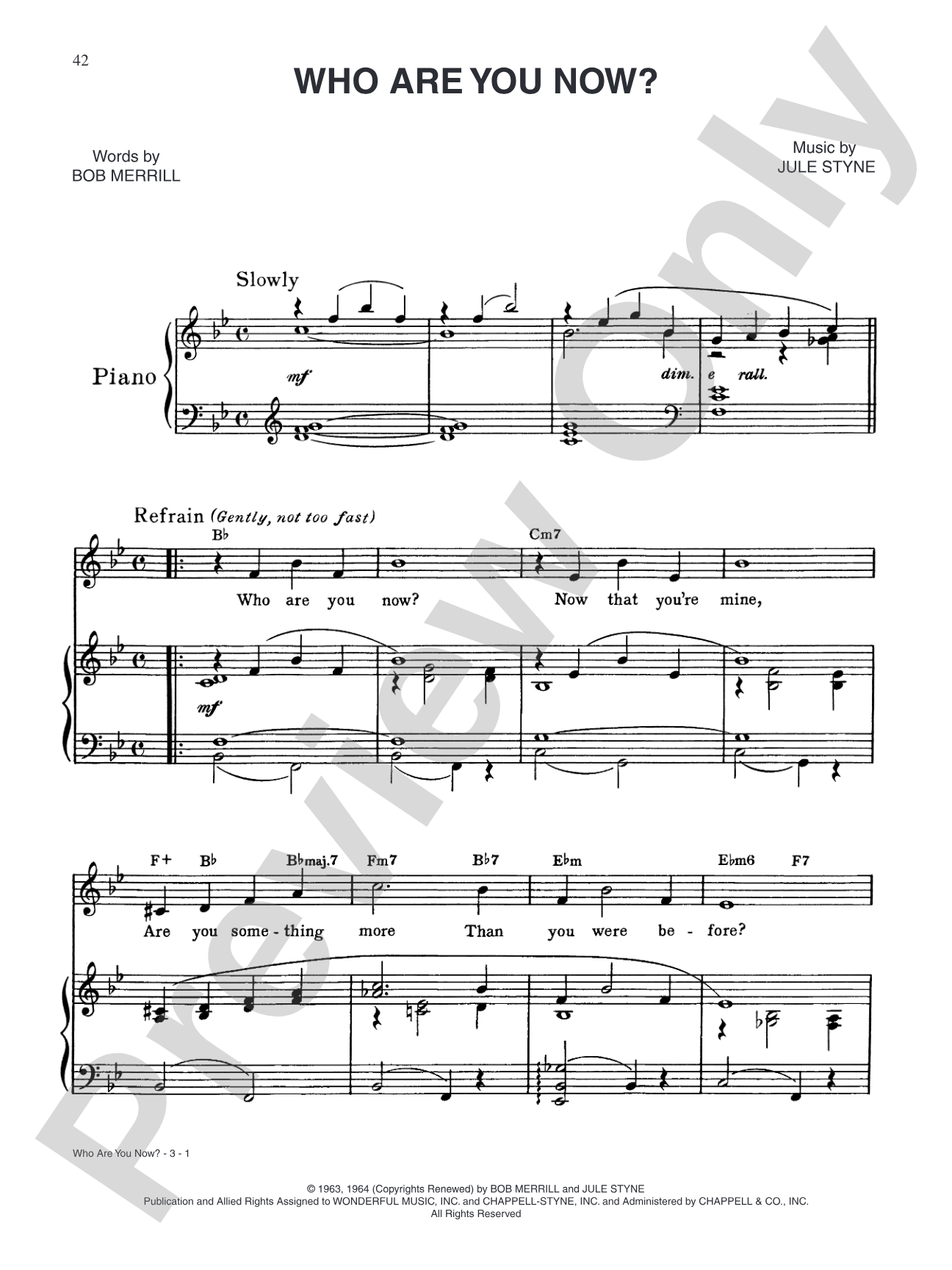

Who Are You Now? (from "Funny Girl"): Piano/Vocal/Chords
Music by Jule Styne, lyrics by Bob Merrill
Item: 00-PS-0013446
$4.99
One moment…
Related Items
Funny Girl (from "Funny Girl"): Piano/Vocal/Chords |
$4.99
|
View | |
The Music That Makes Me Dance (from "Funny Girl"): Piano/Vocal/Chords |
$4.99
|
View | |
Sadie, Sadie (from "Funny Girl"): Piano/Vocal/Chords |
$4.99
|
View | |
His Love Makes Me Beautiful (from "Funny Girl"): Piano/Vocal/Chords |
$4.99
|
View | |
I Want to be Seen with You Tonight (from "Funny Girl"): Piano/Vocal/Chords |
$4.99
|
View | |
Henry Street (from "Funny Girl"): Piano/Vocal/Chords |
$4.99
|
View | |
Cornet Man (from "Funny Girl"): Piano/Vocal/Chords |
$4.99
|
View | |
Don't Rain On My Parade (from "Funny Girl"): Piano/Vocal/Chords |
$5.99
|
View | |
You Are Woman, I Am Man (from "Funny Girl"): Piano/Vocal/Chords |
$4.99
|
View | |
I'm the Greatest Star (from "Funny Girl"): Piano/Vocal/Chords |
$5.99
|
View | |
People (from "Funny Girl"): Piano/Vocal/Chords |
$4.99
|
View |
Description
Funny Girl is Broadway's classic rags-to-riches love story about legendary entertainer Fanny Brice during Ziegfeld's Golden Era of burlesque. Its beloved score by Jule Styne and Bob Merrill is filled with unforgettable songs like "Don't Rain on My Parade," "I'm the Greatest Star," "The Music That Makes Me Dance," and the iconic hit "People." Barbra Streisand first immortalized these songs in the original 1964 Broadway smash, and yet again in the famous movie adaptation several years later. The show continues to enjoy immense popularity today with a major Broadway revival and countless productions worldwide. Pianists and singers will delight in this updated piano/vocal selections folio, in which the arrangements of several songs have been upgraded to better reflect the familiar original cast recordings compared to earlier printed editions. Also added is the song "Funny Girl," which Styne and Merrill wrote for the 1968 movie adaptation. Contents: * I'm the Greatest Star * Cornet Man * His Love Makes Me Beautiful * I Want to Be Seen with You Tonight * Henry Street * People * You Are Woman, I Am Man * Don't Rain on My Parade * Sadie, Sadie * Who Are You Now? * The Music That Makes Me Dance * Funny Girl.


Who Are You Now? (from "Funny Girl"): Piano/Vocal/Chords isn't in MakeMusic Cloud just yet...but it could be. Let us know you'd like to see it, and you'll help shape what comes next. In the meantime, start a free trial and dive into thousands of interactive titles your students can play along with today.
Request This Title
Tell us you want it.
Start Your Free Trial
Explore everything that's ready to play right now.
Sample Audio
No sample audio found.
Sample Video
No sample videos found.
Additional Details
Publisher:
Alfred Music
Page Count:
52
SKU:
00-PS-0013446
More about this title
About the Composer: Jule Styne
Jule Styne (1905-1975) composed some of Broadway's most enduring melodies, creating scores that balanced sophisticated harmonic writing with immediate, singable hooks. His gift for melody served both intimate character moments and spectacular production numbers, making his work as accessible to amateur singers as to Broadway stars. Styne collaborated with some of theater's finest lyricists, but his partnership with Bob Merrill on Funny Girl produced a score of remarkable breadth: tender ballads, comic patter songs, and show-stopping belt numbers that have become standards in the American musical theater canon.
Why we love this
This folio captures the full theatrical scope of Styne and Merrill's score in arrangements that honor the original cast recordings rather than simplified versions. Singers get to experience the real harmonic language beneath these famous melodies, while pianists play genuinely interesting accompaniments that support and enhance the vocal line without overwhelming it. Programming any song from Funny Girl signals musical sophistication and gives your students access to repertoire they've likely heard but rarely performed in authentic form.
What to expect
Funny Girl radiates the glamour and heartbreak of the Jazz Age, with Styne's orchestrations translating into lush piano voicings that feel both theatrical and intimate. These songs balance infectious comedy with genuine emotional vulnerability, moving between the footlights-facing swagger of "I'm the Greatest Star" and the tender vulnerability of "People." From the syncopated charm of "Sadie, Sadie" to the soaring romanticism of "You Are Woman, I Am Man," the score captures a character audience roots for even when she's breaking her own heart.
Who it's for
Pianists preparing for vocal accompanying roles, singers working on American musical theater standards, and anyone building a recital program featuring Broadway's Golden Age classics. This collection works equally well for private studio teaching, recital preparation, or classroom exploration of theatrical songwriting. Advanced high school singers and college-level performers will find substantial musical material here.
How to get the most out of it
- Balance the vocal line against the piano accompaniment by thinking of the keyboard as an ensemble voice rather than a solo vehicle. These arrangements support the singer, so resist the urge to play loudly through the verse.
- Pay close attention to the rhythm section figures in uptempo numbers like "Don't Rain on My Parade." Crisp articulation and steady groove matter more than dramatic dynamics.
- Treat the jazz-influenced harmonic movement in ballads like "The Music That Makes Me Dance" with care; lean into unexpected chord changes slightly to let listeners hear Styne's harmonic sophistication.
- When playing for a vocalist, follow their phrasing and breath. These melodies are written for singers, so your accompaniment should breathe with them rather than push ahead.
How to use it
Build an entire recital around Funny Girl, or select individual songs to anchor a Broadway-themed concert alongside other Styne works or contemporary musical theater. The variety of styles and moods within this collection means you can program uptempo novelty numbers and vulnerable ballads on the same program without tonal monotony. This folio is especially valuable for developing singers' ability to shift between comedic acting and genuine lyrical expression, a skill central to musical theater performance.
Skills your students will build
- Reading jazz-influenced harmonic progressions and chromaticism typical of mid-century Broadway
- Accompanying singers by balancing accompaniment texture with vocal presence
- Performing in varied styles within a single score (comedic patter, romantic ballad, novelty song, torch number)
- Interpreting theatrical language and character subtext through musical choices
- Sight-reading complex piano/vocal scores with multiple staves and tempo changes