
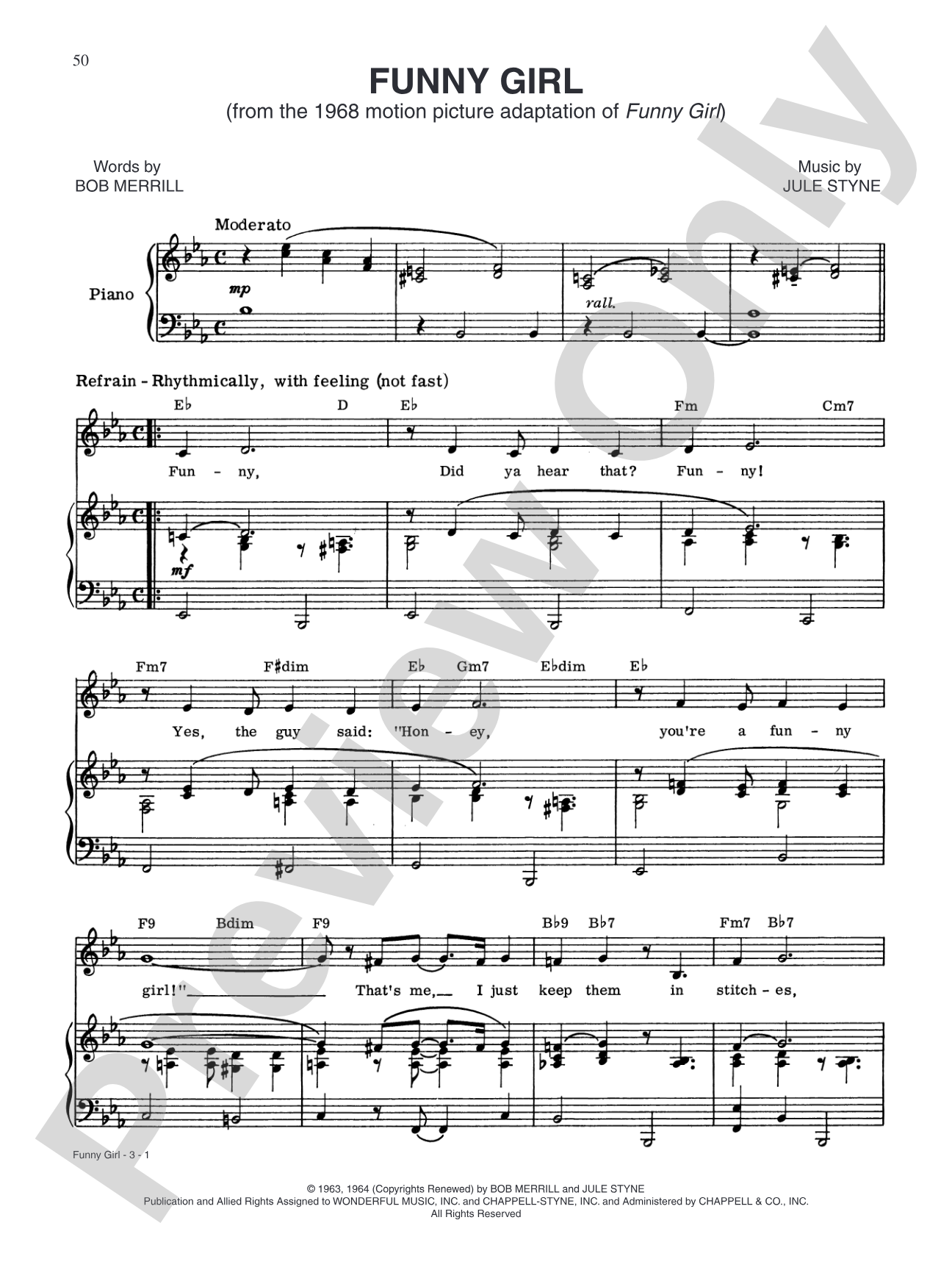

Funny Girl (from "Funny Girl"): Piano/Vocal/Chords
Music by Jule Styne, lyrics by Bob Merrill
Item: 00-PS-0013443
$4.99
One moment…
Related Items
The Music That Makes Me Dance (from "Funny Girl"): Piano/Vocal/Chords |
$4.99
|
View | |
Sadie, Sadie (from "Funny Girl"): Piano/Vocal/Chords |
$4.99
|
View | |
Who Are You Now? (from "Funny Girl"): Piano/Vocal/Chords |
$4.99
|
View | |
His Love Makes Me Beautiful (from "Funny Girl"): Piano/Vocal/Chords |
$4.99
|
View | |
I Want to be Seen with You Tonight (from "Funny Girl"): Piano/Vocal/Chords |
$4.99
|
View | |
Henry Street (from "Funny Girl"): Piano/Vocal/Chords |
$4.99
|
View | |
Cornet Man (from "Funny Girl"): Piano/Vocal/Chords |
$4.99
|
View | |
Don't Rain On My Parade (from "Funny Girl"): Piano/Vocal/Chords |
$5.99
|
View | |
You Are Woman, I Am Man (from "Funny Girl"): Piano/Vocal/Chords |
$4.99
|
View | |
I'm the Greatest Star (from "Funny Girl"): Piano/Vocal/Chords |
$5.99
|
View | |
People (from "Funny Girl"): Piano/Vocal/Chords |
$4.99
|
View |
Description
Funny Girl is Broadway's classic rags-to-riches love story about legendary entertainer Fanny Brice during Ziegfeld's Golden Era of burlesque. Its beloved score by Jule Styne and Bob Merrill is filled with unforgettable songs like "Don't Rain on My Parade," "I'm the Greatest Star," "The Music That Makes Me Dance," and the iconic hit "People." Barbra Streisand first immortalized these songs in the original 1964 Broadway smash, and yet again in the famous movie adaptation several years later. The show continues to enjoy immense popularity today with a major Broadway revival and countless productions worldwide. Pianists and singers will delight in this updated piano/vocal selections folio, in which the arrangements of several songs have been upgraded to better reflect the familiar original cast recordings compared to earlier printed editions. Also added is the song "Funny Girl," which Styne and Merrill wrote for the 1968 movie adaptation. Contents: * I'm the Greatest Star * Cornet Man * His Love Makes Me Beautiful * I Want to Be Seen with You Tonight * Henry Street * People * You Are Woman, I Am Man * Don't Rain on My Parade * Sadie, Sadie * Who Are You Now? * The Music That Makes Me Dance * Funny Girl.


Funny Girl (from "Funny Girl"): Piano/Vocal/Chords isn't in MakeMusic Cloud just yet...but it could be. Let us know you'd like to see it, and you'll help shape what comes next. In the meantime, start a free trial and dive into thousands of interactive titles your students can play along with today.
Request This Title
Tell us you want it.
Start Your Free Trial
Explore everything that's ready to play right now.
Sample Audio
No sample audio found.
Sample Video
No sample videos found.
Additional Details
Publisher:
Alfred Music
Page Count:
52
SKU:
00-PS-0013443
More about this title
About the Composer: Jule Styne
Jule Styne (1905-1975) was one of Broadway's most prolific and successful composers, creating the scores for some of the theatre's most enduring hits. His gift for memorable melody and his ability to craft songs that captured both humor and heart made him a natural collaborator with lyricists and librettists across multiple decades of American musical theatre. Beyond Funny Girl, his output includes Gypsy, Bells Are Ringing, and Gentlemen Prefer Blondes, each demonstrating his skill at writing for diverse character types and theatrical moments.
Why we love this
This folio strikes the rare balance between authenticity and singability. The updated arrangements reflect what audiences know from the original cast recordings and film versions, making it instantly recognizable for singers who've grown up hearing these songs. The 12-song selection spans comedy, romance, and showstopper material, giving you real variety in a single volume.
What to expect
The energy shifts from brash comedic confidence in the opening numbers to genuine vulnerability in the ballads. There's a warmth and directness to Styne's writing that feels both intimate and theatrical, whether you're in a practice room or on stage. The score never loses sight of Fanny Brice herself: a performer brimming with talent and ambition, navigating love and career with wit and heartbreak in equal measure.
Who it's for
This folio works for pianists and singers preparing audition material, recital selections, or ensemble performance from one of Broadway's most celebrated scores. Voice students studying American musical theatre repertoire and accompanying pianists building their show music library will find both technical substance and genuine performance rewards here.
How to get the most out of it
- Balance the piano accompaniment with the vocal line throughout. These arrangements are thick enough to support a full sound, but the lyrics and melody must remain the priority in a small room or during a lesson.
- Study the specific rhythmic language in numbers like "Don't Rain on My Parade" and "I'm the Greatest Star." Styne's syncopation is part of the character, not a complication to smooth over.
- Use dynamics to shape the quieter moments, particularly in "People" and "The Music That Makes Me Dance." The emotional payoff depends on restraint earlier.
- Pay attention to the chord symbols for improvisation or reharmonization options during rehearsal if you're working with a singer interested in stylistic interpretation.
How to use it
Program "Don't Rain on My Parade" and "I'm the Greatest Star" as standalone showstoppers for recital or audition contexts. Alternatively, sequence multiple songs from this collection as an act-two medley or a themed cabaret program celebrating Broadway comedy and romance. These selections work equally well for a singer preparing a solo recital or an accompanist building a season of performance repertoire.
Skills your students will build
- Interpreting syncopated rhythms in Broadway idiom
- Managing dynamic contrast between comedic and lyrical material
- Coordinating vocal phrasing with piano accompaniment in show music arrangement
- Reading chord symbols and understanding harmonic movement in popular song
- Building stamina and character work across contrasting song styles within a single show