
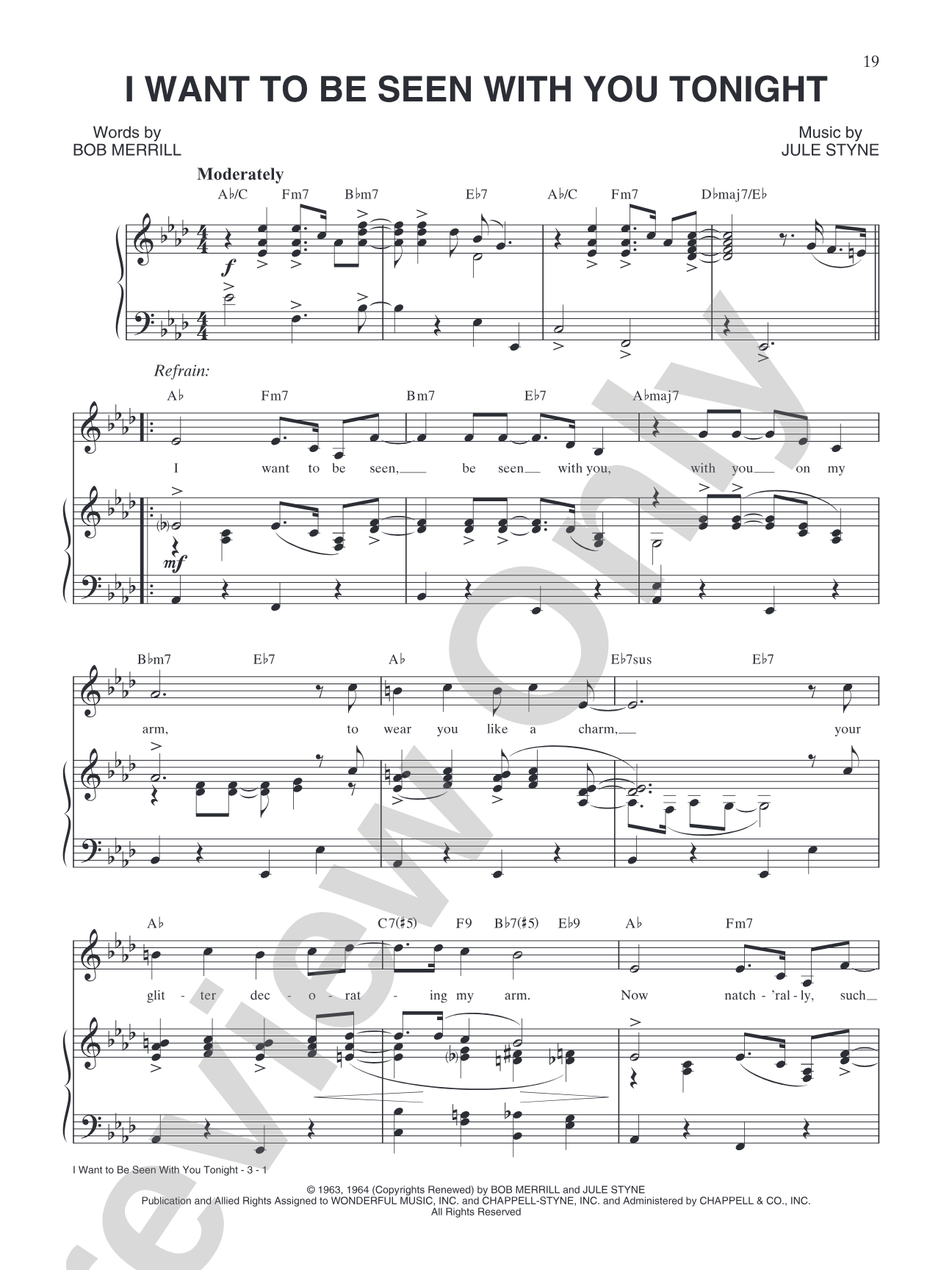

I Want to be Seen with You Tonight (from "Funny Girl"): Piano/Vocal/Chords
Music by Jule Styne, lyrics by Bob Merrill
Item: 00-XS-0000465
$4.99
One moment…
Related Items
Funny Girl (from "Funny Girl"): Piano/Vocal/Chords |
$4.99
|
View | |
The Music That Makes Me Dance (from "Funny Girl"): Piano/Vocal/Chords |
$4.99
|
View | |
Sadie, Sadie (from "Funny Girl"): Piano/Vocal/Chords |
$4.99
|
View | |
Who Are You Now? (from "Funny Girl"): Piano/Vocal/Chords |
$4.99
|
View | |
His Love Makes Me Beautiful (from "Funny Girl"): Piano/Vocal/Chords |
$4.99
|
View | |
Henry Street (from "Funny Girl"): Piano/Vocal/Chords |
$4.99
|
View | |
Cornet Man (from "Funny Girl"): Piano/Vocal/Chords |
$4.99
|
View | |
Don't Rain On My Parade (from "Funny Girl"): Piano/Vocal/Chords |
$5.99
|
View | |
You Are Woman, I Am Man (from "Funny Girl"): Piano/Vocal/Chords |
$4.99
|
View | |
I'm the Greatest Star (from "Funny Girl"): Piano/Vocal/Chords |
$5.99
|
View | |
People (from "Funny Girl"): Piano/Vocal/Chords |
$4.99
|
View |
Description
Funny Girl is Broadway's classic rags-to-riches love story about legendary entertainer Fanny Brice during Ziegfeld's Golden Era of burlesque. Its beloved score by Jule Styne and Bob Merrill is filled with unforgettable songs like "Don't Rain on My Parade," "I'm the Greatest Star," "The Music That Makes Me Dance," and the iconic hit "People." Barbra Streisand first immortalized these songs in the original 1964 Broadway smash, and yet again in the famous movie adaptation several years later. The show continues to enjoy immense popularity today with a major Broadway revival and countless productions worldwide. Pianists and singers will delight in this updated piano/vocal selections folio, in which the arrangements of several songs have been upgraded to better reflect the familiar original cast recordings compared to earlier printed editions. Also added is the song "Funny Girl," which Styne and Merrill wrote for the 1968 movie adaptation. Contents: * I'm the Greatest Star * Cornet Man * His Love Makes Me Beautiful * I Want to Be Seen with You Tonight * Henry Street * People * You Are Woman, I Am Man * Don't Rain on My Parade * Sadie, Sadie * Who Are You Now? * The Music That Makes Me Dance * Funny Girl.


I Want to be Seen with You Tonight (from "Funny Girl"): Piano/Vocal/Chords isn't in MakeMusic Cloud just yet...but it could be. Let us know you'd like to see it, and you'll help shape what comes next. In the meantime, start a free trial and dive into thousands of interactive titles your students can play along with today.
Request This Title
Tell us you want it.
Start Your Free Trial
Explore everything that's ready to play right now.
Sample Audio
No sample audio found.
Sample Video
No sample videos found.
Additional Details
Publisher:
Alfred Music
Page Count:
52
SKU:
00-XS-0000465
More about this title
About the Composer: Jule Styne
Jule Styne (1905-1975) composed the scores for some of Broadway's most enduring musicals, including Gypsy, Bells Are Ringing, and Funny Girl. His gift for memorable melody and theatrical sophistication made him a favorite collaborator for major stars and producers throughout the Golden Age of musical theater. Styne's work continues to define what audiences expect from Broadway songwriting: songs that advance character, drive plot, and lodge themselves in the listener's memory for decades.
In Funny Girl, Styne partnered with lyricist Bob Merrill to create a score that captures both the glamour and vulnerability of Fanny Brice's rise to stardom. The songs range from comedic showstoppers to intimate character moments, showcasing Styne's range as a composer who could write for Barbra Streisand's powerhouse voice while also crafting delicate, introspective numbers.
Why we love this
This collection gives singers and pianist duos access to Funny Girl's most iconic numbers in arrangements that reflect what audiences actually hear in performances, not older, generic versions. The inclusion of "Funny Girl" from the 1968 film adds dimension to what's already a remarkably singable score, and the mix of comedy, drama, and pure showmanship means you can program a single number or teach through multiple selections without repertoire fatigue.
What to expect
The Funny Girl score glides between genuine emotional vulnerability and theatrical bravura, often within the same song. You'll find yourself playing music that's both unapologetically sentimental and sharply comedic, sometimes in the same phrase, which captures the character of Fanny Brice herself—a performer who makes you laugh one moment and believe in her longing the next.
Who it's for
This folio suits singers preparing auditions, recital programs, or concert performances, as well as pianists who accompany vocalists or teach voice students. It works equally well for advanced high school singers and college music majors exploring classic Broadway repertoire with a more sophisticated harmonic and lyrical palette.
How to get the most out of it
- Balance the vocal line with the piano accompaniment so lyrics remain crystal clear; these songs are character-driven, and diction matters as much as vocal beauty.
- Use the chord symbols to explore different interpretations at the keyboard; Styne's harmonies are sophisticated enough to reward both straight-ahead playing and thoughtful reharmonization.
- Let the personality of each song inform your tempo choices. "Don't Rain on My Parade" demands energy and forward motion, while "The Music That Makes Me Dance" needs space and breath.
How to use it
Feature a single Streisand standard as a recital anchor, or build a small concert around three or four numbers that tell Fanny's story in miniature. These songs also pair beautifully alongside other Golden Age material in a Broadway-focused vocal master class or studio recital.
Skills your students will build
- Singing legit Broadway soprano lines with full voice and diction clarity
- Playing piano accompaniment that serves the singer rather than overshadowing
- Interpreting lyrics to reveal character motivation and emotional subtext
- Managing dynamic contrast within a single song to maintain listener engagement
- Navigating moderate harmonic complexity while maintaining rhythmic steadiness