
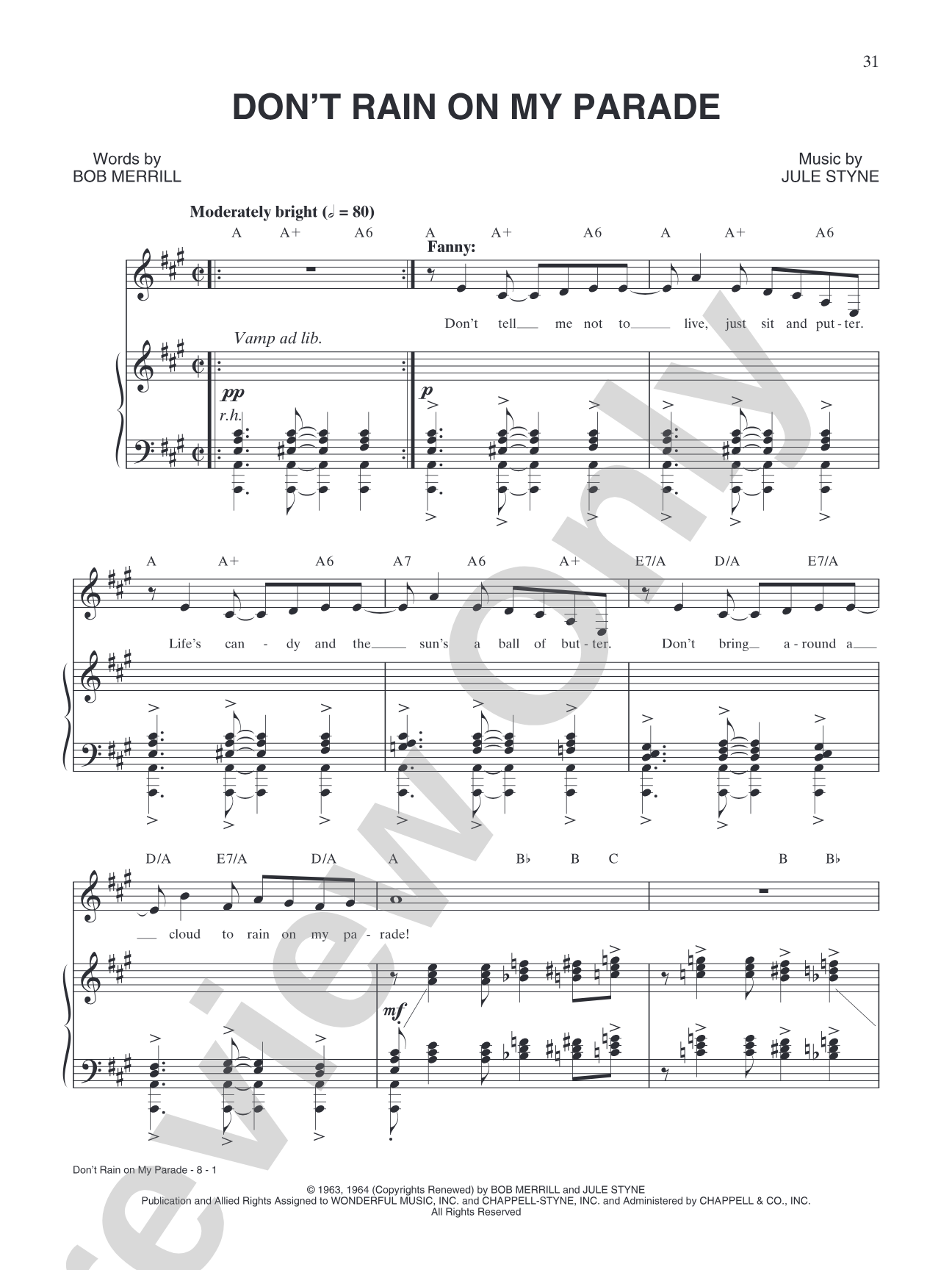
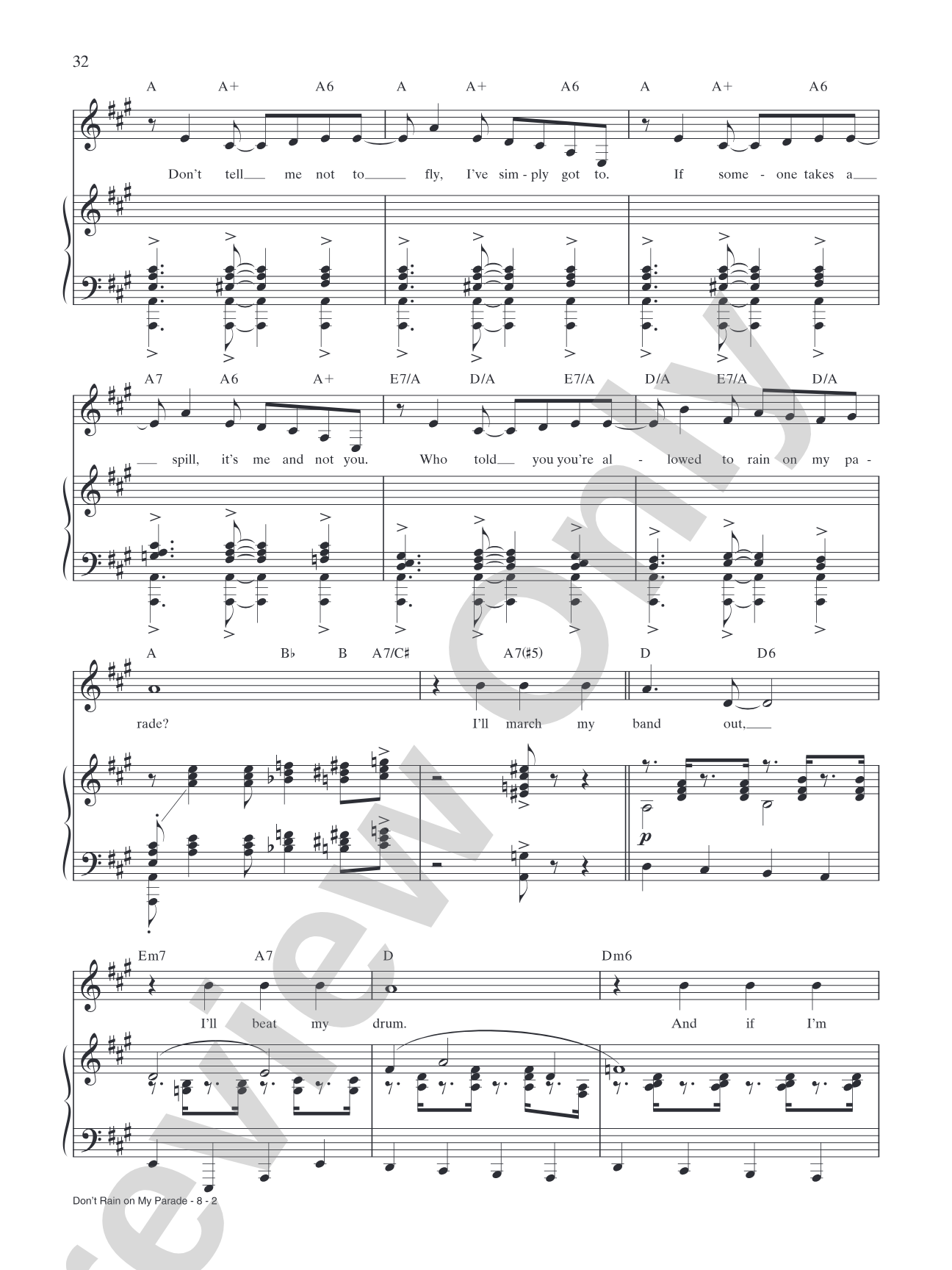

Don't Rain On My Parade (from "Funny Girl"): Piano/Vocal/Chords
Music by Jule Styne, lyrics by Bob Merrill
Item: 00-XS-0000468
$5.99
One moment…
Related Items
Funny Girl (from "Funny Girl"): Piano/Vocal/Chords |
$4.99
|
View | |
The Music That Makes Me Dance (from "Funny Girl"): Piano/Vocal/Chords |
$4.99
|
View | |
Sadie, Sadie (from "Funny Girl"): Piano/Vocal/Chords |
$4.99
|
View | |
Who Are You Now? (from "Funny Girl"): Piano/Vocal/Chords |
$4.99
|
View | |
His Love Makes Me Beautiful (from "Funny Girl"): Piano/Vocal/Chords |
$4.99
|
View | |
I Want to be Seen with You Tonight (from "Funny Girl"): Piano/Vocal/Chords |
$4.99
|
View | |
Henry Street (from "Funny Girl"): Piano/Vocal/Chords |
$4.99
|
View | |
Cornet Man (from "Funny Girl"): Piano/Vocal/Chords |
$4.99
|
View | |
You Are Woman, I Am Man (from "Funny Girl"): Piano/Vocal/Chords |
$4.99
|
View | |
I'm the Greatest Star (from "Funny Girl"): Piano/Vocal/Chords |
$5.99
|
View | |
People (from "Funny Girl"): Piano/Vocal/Chords |
$4.99
|
View |
Description
Funny Girl is Broadway's classic rags-to-riches love story about legendary entertainer Fanny Brice during Ziegfeld's Golden Era of burlesque. Its beloved score by Jule Styne and Bob Merrill is filled with unforgettable songs like "Don't Rain on My Parade," "I'm the Greatest Star," "The Music That Makes Me Dance," and the iconic hit "People." Barbra Streisand first immortalized these songs in the original 1964 Broadway smash, and yet again in the famous movie adaptation several years later. The show continues to enjoy immense popularity today with a major Broadway revival and countless productions worldwide. Pianists and singers will delight in this updated piano/vocal selections folio, in which the arrangements of several songs have been upgraded to better reflect the familiar original cast recordings compared to earlier printed editions. Also added is the song "Funny Girl," which Styne and Merrill wrote for the 1968 movie adaptation. Contents: * I'm the Greatest Star * Cornet Man * His Love Makes Me Beautiful * I Want to Be Seen with You Tonight * Henry Street * People * You Are Woman, I Am Man * Don't Rain on My Parade * Sadie, Sadie * Who Are You Now? * The Music That Makes Me Dance * Funny Girl.


Don't Rain On My Parade (from "Funny Girl"): Piano/Vocal/Chords isn't in MakeMusic Cloud just yet...but it could be. Let us know you'd like to see it, and you'll help shape what comes next. In the meantime, start a free trial and dive into thousands of interactive titles your students can play along with today.
Request This Title
Tell us you want it.
Start Your Free Trial
Explore everything that's ready to play right now.
Sample Audio
No sample audio found.
Sample Video
No sample videos found.
Additional Details
Publisher:
Alfred Music
Page Count:
52
SKU:
00-XS-0000468
More about this title
About the Composer: Jule Styne
Jule Styne (1905-1975) composed some of Broadway's most enduring scores, working with lyricists like Bob Merrill and Stephen Sondheim across a career spanning five decades. His gift for melody and theatrical storytelling shaped hits including Gypsy, Bells Are Ringing, and Funny Girl, each showcasing his ability to write music that feels both sophisticated and instantly singable. Styne's arrangements and orchestrations remain central to how these shows are performed and recorded today.
In the classroom and studio, Styne's melodies teach singers how to balance legibility with personality. His piano writing is idiomatic without being overly demanding, making his scores accessible to advancing pianists while offering room for expressive interpretation. For students encountering Broadway repertoire, Styne's work demonstrates how strong melodic writing and clear harmonic structure create songs that last.
Why we love this
This collection captures the brightness and humor that made Funny Girl a cultural phenomenon, and the updated arrangements align the printed music with how these songs actually sound in performance. Singers get to work with some of Broadway's most singable melodies, each with distinct character and emotional range. The piano parts are crafted to support the vocalist without overwhelming, making this folio genuinely useful in teaching and recital contexts rather than merely decorative.
What to expect
Styne's music sparkles with optimism and theatricality. These songs breathe confidence and humor, from the brash self-promotion of 'I'm the Greatest Star' to the romantic sincerity of 'People,' creating a sense of spectacle grounded in genuine human emotion. The orchestration feels bright and forward-moving, inviting performers and audiences into the world of the show.
Who it's for
Singers working through contemporary musical theater repertoire will find these melodies rewarding to learn and perform, whether in recital, studio lessons, or ensemble contexts. Pianists preparing to accompany singers benefit from arrangements that respect the vocal line while offering enough harmonic interest to keep the accompaniment engaging. This folio works for intermediate-to-advanced vocalists and pianists who want to engage with American musical theater standards from a secure technical foundation.
How to get the most out of it
- Anchor the rhythm section feel in the vocal line rather than chasing the piano alone. These songs sit best when the singer and pianist move together as a unit, with the accompaniment following the phrasing choices.
- Commit to the comedic timing in numbers like 'I'm the Greatest Star' and 'Sadie, Sadie.' Rushing or playing it safe flattens the humor that drives these moments.
- Balance legit singing with character expression, especially in 'Don't Rain on My Parade.' The song needs both vocal security and personality to land its optimistic punch.
- Listen closely to how the original cast recordings handle the bridge sections and key modulations. Styne's harmonic moves feel natural once you hear them, but reading ahead is essential.
How to use it
Pair these songs in a recital to explore contrasting moods within a single score, or select individual numbers to showcase different vocal qualities and acting skills. In a musical theater survey course, this folio represents the Golden Age of American musical theater songwriting at its most accessible. For studio teachers, the range of tempos and styles offers teaching material that develops both technical control and interpretive maturity.
Skills your students will build
- Singing through longer melodic phrases with stylistic clarity
- Coordinating rhythm and phrasing between singer and accompanist
- Interpreting Broadway-style articulation, particularly in up-tempo numbers
- Navigating harmonic movement typical of mid-century songwriting
- Balancing vocal legit technique with character and comedic timing