
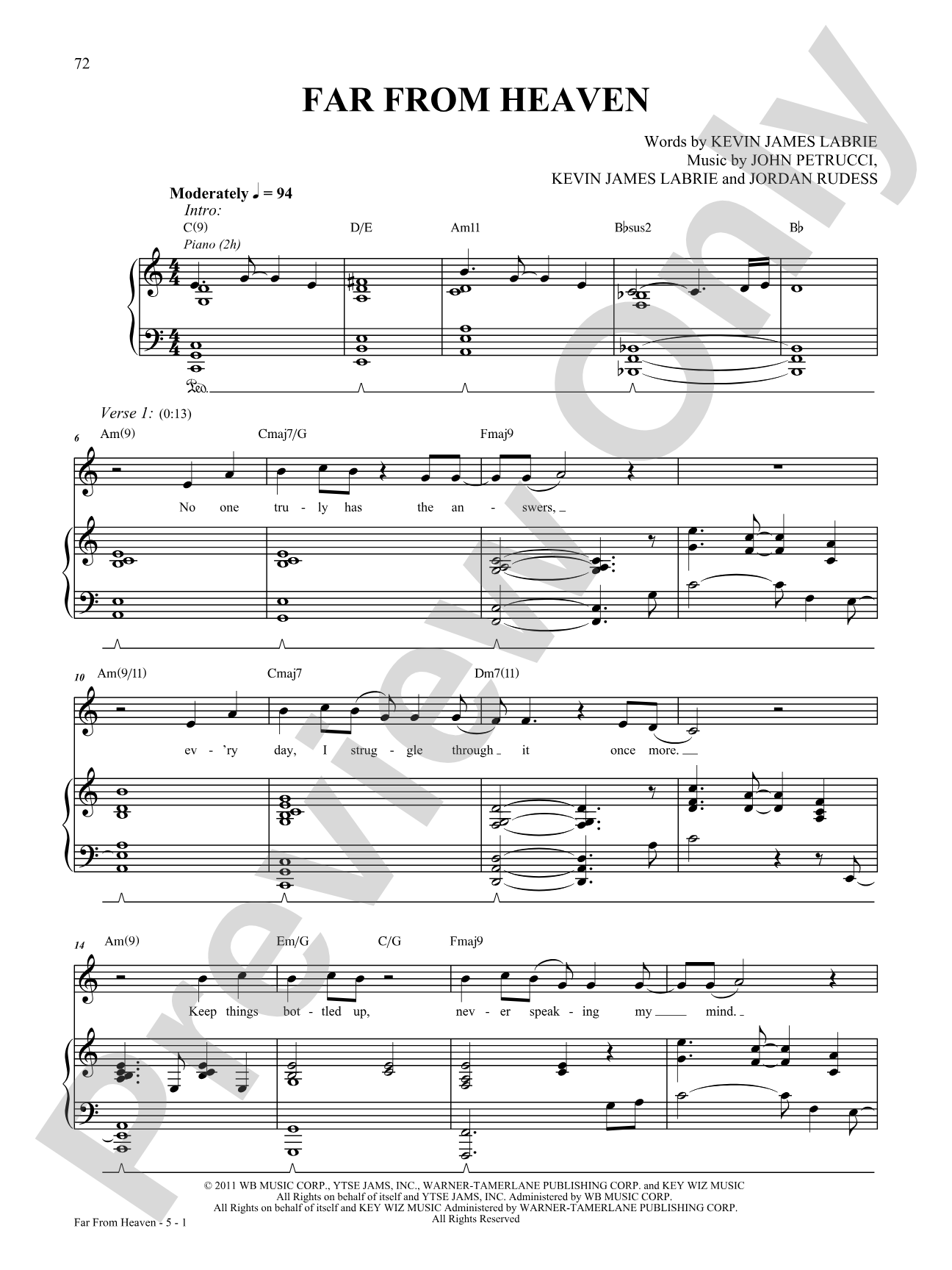

Far From Heaven: Piano/Vocal/Chords
Dream Theater featuring Jordan Rudess
Item: 00-PS-0013516
$4.99
One moment…
Related Items
On the Backs of Angels: Authentic Guitar TAB |
$9.99
|
View | |
On the Backs of Angels: Piano/Vocal/Chords |
$9.99
|
View | |
Bridges in the Sky: Authentic Guitar TAB |
$9.99
|
View | |
Bridges in the Sky: Piano/Vocal/Chords |
$5.99
|
View | |
Outcry: Piano/Vocal/Chords |
$9.99
|
View | |
Outcry: Authentic Guitar TAB |
$9.99
|
View | |
Far From Heaven: Authentic Guitar TAB |
$4.99
|
View | |
Build Me up, Break Me Down: Piano/Vocal/Chords |
$5.99
|
View | |
Build Me up, Break Me Down: Authentic Guitar TAB |
$5.99
|
View | |
Lost Not Forgotten: Authentic Guitar TAB |
$9.99
|
View | |
Lost Not Forgotten: Piano/Vocal/Chords |
$9.99
|
View | |
This is the Life: Authentic Guitar TAB |
$9.99
|
View | |
This is the Life: Piano/Vocal/Chords |
$5.99
|
View | |
Breaking All Illusions: Piano/Vocal/Chords |
$9.99
|
View | |
Breaking All Illusions: Authentic Guitar TAB |
$9.99
|
View | |
Beneath the Silence: Authentic Guitar TAB |
$5.99
|
View | |
Beneath the Surface: Piano/Vocal/Chords |
$9.99
|
View |
Description
Keyboardists who are fans of Dream Theater's Jordan Rudess know that it's nearly impossible to nail down by ear exactly what he plays. Alfred Music is honored to assist with this album-matching sheet music collection, meticulously transcribed by prog keyboard aficionado Chris Romero in direct consultation with Rudess himself. The nearly 100 pages of note-for-note keyboard madness in this collection will challenge any keyboardist to aim high and tackle pioneering techniques that only Jordan Rudess could conceive. Titles: * On the Backs of Angels * Build Me Up Break Me Down * Lost Not Forgotten * This Is the Life * Bridges in the Sky * Outcry * Far from Heaven * Breaking All Illusions * Beneath the Surface.


Far From Heaven: Piano/Vocal/Chords isn't in MakeMusic Cloud just yet...but it could be. Let us know you'd like to see it, and you'll help shape what comes next. In the meantime, start a free trial and dive into thousands of interactive titles your students can play along with today.
Request This Title
Tell us you want it.
Start Your Free Trial
Explore everything that's ready to play right now.
Sample Audio
No sample audio found.
Sample Video
No sample videos found.
Additional Details
Publisher:
Alfred Music
Page Count:
100
SKU:
00-PS-0013516
More about this title
About the Composer: John Petrucci
John Petrucci is the guitarist and primary songwriter of Dream Theater, the progressive metal band that has defined technical complexity and conceptual ambition in rock music since the 1980s. His compositions balance intricate instrumental passages with visceral emotional intensity, consistently pushing the boundaries of what's possible across multiple instruments and song structures that defy conventional verse-chorus frameworks.
Beyond the recording studio, Petrucci has become a significant figure in music education through his instructional materials and masterclasses, demonstrating that technical mastery and artistic depth are inseparable. His work with collaborators like keyboardist Jordan Rudess exemplifies how modern progressive music demands that every band member operate at the highest level of instrumental command.
Why we love this
This transcription collection captures the exact architecture of some of Dream Theater's most demanding keyboard work, verified directly with Rudess himself. Rather than forcing keyboardists to reverse-engineer prog metal from recordings, you get nearly 100 pages of meticulously notated material that honors both the compositional intent and the performance reality. For advanced students ready to engage with music that respects neither time signatures nor technical shortcuts, this is where serious keyboard study meets contemporary artistry.
What to expect
Navigating these pages feels like looking at a blueprint of technical audacity: sudden harmonic shifts, rapid scalar passages in unexpected keys, layered accompaniment figures that seem to move independently of the main melodic line, and the constant presence of unconventional structural choices. The music breathes with the intensity of progressive metal while requiring the precision of classical training, creating a visceral tension between raw power and intricate control.
Who it's for
Advanced keyboardists and pianists who have moved beyond standard classical or contemporary repertoire and are ready to engage with progressive metal's technical and compositional demands. This collection assumes strong reading skills, comfort with complex time signatures, and genuine interest in understanding how modern keyboard virtuosity actually functions in ensemble contexts.
How to get the most out of it
- Study the time signature changes and meter modulations in isolation before attempting to play them at tempo; Dream Theater compositions frequently shift between 4/4, 7/8, and other divisions within single passages, and locking these transitions is non-negotiable.
- Work through the polyrhythmic sections hands separately first, then gradually layer them together; the independence required between left and right hands reflects Rudess's approach to layering synthesizer and acoustic piano lines simultaneously.
- Use a tempo that allows you to hear every note clearly before increasing speed; these transcriptions are note-for-note matches to recorded performances, meaning rushing will expose gaps in your command of the material.
- Reference the original album recordings frequently to understand the layering of keyboard textures; some passages combine multiple keyboard sounds (organ, strings, synth pads) that notation alone cannot fully convey.
How to use it
Present this as a masterclass resource for your most advanced keyboard students rather than as ensemble repertoire; the material demands individual study and mastery before any collaborative performance would be musically viable. Alternatively, advanced keyboardists tackling this collection represent the kind of personalized instruction and self-directed musicianship that strengthens an entire studio's reputation for serious training.
Skills your students will build
- Reading and executing complex, irregular time signatures (5/8, 7/8, 11/8) and meter modulations within single pieces
- Managing polyrhythmic material where left and right hands operate in different metric frameworks simultaneously
- Executing rapid scalar passages and arpeggios across extended keyboard range with precision and musical intention
- Understanding harmonic movement in extended tonality and non-diatonic chord progressions typical of progressive rock
- Building stamina and focus for sustained technical passages that demand consistent accuracy over multiple minutes
- Interpreting synthesizer layering and texture in notated form, translating studio sound design into live performance choices