
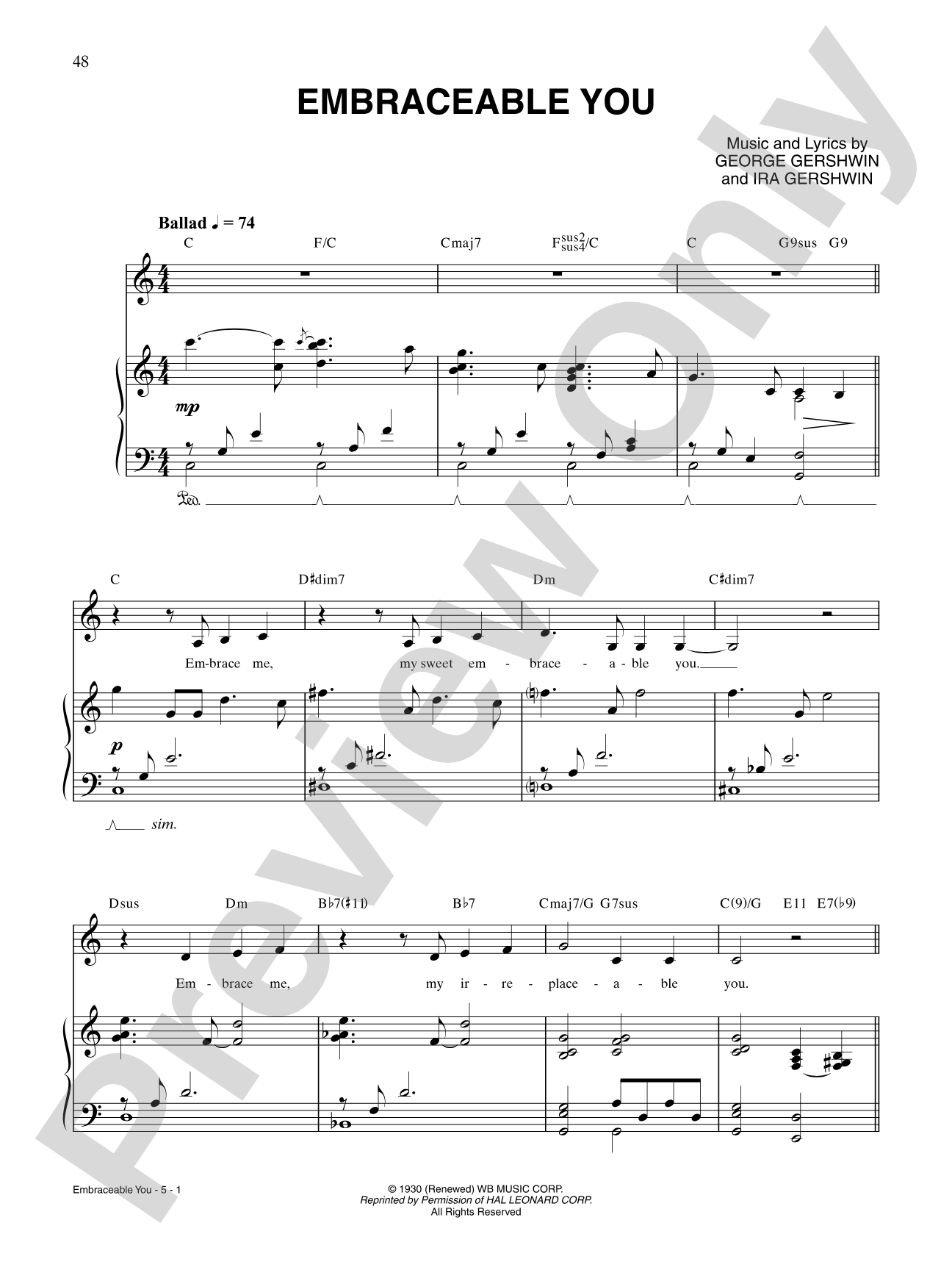

Embraceable You: Piano/Vocal/Chords
The music of various composers as performed by Gloria Estefan
Item: 00-PS-0015771
$4.99
One moment…
Related Items
For All We Know: Piano/Vocal/Chords |
$5.99
|
View | |
Good Morning Heartache: Piano/Vocal/Chords |
$5.99
|
View | |
I've Grown Accustomed to His Face: Piano/Vocal/Chords |
$5.99
|
View | |
They Can't Take That Away from Me: Piano/Vocal/Chords |
$9.99
|
View | |
How Long Has This Been Going On?: Piano/Vocal/Chords |
$5.99
|
View | |
What a Wonderful World: Piano/Vocal/Chords |
$5.99
|
View | |
They Day You Say You Love Me: Piano/Vocal/Chords |
$5.99
|
View | |
Gloria Estefan: The Standards: Piano/Vocal/Guitar Book |
$19.99
|
View |
Description
Few artists have turned out as many powerhouse albums as Gloria Estefan. With her newest release, The Standards, she has managed to capture the essence of some of the most popular and timeless songs and transform them into entirely new experiences. Now pianists can explore the rich harmonies in each original arrangement as performed by the artist. Titles: Call Me Irresponsible * Embraceable You * Eu Sei Que Vou Te Amar * For All We Know * Good Morning Heartache * How Long Has This Been Going On * I've Grown Accustomed to His Face * Sonríe * The Day You Say You Love Me * The Way You Look Tonight * They Can't Take That Away from Me * What a Difference a Day Makes * What a Wonderful World * You Made Me Love You * Young at Heart.


Embraceable You: Piano/Vocal/Chords isn't in MakeMusic Cloud just yet...but it could be. Let us know you'd like to see it, and you'll help shape what comes next. In the meantime, start a free trial and dive into thousands of interactive titles your students can play along with today.
Request This Title
Tell us you want it.
Start Your Free Trial
Explore everything that's ready to play right now.
Sample Audio
No sample audio found.
Sample Video
No sample videos found.
Additional Details
Publisher:
Alfred Music
Page Count:
108
SKU:
00-PS-0015771
More about this title
About the Composer: George Gershwin
George Gershwin (1898-1937) fundamentally changed American music by synthesizing jazz idioms with classical forms. His harmonically sophisticated compositions bridged concert halls and Broadway stages, establishing a new standard for what popular song could be artistically. Gershwin's melodies remain central to music education because they reward deep study: their apparent simplicity masks complex harmonic movement and voice leading that students discover through repeated playing and analysis.
Why we love this
These arrangements preserve Gershwin's sophisticated harmonic language while honoring Gloria Estefan's interpretive choices, giving pianists access to sophisticated jazz standards without oversimplification. The collection spans a century of great songwriting (Gershwin, Ellington, Cole Porter, and others), so you can program a concert that feels cohesive yet diverse. The vocal line sits comfortably for singers exploring the American songbook, and the chord voicings reward both jazz players and classically trained pianists looking to deepen their interpretive toolkit.
What to expect
These pieces evoke intimate sophistication. The melodies are immediately recognizable, yet the harmonies beneath them reveal layers of emotion and craft that deepen with each listening. There's a feeling of maturity in the phrasing and restraint, where a single well-placed chord voicing carries more weight than busy passagework.
Who it's for
This collection serves pianists and singer-pianists who want to explore the American songbook through carefully curated professional arrangements. It's equally valuable for jazz pianists building their standards vocabulary and classical players seeking to expand beyond traditional repertoire into music with rhythmic and harmonic complexity.
How to get the most out of it
- Study the chord changes independently from the melody line. These arrangements contain rich secondary dominants and chromatic voice leading that sound best when you understand the harmonic architecture, not just the surface notes.
- Treat the accompaniment patterns as conversation partners to the vocal line rather than mere support. Estefan's versions often feature rhythmic interplay between voice and piano that shifts the character of how the melody lands.
- Adjust pedal use by section. The standards in this collection benefit from precise pedal work that clears between chord changes in faster-moving passages but sustains harmonic color in balladic sections.
- If you're singing the melody, practice the piano part first on its own. The voicings will inform your phrasing choices and help you understand where the harmony wants to breathe.
How to use it
Build a recital or concert set around these standards as a thematic program exploring the evolution of American songwriting. You might pair several selections from this book to create a coherent evening, or use individual titles as encores that show different facets of your artistry. These arrangements also work well as solo performance material for jury exams or community recitals where sophisticated yet accessible programming is valued.
Skills your students will build
- Reading and interpreting complex jazz chord symbols and upper-structure voicings
- Balancing harmonic independence in the left hand with melodic clarity in the right
- Shaping phrase contours across syncopated and rubato passages
- Understanding chromatic voice leading and secondary dominants in real musical context
- Adapting accompaniment patterns to serve different interpretive tempos and song moods